
Want to Try Narrative Journalism? Start With These Basics
Narrative journalism combines factual reporting with storytelling techniques. Instead of simply presenting information, you build a story around people, scenes, events, and a clear narrative thread.
That doesn’t mean you can invent details. The reporting still comes first. Your job is to make a true story engaging without sacrificing accuracy.
| Day-One Metric | Beginner Target |
|---|---|
| Hours to Basic Competency | 25–40 hours |
| Minimum Budget | $0 |
| Free Software Prerequisites | Google Docs, phone recorder, spreadsheet |
| Learning Difficulty | 4/5 |
What Is Narrative Journalism?
Narrative journalism tells real stories using narrative techniques.
A traditional news report might lead with the most important fact. A narrative piece may begin with a person, moment, location, or scene that draws readers into the story.
The underlying reporting remains essential.
You still need:
- Reliable sources
- Accurate quotations
- Verified facts
- Interviews
- Background research
- Clear attribution
- Ethical judgment
The difference is how you organize and present the material.
What Should You Learn First in Narrative Journalism?
Start with three foundational skills: immersive observation, reconstructive interviewing, and deliberate story structure.
1. Learn to Observe Scenes
Narrative journalism depends on concrete details rather than broad summaries. When you report in the field, you must do far more than log chronological events as they unfold; you need to capture the precise textures of reality. Train yourself to observe how people position themselves in a room, how their shoulders drop when they grow tired, and what their hands do during awkward pauses. Listen closely for natural speech cadences, involuntary sighs, and the heavy silences that linger between tense answers.
Catalog the physical surroundings, including the smell of stale coffee, the low hum of street traffic, shifts in daylight, and the personal clutter resting on shelves or kitchen tables. These physical artifacts reveal underlying character, history, and unspoken social priorities. However, you must never treat observation as simple ornamentation. A vivid detail must never exist merely to sound poetic; it earns its presence on the page only when it illuminates personality, clarifies an environment, or anchors an emotional conflict.
2. Learn Better Interviewing
Strong narrative writing depends on interviews that gather vivid scenes rather than abstract summaries. While conventional journalism frequently stops at surface facts and sound bites, narrative reporting requires guiding sources through the careful reconstruction of their past experiences. Instead of asking how an event felt in general terms, ask subjects to retrace their physical actions step by step. Ask what the clock read when the door swung open, what specific thought surfaced right before they answered, and what visual detail first grabbed their attention.
Whenever a subject relies on generic shorthand—claiming an afternoon was surreal, hectic, or terrifying—refuse to let that generalized label stand as the final answer. Treat vague descriptors as direct cues for relentless follow-up questions. Ask what physical elements made the room chaotic, who was yelling, and what was knocked to the floor. These precise fragments provide the verifiable factual scaffolding required to write authentic dramatic sequences.
3. Learn Story Structure
Compelling narrative journalism requires structural tension to pull readers forward across the page. Without an intentional architectural design, even the most meticulous reporting deteriorates into a wandering catalog of interesting anecdotes. A reliable dramatic structure often unfolds systematically: an opening scene establishes the stakes, background context provides perspective, a central complication creates friction, a distinct turning point forces a decision, and a resolution reveals the final aftermath.
You do not need to adhere rigidly to this formula in every piece, but you must always resolve the central narrative question that sustains momentum. You must determine what immediate goal the subject is trying to reach, what escalating conflict stands directly in the way, and what fundamental reality shifts between the opening line and the final period. Once you understand the core engine driving your plot forward, you will know exactly which details to build up and which distractions to discard entirely.
Narrative Journalism: How Do You Build a Strong Story?
Once you’ve gathered your reporting, look for the story underneath the information.
Find the Central Character
Many narrative pieces work because readers have someone to follow.
That person doesn’t have to be famous.
It could be:
- A teacher dealing with a major change
- A small-business owner facing a difficult decision
- A student preparing for an important event
- A community member affected by a local issue
- A researcher working on a complex problem
Choose a character who gives readers a way into the larger subject.
Find the Central Conflict
A narrative needs movement.
Ask what is changing or what problem needs to be resolved.
The conflict could involve:
- A difficult decision
- Competing interests
- A personal challenge
- A major event
- An unexpected consequence
- A disagreement
- A goal that becomes difficult to achieve
Conflict doesn’t mean manufactured drama.
Don’t exaggerate ordinary events to make them seem dramatic.
Build Around Scenes
Scenes allow readers to experience reported events.
Instead of explaining everything from a distance, show what happened through verified observations and quotations.
For example, a scene might describe someone entering a meeting, hearing an announcement, and responding to it.
Then you can step back and explain the larger context.
This creates a rhythm between scene and information.
The Beginner Friction Factor: Inventing Details
One of the biggest problems beginners face is confusing vivid writing with invented writing.
Narrative journalism gives you permission to write creatively. It does not give you permission to create facts.
If you didn’t observe something yourself, don’t present it as though you did.
If a source can’t remember an exact detail, don’t manufacture one.
Be especially careful with:
- Exact times
- Thoughts and emotions
- Physical descriptions
- Dialogue
- Sequences of events
- Unrecorded conversations
Keep detailed reporting notes.
Record interviews when appropriate and permitted. Save documents and source links. Separate direct observation from information supplied by someone else.
When you can’t verify a detail, leave it out or attribute it clearly.
What Writing Techniques Should You Practice?
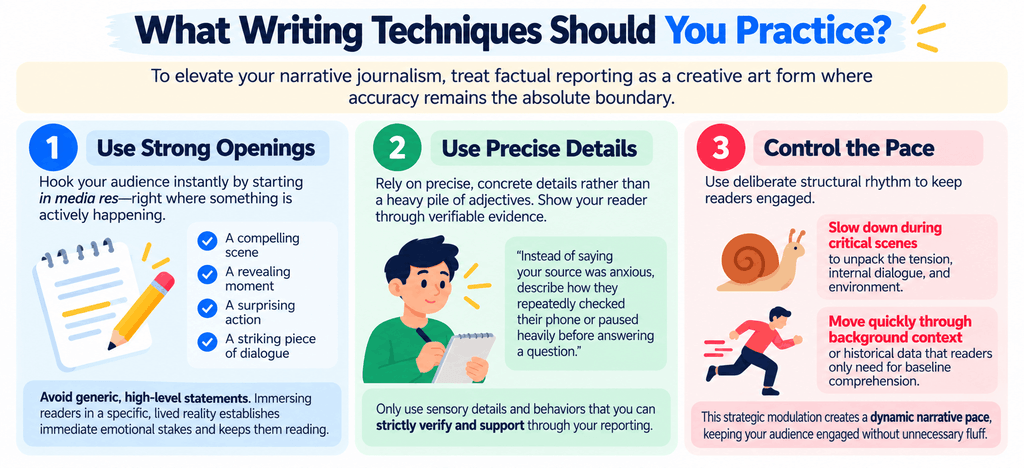
To elevate your narrative journalism, you must treat factual reporting as a creative art form where accuracy remains the absolute boundary. By mastering a few literary techniques, you can transform dense, informative reports into gripping, human-centric stories.
Use Strong Openings
Hook your audience instantly by starting in media res—right where something is actively happening. Avoid generic, high-level statements about why your topic matters. Instead, launch your piece with a compelling scene, a revealing moment, a surprising action, or a striking piece of dialogue. Immersing readers in a specific, lived reality establishes immediate emotional stakes and forces them to keep reading.
Use Precise Details
Vivid storytelling relies on precise, concrete details rather than a heavy pile of adjectives. Instead of simply telling your reader that a source was anxious, show their observable behavior using verifiable evidence. Describe how they repeatedly checked their phone or paused heavily before answering a question. However, remember the golden rule of journalism: only use sensory details and behaviors that you can strictly verify and support through your reporting.
Control the Pace
An effective narrative requires deliberate structural rhythm. Slow down during critical scenes to unpack the tension, internal dialogue, and environment. Conversely, move quickly through background context or historical data that readers only need for baseline comprehension. This strategic modulation creates a dynamic narrative pace, keeping your audience engaged without padding the article with unnecessary fluff.
What Courses Can Help You Learn Narrative Journalism?
Courses can help you understand structure and reporting techniques. We would prioritize programs that involve actual writing and reporting.
1. Creative Writing: The Narrative
Platform: Coursera
Ideal student: A beginner who wants to understand narrative structure and storytelling techniques.
Portfolio project: Narrative writing exercises that can become the foundation for longer work.
Honest limitation: Creative-writing instruction is not the same as journalism training. You’ll still need to learn reporting, verification, attribution, and journalism ethics separately.
Coursera courses can often be audited or accessed through free options, while certificates may require payment.
2. Journalism Courses With Narrative Reporting Components
Platform: Coursera
Ideal student: Someone who wants journalism fundamentals before specializing in narrative work.
Portfolio project: Reported stories and journalism exercises.
Honest limitation: General journalism courses may spend less time on long-form narrative structure than a dedicated narrative-writing program.
This route can be useful if you’re starting from zero because reporting fundamentals are difficult to replace.
3. Independent Practice
Platform: Free resources
Ideal student: Someone who wants to learn by doing.
Portfolio project: A 1,000-word reported profile or human-interest story.
Honest limitation: You’ll need to evaluate your own work and identify weaknesses without an instructor.
Read strong narrative journalism from established publications. Study how stories open, where background information appears, how scenes are constructed, and how quotations are used.
Then write your own piece.
What Should You Learn After Narrative Journalism?
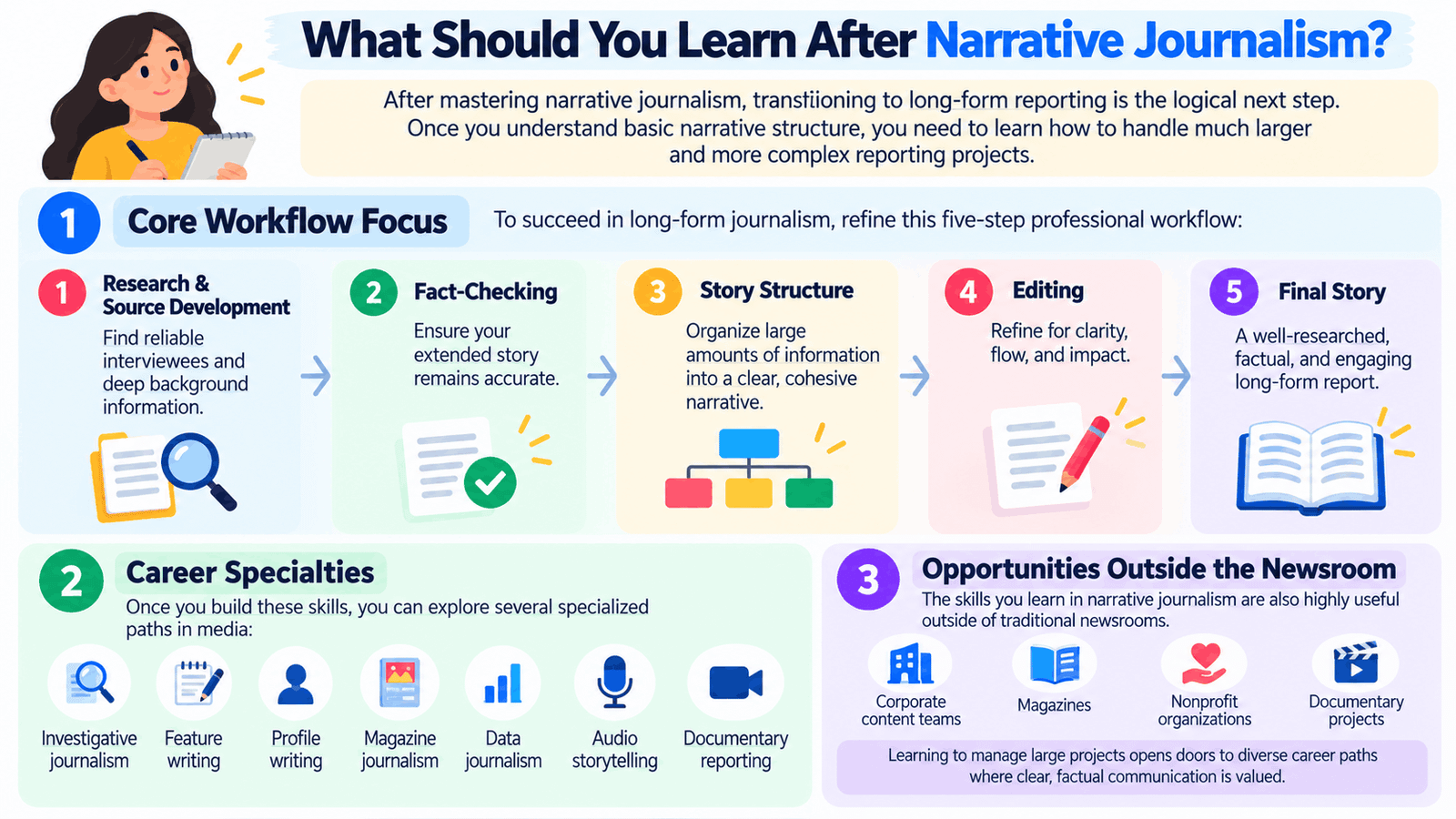
After mastering narrative journalism, transitioning to long-form reporting is the logical next step. Once you understand basic narrative structure, you need to learn how to handle much larger and more complex reporting projects.
Core Workflow Focus
To succeed in long-form journalism, you must focus on refining a five-step professional workflow. First, you need to improve your research and source development by finding reliable interviewees and deep background information. Next, rigorous fact-checking is essential to ensure your extended story remains accurate. Finally, mastering story structure and editing allows you to shape massive amounts of information into a clear, cohesive narrative.
Career Specialties
Once you build these skills, you can explore several specialized paths in media. These include investigative journalism, feature writing, profile writing, and magazine journalism. You can also branch out into data journalism, audio storytelling, or documentary reporting.
Opportunities Outside the Newsroom
The skills you learn in narrative journalism are also highly useful outside of traditional newsrooms. Today, corporate content teams, magazines, nonprofit organizations, and documentary projects all rely heavily on forms of reported storytelling. Learning to manage large projects opens doors to diverse career paths where clear, factual communication is valued.
Your Narrative Journalism Day-One Action Plan
Start with a small story rather than planning a 5,000-word feature.
- Choose one person and one real situation. Pick something you can observe or report locally.
- Conduct one short interview. Ask open-ended questions and follow interesting answers.
- Write a 500-word scene-based story. Use only details you can verify, then mark every fact that needs another source.
Afterward, read the piece aloud.
Look for places where the story slows down, where context arrives too late, or where a sentence makes a claim you can’t prove.
That’s the real starting point for narrative journalism: learn to tell compelling stories without losing control of the facts.