
How to Keep Your Brand Consistent Across Social Media
Brand consistency across social media does not mean making every post look identical. It means that people should be able to recognize what your brand stands for, how it sounds, and what it looks like whether they find you on Instagram, TikTok, LinkedIn, Facebook, or another platform.
For beginners, the easiest way to achieve this is to create a small set of rules and use them consistently.
What Does Brand Consistency Actually Mean?
Brand consistency means presenting the same core identity across different customer touchpoints.
That includes more than your logo.
A consistent social media brand usually has recognizable:
- Visual style
- Colors
- Typography
- Photography or illustration style
- Brand voice
- Messaging
- Content themes
- Personality
The exact format can change from one platform to another.
A LinkedIn post does not need to look exactly like an Instagram Reel.
What should remain consistent is the underlying brand identity.
1. Define Your Brand Voice
Your brand voice determines how your business communicates.
Start by choosing three to five characteristics.
For example, your brand might be:
Friendly → Practical → Knowledgeable → Encouraging
Then turn those characteristics into simple writing rules.
For example:
- Use straightforward language.
- Explain complicated ideas simply.
- Avoid unnecessary jargon.
- Be helpful rather than overly promotional.
- Sound confident without sounding arrogant.
This gives anyone creating content a reference point.
Why Brand Voice Matters
Without clear guidelines, different people may produce completely different content.
One post might sound playful.
The next might sound extremely formal.
Another might sound like advertising copy.
Even if the visual identity is consistent, the brand can still feel fragmented.
A simple voice guide reduces that problem.
2. Create a Simple Visual System
You do not need a huge brand book to get started.
Create a basic visual system containing:
- Primary colors
- Secondary colors
- Font choices
- Image style
- Graphic style
- Logo usage
- Basic layout principles
The goal is not to make every post identical.
Instead, give your content a recognizable visual family.
For example, you might consistently use the same typography hierarchy, photography style, and color combinations.
3. Choose a Few Content Pillars
Your brand should not talk about everything.
Choose several recurring themes that reflect what your audience cares about and what your business wants to be known for.
For example:
| Content Pillar | Example |
|---|---|
| Education | Tips and tutorials |
| Problems | Common customer mistakes |
| Expertise | Industry insights |
| Community | Questions and conversations |
| Product | Features and use cases |
These pillars make content planning easier.
They also help create consistency because your audience repeatedly sees the subjects you want your brand associated with.
4. Adapt Content to Each Platform
One of the biggest mistakes is confusing consistency with duplication.
You can keep the same core message while changing the execution.
For example:
One idea → Instagram carousel → TikTok video → LinkedIn post → Facebook discussion
The subject remains consistent.
The format changes according to the platform.
This is a much stronger approach than publishing exactly the same post everywhere.
Keep the Message, Change the Format
Think of your brand identity as the foundation.
The platform is the environment.
Your brand should remain recognizable while the content adapts to the environment.
The Beginner Friction Factor: Too Many Rules
Brand guidelines can become overwhelming.
A beginner may create a 40-page document covering every possible situation.
That is rarely necessary.
Start with a one-page social media brand guide.
Include:
Voice
Three to five personality traits.
Visuals
Colors, fonts, imagery, and basic layouts.
Messaging
What your brand talks about and what it avoids.
Examples
Show two or three examples of content that feels on-brand.
Don’ts
List common mistakes, such as excessive jargon or overly promotional language.
The guide should be easy enough that someone can actually use it while creating a post.
5. Build Templates for Repeated Content
Templates can make consistency much easier.
Create reusable designs for recurring formats such as:
- Tips
- Quotes
- Announcements
- Product features
- Customer stories
- Educational carousels
The templates do not need to be identical.
Give them shared design elements so that they feel like part of the same system.
This also reduces the time required to create each post.
6. Create a Content Approval Checklist
Before publishing, ask a few simple questions.
Brand Voice
- Does this sound like us?
- Is the language appropriate for our audience?
Visual Identity
- Does the design follow our basic visual rules?
- Are the colors and typography consistent?
Messaging
- Does this support one of our content pillars?
- Is the message clear?
Platform
- Has the content been adapted appropriately for this platform?
Accuracy
- Have important facts and claims been checked?
A checklist can prevent small inconsistencies from accumulating.
How Can AI Help Keep Your Brand Consistent?
AI can be useful as a brand consistency assistant.
You can provide your approved brand voice, content pillars, and examples, then use AI to help review or adapt content.
For example, AI can help:
- Rewrite a caption in your established tone
- Generate variations of a post
- Check whether content matches your guidelines
- Turn one idea into several platform-specific versions
- Identify repetitive wording
- Create content ideas within your chosen pillars
But AI should work from your existing brand rules.
Do not ask it to invent your entire brand identity every time you create a post.
Human review is still important, particularly for messaging and anything that could affect how customers perceive the business.
What If Multiple People Create Your Content?
Consistency becomes harder as a team grows.
That is why documentation matters.
Give everyone access to the same:
- Brand guide
- Templates
- Content pillars
- Approved examples
- Image resources
- Publishing checklist
You can also establish a simple approval process.
For example:
Creator → Editor → Final approval → Publish
The exact process can be lightweight.
The important thing is that everyone is working from the same definition of “on-brand.”
How Do You Know If Your Brand Is Consistent?
Look at your social profiles as if you were a new customer.
Ask:
Could I recognize these accounts as belonging to the same business?
Then compare:
- Profile images
- Bios
- Colors
- Post designs
- Writing style
- Topics
- Calls to action
- Photography
You can also ask someone unfamiliar with the business to look at your profiles.
If they cannot tell that the accounts belong together, your brand system may need more consistency.
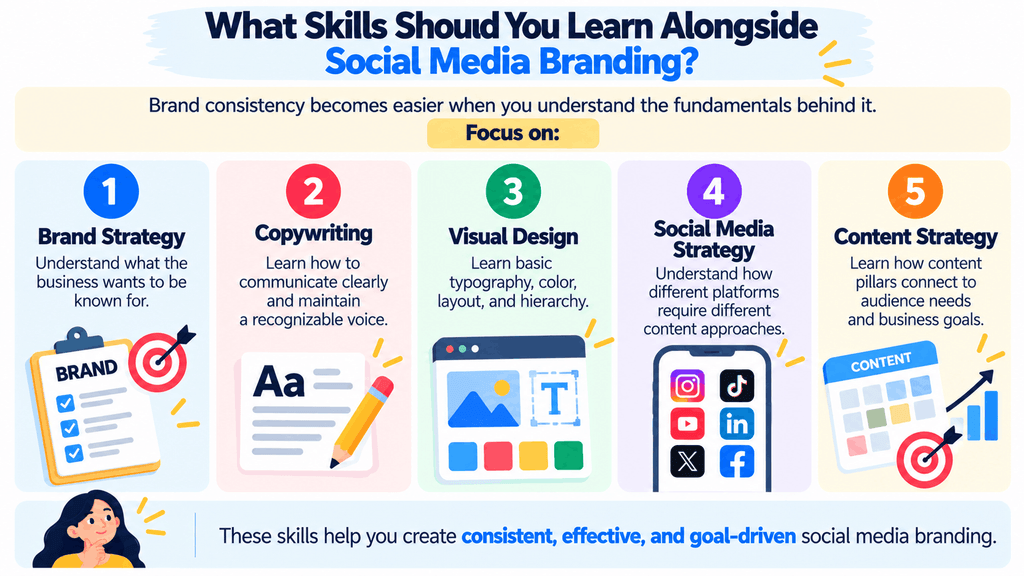
What Skills Should You Learn Alongside Social Media Branding?
Brand consistency becomes easier when you understand the fundamentals behind it.
Focus on:
Brand Strategy
Understand what the business wants to be known for.
Copywriting
Learn how to communicate clearly and maintain a recognizable voice.
Visual Design
Learn basic typography, color, layout, and hierarchy.
Social Media Strategy
Understand how different platforms require different content approaches.
Content Strategy
Learn how content pillars connect to audience needs and business goals.
The SkillAdvisor framework emphasizes practical, beginner-friendly learning and matching platforms to specific learning needs rather than treating every course as interchangeable.
Which Learning Platforms Can Help?
Based on the supplied SkillAdvisor platform framework:
| Platform | Best Fit | Pricing Consideration |
|---|---|---|
| Udemy | Specific, practical branding and social media workflows | Wait for frequent discount sales |
| Skillshare | Creative execution and visual design | Subscription makes more sense if you take several classes |
| Coursera / edX | Broader marketing and branding concepts | Many courses can be audited free; certificates may cost extra |
| LinkedIn Learning | Professional marketing and design workflows | Check whether employer or library access is available |
The supplied materials do not identify specific current courses for social media brand consistency, so we would not invent course names or claim that a particular course is currently the best option.
Instead, look for practical training where you create a brand guide, content strategy, visual system, or social media campaign.
What Should You Learn Next?
Once you have established brand consistency, learn content analytics.
Consistency gives you a recognizable foundation.
Analytics tells you whether the content is actually working.
Track things such as:
- Engagement
- Saves and shares
- Clicks
- Leads
- Conversions
- Audience growth
Then look for patterns.
If certain topics consistently perform well, you can create more content around them without abandoning your brand identity.
This creates a useful cycle:
Brand system → Consistent content → Measure → Learn → Improve
Your Day-One Action Plan
You can improve your brand consistency without redesigning everything.
- Choose three words that describe your brand.
- Create a one-page guide covering your voice, colors, visual style, and content pillars.
- Review your last 10 social posts against the guide and identify three inconsistencies to fix.
Keeping your brand consistent across social media is less about making everything look the same and more about creating a recognizable system.
Define your voice. Establish a simple visual identity. Choose content pillars. Adapt ideas to each platform. Then use templates, guidelines, and checklists to keep everything connected.
Your next step: create a one-page social media brand guide and use it to review your next post before publishing.