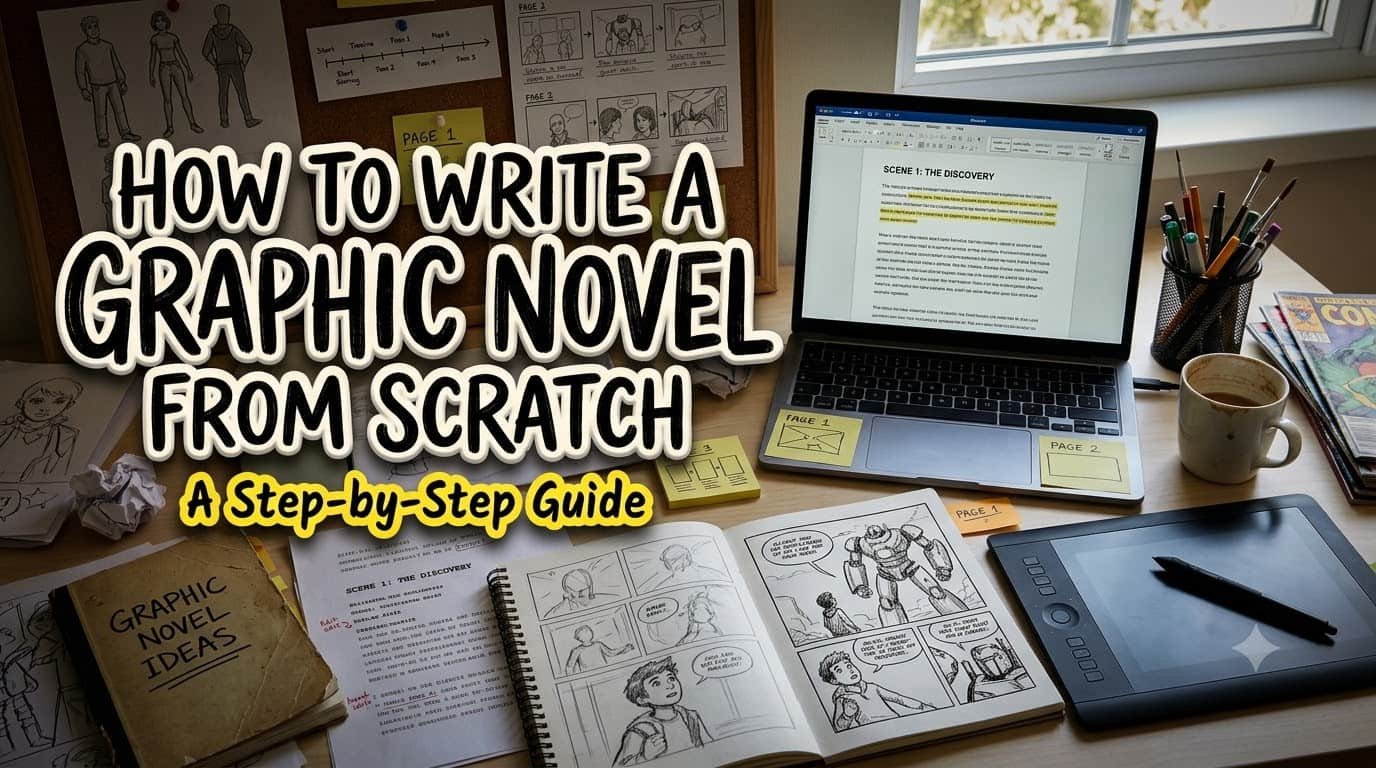
How Do You Write a Graphic Novel From Scratch?
Writing a graphic novel starts with story structure, not drawing. You need a clear premise, believable characters, visual pacing, and a script that tells the story through both words and images.
A graphic novel is different from a traditional novel. You cannot explain everything through paragraphs of prose. The art carries part of the storytelling, so your writing needs to leave room for panels, expressions, settings, movement, and silence.
Our SkillAdvisor approach focuses on building a small, finished project before attempting a 200-page book.
| Day-One Metric | Beginner Target |
|---|---|
| Hours to basic competency | 8–15 hours |
| Minimum budget | $0 with paper and free writing software |
| Difficulty | 4/5 |
| First portfolio project | 4–8 page graphic novel scene |
1. Start With a Story You Can Actually Finish
The biggest beginner mistake is starting with a massive universe.
You might have ten characters, three kingdoms, a complicated timeline, and ideas for five sequels. That sounds exciting, but it can make your first project impossible to finish.
Instead, begin with a small story problem.
Ask:
- Who is the main character?
- What do they want?
- What is stopping them?
- What changes by the end?
- Why does this story need to be visual?
For your first project, aim for 4–8 pages. A short story teaches you more about comics than an unfinished 100-page manuscript.
Build a Simple Story Structure
A useful beginner structure is:
- Setup: Introduce the character and situation.
- Conflict: Something disrupts the character’s normal life.
- Escalation: The character makes increasingly difficult choices.
- Resolution: The character faces the central problem.
- Change: Show what is different afterward.
Do not worry about creating a complicated plot yet. Focus on giving the reader a reason to turn the page.
2. Create Characters Who Can Carry the Story
A graphic novel character needs more than a biography.
Think visually.
What does the character look like when they are confident? How do they move when nervous? What objects do they always carry? How does their posture change when they become angry?
These details give an artist material to work with.
Create a simple character sheet containing:
- Name and age
- Goal
- Fear
- Personality
- Visual appearance
- Important relationships
- Typical expressions
- What changes during the story
You do not need twenty pages of character notes. A focused one-page profile is enough for a first project.
3. Write the Graphic Novel Before Drawing Every Page
You do not have to illustrate your graphic novel yourself.
If you are working with an artist, your job is to communicate what each page needs to accomplish. That means learning to think visually.
Instead of writing:
Sarah feels extremely nervous about entering the abandoned house because she remembers everything that happened there.
You could write a visual direction such as:
Panel 1: Sarah stands outside the house.
Panel 2: Close-up of her hand tightening around the door handle.
Panel 3: She notices a child’s shoe inside the doorway.
Panel 4: Sarah steps backward.
The images communicate the emotion without requiring a paragraph explaining it.
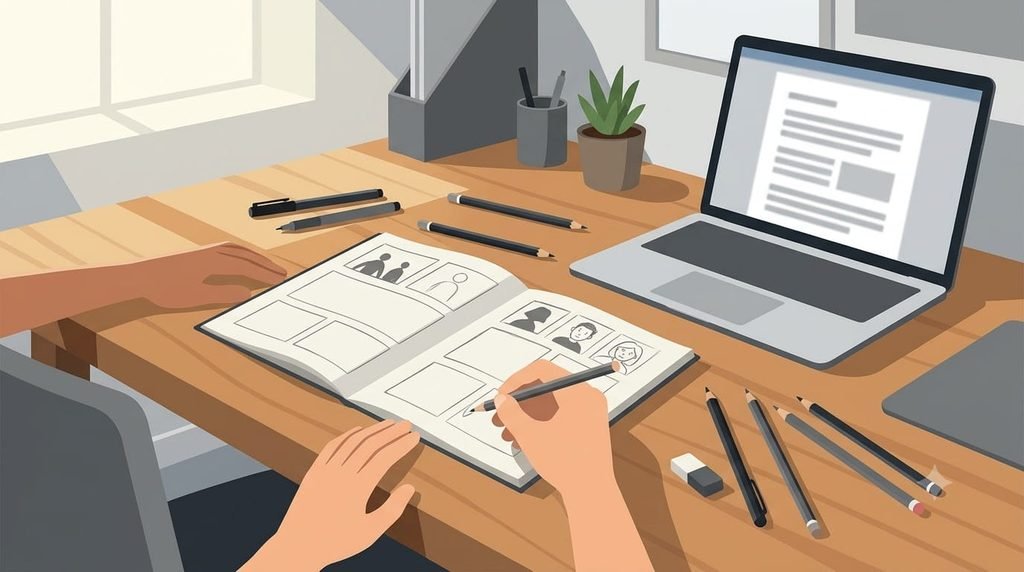
Think in Pages, Panels, and Turns
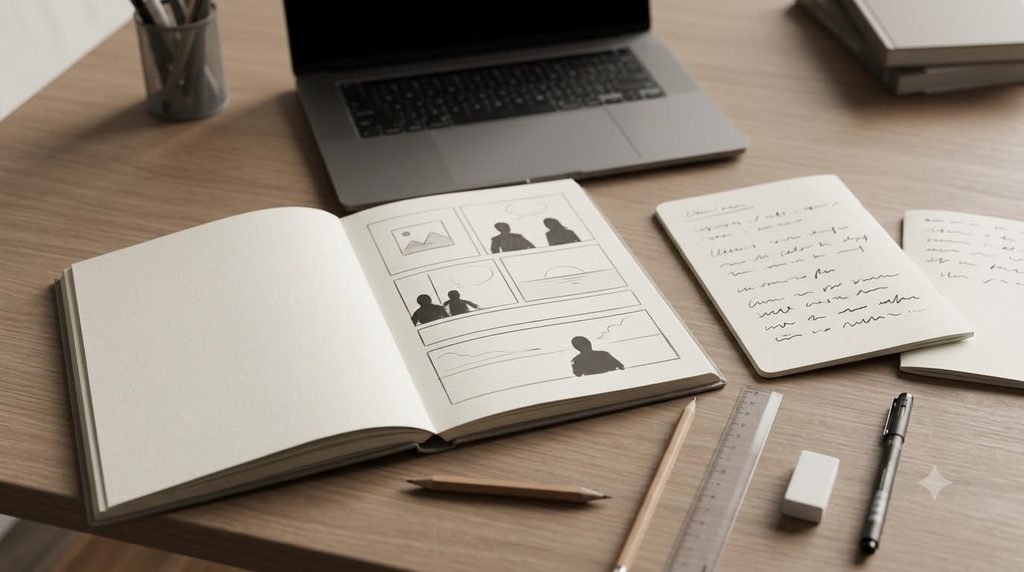
A graphic novel is built from units.
Story → pages → panels → images → dialogue
Page turns are especially useful. A major reveal can become much more effective when the reader has to physically turn the page to see it.
Your script should therefore consider pacing, not just dialogue.
4. Write Dialogue That Leaves Space for the Art
Graphic novel dialogue should usually be concise.
Readers are looking at artwork while reading the words. Large speech balloons can overwhelm a panel and compete with the illustration.
Before keeping a line of dialogue, ask:
Does the reader need these words, or can the image communicate this?
If a character says, “I’m terrified because I have no idea what is hiding behind that door,” you may be explaining something the artwork can already show.
A shorter line such as “Don’t open it.” may create more tension.
Silence can also be powerful.
A character staring at an empty chair may communicate more than several sentences of narration.
5. The Beginner Friction Factor: Writing Too Much Per Panel
One of the most common problems is overloading panels with instructions and dialogue.
Beginners often write scripts like miniature novels. They describe every facial expression, movement, background detail, and thought.
The result is difficult to draw and difficult to read.
Use this debugging method:
Step 1: Read the panel description.
Step 2: Ask what the reader must see.
Step 3: Remove details that do not affect the story.
Step 4: Check whether the dialogue repeats the image.
Step 5: Read the page as a sequence rather than as individual panels.
If one page feels crowded, do not immediately add another page. First look for information that can be shown visually or removed.
6. Learn How to Format a Graphic Novel Script
There is no single universal script format, but professional comic scripts commonly organize information page by page and panel by panel.
A simple beginner format might look like this:
PAGE 1
Panel 1: Wide shot of a quiet apartment at night. Rain covers the windows.
CAPTION: 2:13 A.M.
Panel 2: Maya sits at the kitchen table, staring at her phone.
MAYA: He’s late.
Panel 3: Her phone suddenly lights up.
SFX: BZZZT.
Panel 4: Maya looks at the screen.
MAYA: No.
The format is simple. The important thing is clarity.
Your artist should understand what needs to appear without having to decode your intentions.
7. Choose the Right Learning Resource
You do not need an expensive course to start. Free tutorials, library resources, creator interviews, and practice projects can teach the fundamentals.
Paid courses become more useful when you want structured instruction and a finished project.
Script Writing for Comics: Explore Visual Storytelling — Domestika
This course by Fred Van Lente focuses on visual storytelling, professional comic scripts, page breakdowns, dialogue, and character descriptions. Its final project is a six-to-eight-page comic script.
Core promise: Finish a short comic script suitable for presenting to an artist or editor.
Ideal student: A beginner who wants to focus primarily on writing rather than illustration.
Honest limitation: It focuses on comic scripting, so you will still need to develop drawing, lettering, or production skills separately.
Domestika is strong for specialized creative instruction. Check the course’s native audio language before buying, especially if subtitles affect how you prefer to learn.
Creation and Development of Graphic Novels — Domestika
María Luque’s course covers the process from initial idea through characters, layouts, comic strips, and publication. The project involves developing a graphic novel from start to finish.
Core promise: Build a complete graphic novel project rather than only studying theory.
Ideal student: A visual creator who wants to understand the entire production process.
Honest limitation: Basic drawing skills are recommended, so writers without visual experience may need additional practice.
Comic Book and Graphic Novel Scriptwriting: Short Stories — Udemy
This beginner course focuses on writing an 8–10-page comic script, outlining, professional formatting, captions, and working with artists.
Core promise: Produce a short, professionally formatted comic script.
Ideal student: A writer who wants a compact introduction without a long course.
Honest limitation: The course is short and was last updated in 2021, so some production advice may need to be supplemented with current resources.
With Udemy, do not pay full price. Wait for one of its frequent discount periods rather than buying at the standard list price.
8. Decide Who Will Make the Artwork
There are three common paths.
Write and Draw It Yourself
You control the entire project. This is slower but gives you complete creative control.
You can use traditional tools or software such as Clip Studio Paint.
Work With an Artist
You concentrate on story, scripting, characters, and direction.
The artist handles visual development and finished artwork.
In this case, your script needs to be especially clear. Discuss page counts, deadlines, revisions, ownership, and payment before starting.
Build a Small Team
A larger project might involve a writer, penciller, inker, colorist, and letterer.
Do not start there unless your project requires it. A small team is easier to coordinate.
9. What Should You Learn After Writing Your First Graphic Novel?
Your next skill depends on your role.
If you are primarily a writer, learn:
- Visual storytelling
- Panel composition
- Comic script formatting
- Dialogue editing
- Character development
- Working with artists
If you are also an artist, learn:
- Perspective
- Anatomy
- Gesture drawing
- Sequential composition
- Lettering
- Digital coloring
The best progression is project-based.
Write one short story. Finish it. Study what went wrong. Then make the next one slightly more ambitious.
Your Day-One Action Plan
Do not spend your first day researching every comic-making tool available.
Create something.
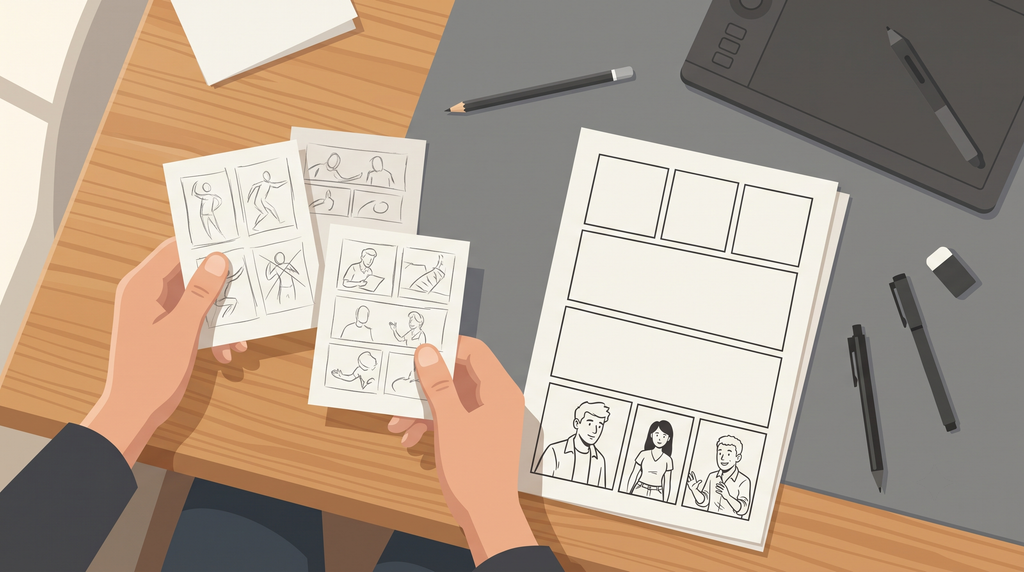
- Write a one-sentence premise.
Example: “A teenager discovers that her missing brother is sending messages from a locked room.” - Create a four-page outline.
Give each page one major story purpose. Decide where the strongest reveal happens. - Script the first page.
Break it into panels. Keep the dialogue short. Describe only what the artist needs to know.
Then stop.
You now have the beginning of a real graphic novel instead of another idea sitting in a notebook.
Your next goal is simple: finish four pages before expanding the story.