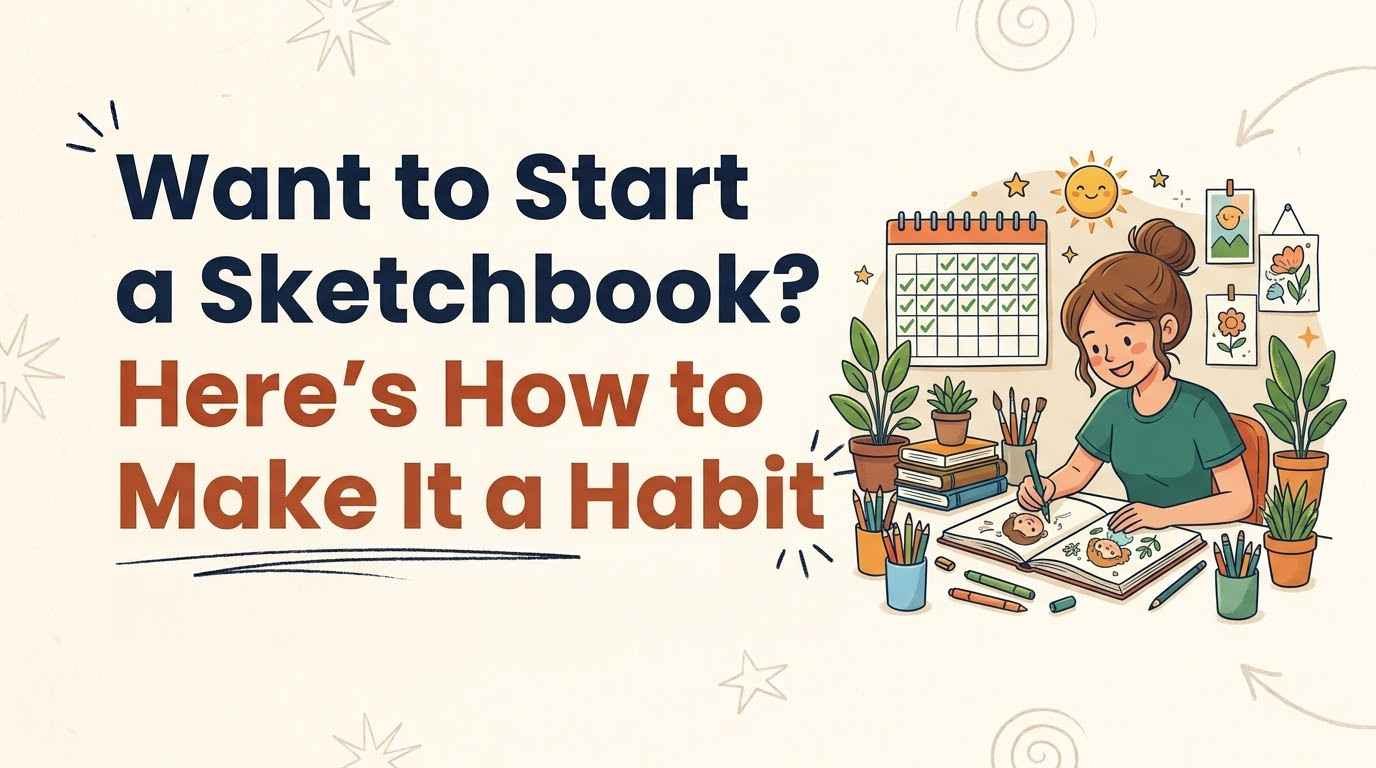
Want to Start a Sketchbook? Here’s How to Make It a Habit
A sketchbook does not need to become a collection of perfect drawings.
It can be a place to think, experiment, observe, practice, and make mistakes. The easiest way to keep using one is to remove the pressure to make every page impressive.
If you want your sketchbook to become a regular habit, start with a simple routine. Give yourself a small daily target, keep drawing materials accessible, and make sure some sessions are purely for fun.
| Day-One Metric | Beginner Target |
|---|---|
| Hours to basic competency | 10–20 focused practice hours |
| Minimum budget | $5–$20 for a basic sketchbook and pencil |
| Difficulty | 2/5 |
| Core skills | Observation, consistency, experimentation, basic drawing |
| Best first project | A 7-day sketchbook challenge |
Choose a Sketchbook You Will Actually Use
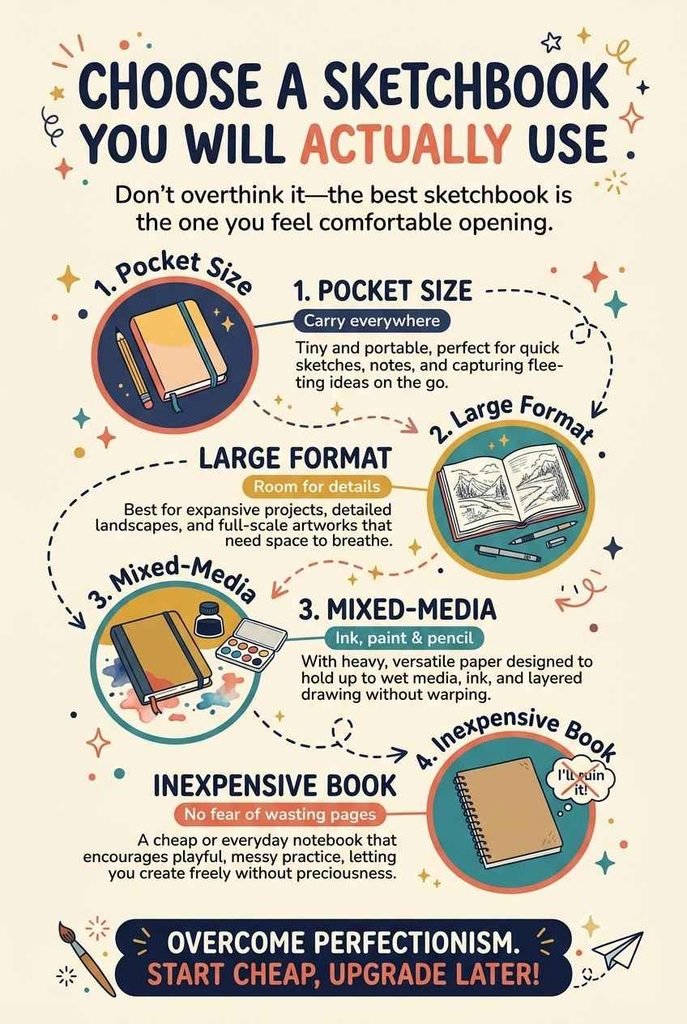
Do not overthink your first sketchbook.
You might prefer:
- A small notebook you can carry everywhere
- A larger sketchbook for detailed drawings
- A mixed-media book for pencil, ink, and watercolor
- A cheap notebook that removes the fear of “wasting” pages
The best sketchbook is the one you feel comfortable opening.
If expensive paper makes you afraid to make mistakes, start with something inexpensive.
You can always upgrade later.
Give Your Sketchbook a Purpose
You do not need a strict theme.
But having a general purpose can make it easier to decide what to draw.
Your sketchbook could be for:
Daily observation: Draw something you see each day.
Drawing practice: Use it for perspective, gesture, forms, or anatomy.
Ideas: Develop characters, compositions, stories, or illustrations.
Visual journaling: Record places, objects, thoughts, and everyday moments.
Experimentation: Try different tools, colors, textures, and techniques.
You can also combine several of these.
The important part is knowing that the sketchbook does not have to produce a polished portfolio.
Start With a Tiny Daily Goal
Do not begin with “I will fill one page every day.”
That sounds manageable until you have a busy day.
Instead, set a minimum of 5–15 minutes.
You could draw:
- One object
- One hand
- Three gestures
- Five geometric forms
- One small landscape
- A quick self-portrait
If you have more time, continue.
If you do not, stop after your minimum.
The habit is built by showing up, not by forcing yourself to create a masterpiece.
The Biggest Beginner Sketchbook Problem
The most common conceptual roadblock is being afraid of ruining the first page.
You may keep searching for the “right” first drawing.
Then the sketchbook remains empty.
There is no perfect first page.
Make a deliberately bad drawing if necessary. Write the date. Draw something ordinary. Turn the page.
Once the book has a few imperfect pages, the pressure usually drops.
That is exactly what you want.
Create a Simple Sketchbook Routine
Attach your drawing habit to something you already do.
For example:
After morning coffee: Five-minute sketch.
After lunch: Draw one object.
Before bed: Ten-minute observation drawing.
A consistent trigger makes the habit easier to remember.
Keep the sketchbook visible too.
If it is buried in a drawer, you have added another reason not to use it.
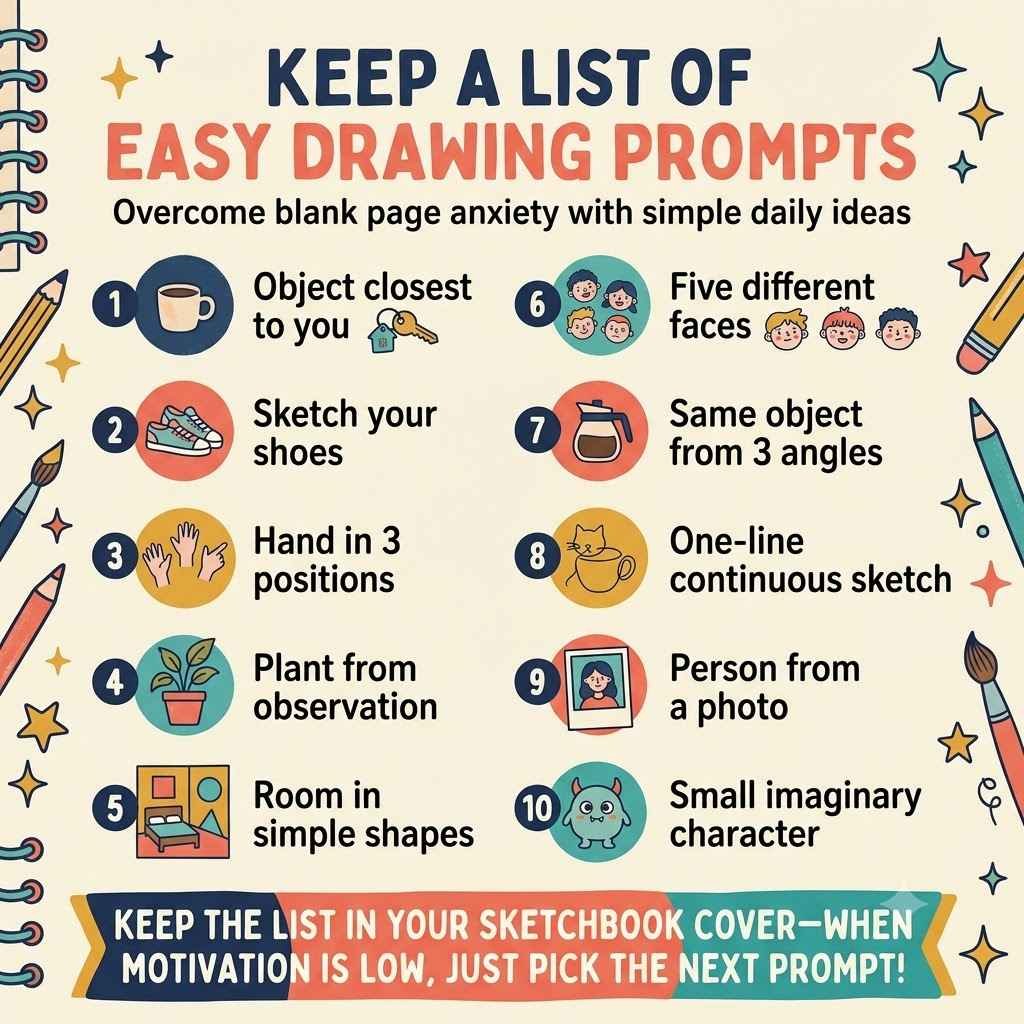
Keep a List of Easy Drawing Prompts
Sometimes the hardest part is deciding what to draw.
Create a prompt list before you need it.
Try:
- Draw the object closest to you.
- Sketch your shoes.
- Draw your hand in three positions.
- Draw a plant from observation.
- Sketch a room using simple shapes.
- Draw five different faces.
- Draw the same object from three angles.
- Sketch something without lifting your pencil.
- Draw a person from a photograph.
- Make a small imaginary character.
Keep the list inside the front or back cover.
When motivation is low, simply pick the next prompt.
Use Your Sketchbook for Learning
A sketchbook can become much more useful when you combine free drawing with focused exercises.
For example, spend ten minutes practicing perspective.
Then use another ten minutes to draw a small room using the same perspective principles.
This creates a simple cycle:
Learn → Practice → Apply → Review
You do not need to separate your “practice sketchbook” and “fun sketchbook” unless that helps you.
Your pages can contain both.
Do Not Erase Everything
Erasing every mistake can make a sketchbook feel sterile.
Sometimes leave the wrong lines.
Circle a mistake and write a tiny note such as:
- “Head too wide”
- “Perspective wrong”
- “Need darker shadow”
- “Pose feels stiff”
Then move on.
This turns mistakes into visual feedback.
Your sketchbook becomes a record of what you were learning rather than a collection of drawings that survived an editing process.
Change Your Subjects Before You Get Bored
You do not have to draw the same thing every day.
Rotate your subjects.
| Day | Sketchbook Idea |
|---|---|
| Monday | Household objects |
| Tuesday | People and gestures |
| Wednesday | Plants or nature |
| Thursday | Architecture |
| Friday | Characters |
| Saturday | Personal illustration |
| Sunday | Free sketching |
You can change this schedule whenever you want.
The goal is to keep your practice interesting enough to continue.
Experiment With Different Materials
A sketchbook can also be a place to test materials.
Try:
- Graphite
- Colored pencil
- Fineliner
- Brush pen
- Watercolor
- Gouache
- Digital sketching
You do not need expensive supplies.
Experimenting can help you discover what kind of marks you enjoy making.
It can also prevent your daily routine from becoming mechanically repetitive.
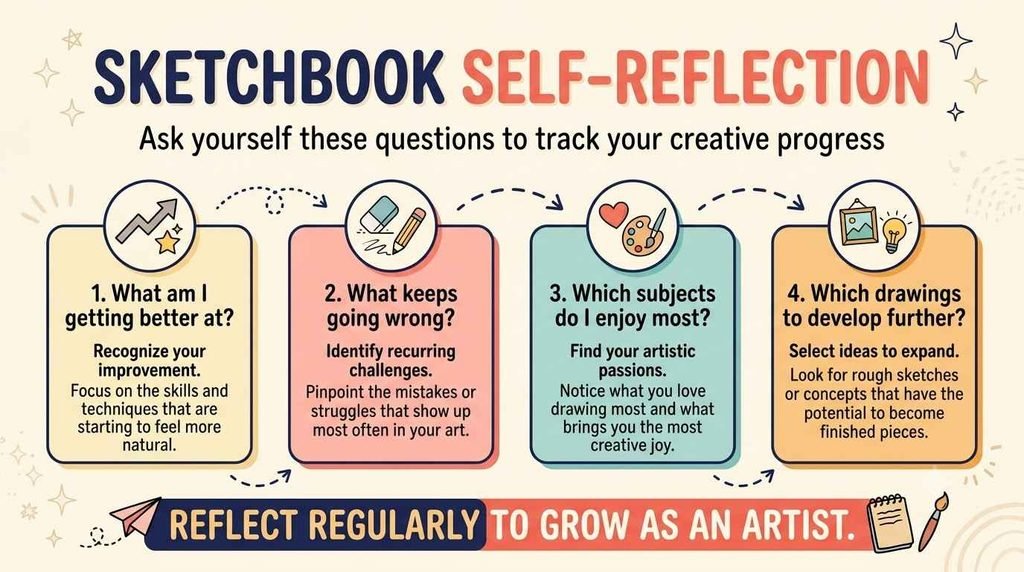
Review Your Sketchbook Once a Week
Do not only look at your newest page.
Once a week, flip through the previous pages.
Ask:
What am I getting better at?
What keeps going wrong?
Which subjects do I enjoy most?
Which drawings would I like to develop further?
Choose one answer and use it to plan the following week.
This gives your sketchbook habit a sense of direction without turning it into a rigid course.
What If You Miss a Day?
Nothing happens.
Do not restart the entire challenge.
Do not fill three pages to “catch up.”
Just open the sketchbook the next day.
A sustainable habit is not a perfect streak. It is the ability to return after interruptions.
If you miss several days, make your next session deliberately easy.
Draw one object for five minutes.
Then continue from there.
What Should You Learn After Building the Habit?
Once sketching becomes regular, use your pages to develop a specific skill.
For portraits, practice head construction, facial proportions, and values.
For characters, study gesture, anatomy, expressions, and shape language.
For architecture, work on perspective, simple volumes, and composition.
For illustration, combine drawing practice with storytelling, color, and composition.
Your sketchbook should eventually become a place where you test ideas for larger projects.
Your Day-One Action Plan
Start before you feel ready.
- Choose an inexpensive sketchbook that feels comfortable to use.
- Set a five-minute timer and draw the first object you see.
- Leave the sketchbook somewhere visible and decide when you will draw tomorrow.
That is enough for day one.
You do not need a perfect routine, expensive materials, or an impressive first page.
Keep the sessions small. Draw subjects you enjoy. Leave mistakes visible. Review your progress.
Most importantly, make opening the sketchbook easy enough that you want to do it again tomorrow.