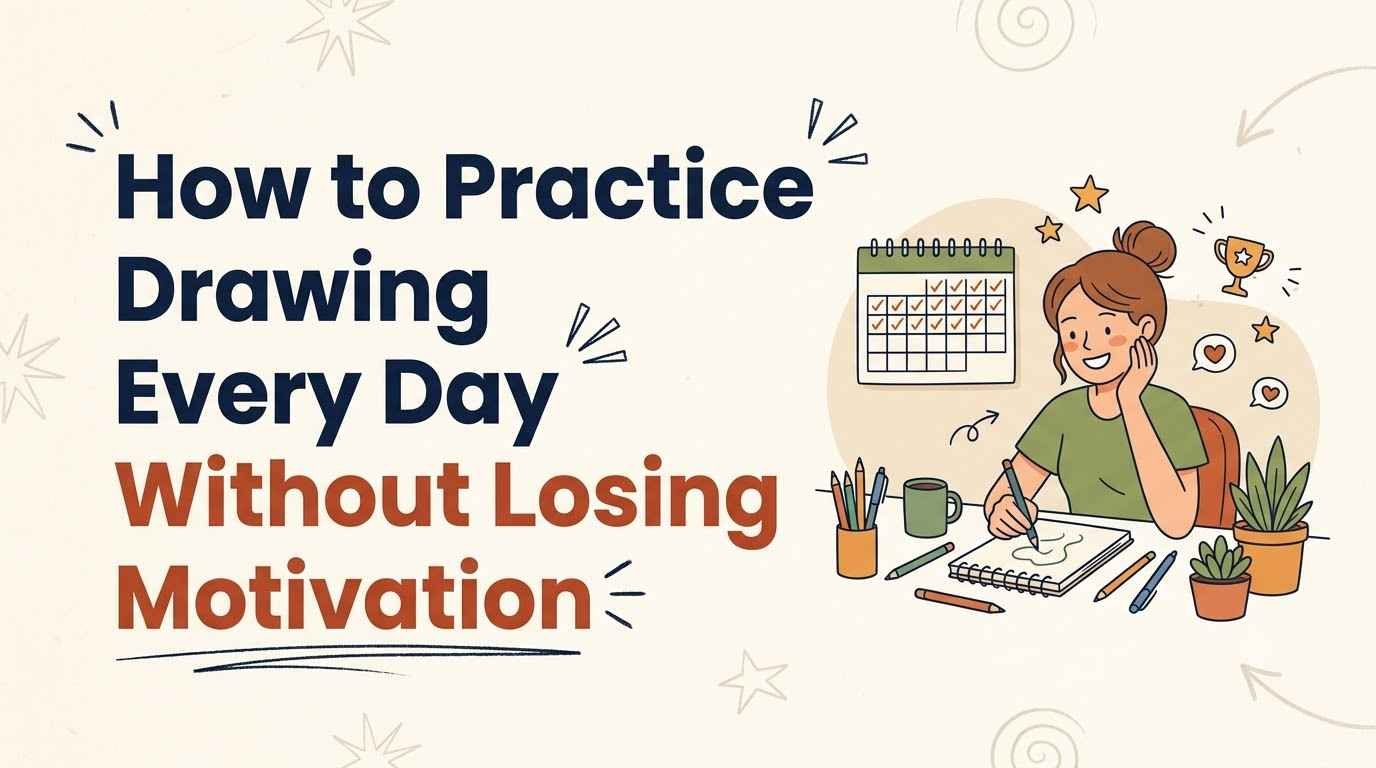
How to Practice Drawing Every Day Without Losing Motivation
Drawing every day sounds simple until life gets busy.
Some days you have an hour to sketch. Other days, you have ten minutes. If your routine only works when you have plenty of time and motivation, it will eventually break.
A better approach is to build a flexible drawing habit. Practice regularly, keep sessions manageable, and give yourself enough variety to stay interested.
You do not need to create finished artwork every day. You need to make drawing easy enough to return to tomorrow.
| Day-One Metric | Beginner Target |
|---|---|
| Hours to basic competency | 15–30 focused hours |
| Minimum budget | $5–$20 for basic drawing supplies |
| Difficulty | 3/5 |
| Core skills | Observation, proportion, form, gesture, consistency |
| Best first project | A 7-day drawing practice challenge |
Start With a Small Daily Drawing Goal
The biggest mistake is making your daily goal too ambitious.
If you decide to draw for two hours every day, missing one session can make the entire routine feel like a failure.
Start smaller.
Try:
- 10 minutes on busy days
- 20–30 minutes on normal days
- Longer sessions when you genuinely have time
Your minimum goal should feel almost too easy.
Once you start drawing, you may continue longer. But you do not have to.
The purpose of a minimum session is to keep the habit alive.
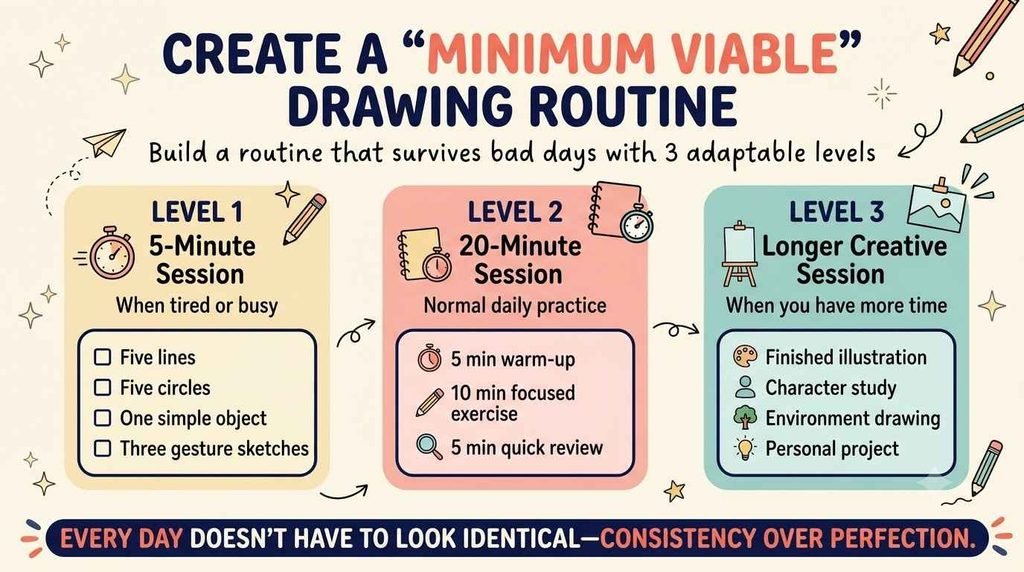
Create a “Minimum Viable” Drawing Routine
You need a routine that survives bad days.
Create three levels.
Level 1: Five-minute session
Use this when you are tired or busy.
Draw:
- Five lines
- Five circles
- One simple object
- Three gesture sketches
Then stop if you want.
Level 2: Twenty-minute session
Use this as your normal practice.
Spend:
5 minutes: Warm-up
10 minutes: Focused exercise
5 minutes: Quick review
Level 3: Longer creative session
Use this when you have more time.
Work on a finished illustration, character, environment, portrait, or personal project.
This system removes the idea that every day has to look identical.
Do Not Practice the Same Thing Every Day
Repetition helps.
Too much repetition can also make drawing feel like homework.
Rotate your subjects.
| Day | Practice Focus |
|---|---|
| Monday | Basic forms |
| Tuesday | Observation |
| Wednesday | Gesture drawing |
| Thursday | Perspective |
| Friday | Portraits or characters |
| Saturday | Personal illustration |
| Sunday | Review and free sketching |
You can change the subjects based on your interests.
The key is to combine technical practice with drawing you actually enjoy.
The Biggest Motivation Problem: Turning Drawing Into Homework
A common conceptual roadblock is making every drawing session about fixing weaknesses.
If you only practice things you dislike, motivation eventually disappears.
Keep some sessions completely open.
Draw your favorite character. Sketch your pet. Draw a café. Make a silly comic. Experiment with a new brush.
Your personal drawings do not have to serve a technical purpose every time.
Enjoyment is part of a sustainable practice habit.
Use a Simple Drawing Prompt List
Motivation drops quickly when you spend ten minutes asking yourself what to draw.
Keep a list nearby.
Try prompts such as:
- Draw the object closest to you.
- Draw five different mugs.
- Sketch your hand in three positions.
- Draw a person sitting.
- Draw a room using simple boxes.
- Draw the same character with five expressions.
- Draw an object using only three values.
- Redraw yesterday’s sketch from memory.
- Draw something without lifting your pencil.
- Sketch a scene from your window.
When you finish one prompt, choose another.
The goal is to remove decision fatigue.
Track Practice, Not Quality
Do not rate every drawing from 1 to 10.
That can make practice unnecessarily stressful.
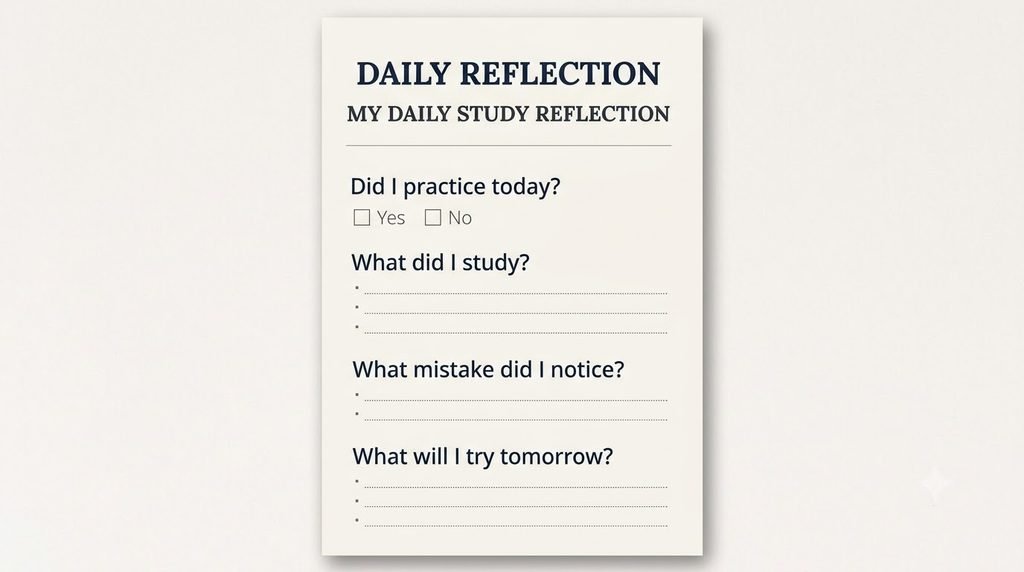
Instead, track things you can control:
Did I practice today?
What did I study?
What mistake did I notice?
What will I try tomorrow?
A simple calendar can work.
Put a mark on each day you practice. You are tracking consistency, not artistic perfection.
Avoid the “Streak” Trap
A drawing streak can be motivating.
It can also become counterproductive.
Missing one day does not erase your previous practice.
If you miss Tuesday, simply draw on Wednesday.
Do not tell yourself that the entire challenge is ruined.
The useful goal is returning to the habit quickly.
A sustainable artist is not someone who never misses a session. It is someone who keeps coming back.
Keep a “Bad Drawing” Page
This sounds strange.
It can be useful.
Keep a section of your sketchbook for drawings that went badly.
Write down what went wrong:
- Head too large
- Perspective inconsistent
- Hands too small
- Values too similar
- Pose too stiff
Then use the next session to address one problem.
This turns mistakes into practice targets.
It also helps you stop expecting every drawing to look good.
Use References Without Feeling Guilty
You do not need to draw everything from imagination.
Use photographs, objects around you, people in public spaces, architecture, plants, and other real references.
References help train your observation.
Try a simple progression:
Reference → Draw → Identify mistakes → Redraw → Draw from memory
Over time, you will build a stronger visual library.
Take Progress Photos
Your improvement may be difficult to notice from one day to the next.
Take a photograph of one drawing each week.
After a month, compare the four drawings.
Look for changes in:
- Line confidence
- Proportion
- Form
- Perspective
- Values
- Composition
Do not ask whether you have “become good.”
Ask what specifically changed.
That makes progress easier to recognize.
Know When to Stop Drawing for the Day
More practice is not always better practice.
If you are tired and mindlessly repeating the same mistake, stop.
A useful session should leave you with at least one clear takeaway.
Write something simple:
“My heads are too narrow.”
Then make that the focus tomorrow.
This creates a continuous learning loop instead of random practice.
What Should You Practice Each Month?
Your focus can change as your skills develop.
Month 1: Lines, shapes, observation, and simple forms.
Month 2: Perspective, proportion, and construction.
Month 3: Gesture, figures, and portraits.
Month 4: Values, light, and composition.
After that, choose a specialization such as character design, children’s illustration, concept art, comics, environments, or digital illustration.
You do not need to follow these exact months.
Use them as a general progression.
Your Day-One Action Plan
Start today with the smallest version of the habit.
- Set a 15-minute timer and draw one object from observation.
- Spend five minutes reviewing it and identify one specific mistake.
- Write tomorrow’s drawing prompt before closing your sketchbook.
Tomorrow, come back and do it again.
If you have more time, keep drawing. If you do not, your minimum session still counts.
The goal is not to become someone who draws perfectly every day.
It is to become someone who keeps drawing even when motivation is low.
Make the habit small. Keep the subjects interesting. Focus on one weakness at a time. And most importantly, return tomorrow.