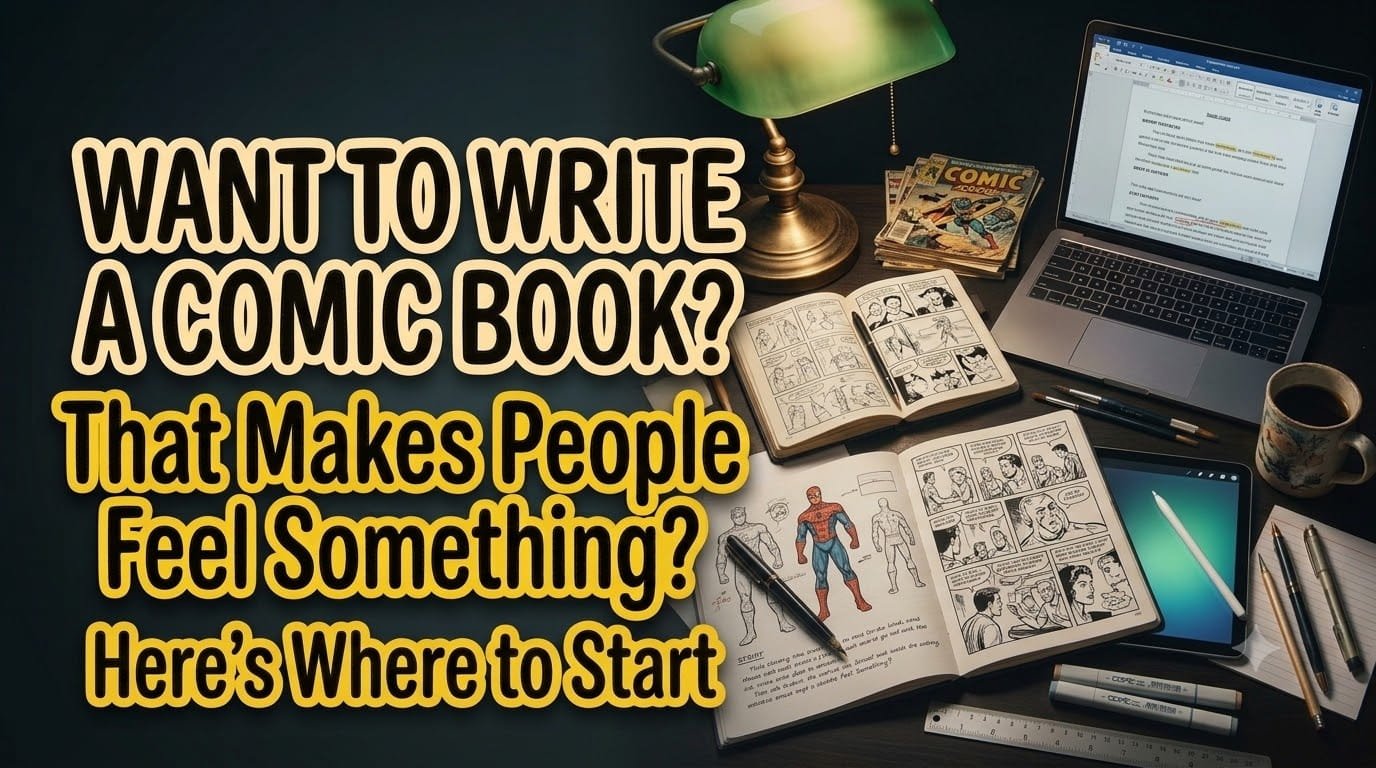
Want to Write a Comic Book? Here’s Where to Start
Writing a comic book is about more than coming up with a good story. You also have to think visually. Every page needs to communicate through a combination of panels, dialogue, captions, character actions, and artwork.
The good news is that you don’t need to know how to draw before you can start writing comics. Your first job is to understand what happens, who is involved, and how the reader experiences each moment.
| Day-One Metric | Beginner Target |
|---|---|
| Hours to Basic Competency | 10–20 hours |
| Minimum Budget | $0 |
| Free Software Prerequisites | Google Docs or any basic word processor |
| Learning Difficulty | 3/5 |
What Should You Write Before You Draw Anything?
Start with the story, not the artwork.
Write down:
- Who the main character is
- What they want
- What stands in their way
- Where the story takes place
- What changes during the story
- How the story ends
You don’t need a complete 100-page plot.
For your first project, a short comic of 4–8 pages is much easier to manage.
Start With a Simple Premise
Try to summarize your idea in one sentence.
For example:
A young inventor has one night to repair a machine before it erases the memories of everyone in the neighborhood.
That gives you a protagonist, goal, deadline, and stakes.
You can develop the details afterward.
How Is Comic Writing Different From Regular Writing?
The biggest difference is that comics are visual.
In a novel, you can spend several paragraphs explaining a character’s thoughts.
In a comic, you might show the character staring at an old photograph instead.
The artwork communicates part of the story.
That means comic writers need to think about what the reader sees, not just what the characters say.
Write for the Page
Instead of writing:
Sarah walks into the abandoned building, remembers her childhood, feels nervous about what she might find, and starts thinking about leaving.
A comic could break that into several visual moments:
Panel 1: Sarah stands outside the abandoned building.
Panel 2: She pushes the door open.
Panel 3: She notices an old photograph on the wall.
Panel 4: Close-up of Sarah’s expression.
Panel 5: She takes a step backward.
The reader experiences the sequence visually.
What Are Panels and Why Do They Matter?
A panel is one visual moment in a comic.
A page can contain one large panel or several smaller ones.
Panels control the pace of the story.
A series of small panels can make an action feel quick.
A large panel can give an important moment more weight.
For beginners, don’t worry about complicated layouts.
Focus on one question:
What does the reader need to see at this moment?
How Do You Write a Comic Book Script?
There isn’t one universal comic-script format, but a simple structure works well for beginners.
For each page, identify:
PAGE 1
Panel 1: Describe what the reader sees.
CAPTION: Optional narration.
CHARACTER: Dialogue.
Panel 2: Describe the next visual moment.
Then continue.
Keep descriptions clear enough for an artist to understand the intended action without writing a novel inside every panel.
Give the Artist Useful Information
Your script should communicate important things such as:
- Character actions
- Setting
- Important objects
- Expressions
- Changes in location
- Visual clues
- Relevant atmosphere
Avoid describing every tiny artistic decision unless it is important to the story.
The artist needs direction, not a wall of unnecessary instructions.
How Much Dialogue Should a Comic Have?
Usually, less is better.
Comics already communicate through artwork.
If a character says exactly what the reader can already see, the dialogue is probably unnecessary.
For example, if the panel clearly shows someone opening a door, you probably don’t need:
“I’m opening this door.”
Instead, let the artwork communicate the action.
Use dialogue for information, personality, conflict, or something the image can’t communicate.
Give Characters Distinct Voices
Your characters shouldn’t all sound identical.
Think about:
- Vocabulary
- Sentence length
- Humor
- Formality
- Confidence
- Habits
- What they avoid saying
A character’s voice can reveal personality without requiring a long explanation.
The Beginner Friction Factor: Trying to Fit Too Much Into One Page
One of the hardest parts of comic writing is space.
You may have a great scene that would work perfectly in a novel.
But a comic has a limited number of panels.
If you try to include every action, explanation, and conversation, the page can become crowded.
Start asking:
What is the most important visual moment?
Then remove everything that doesn’t support it.
This is why short comics are such good practice.
They force you to make decisions.
How Do You Create a Strong Comic Story?
Use the same basic storytelling principles you would use elsewhere.
Give your protagonist:
A goal → An obstacle → A choice → A consequence
For example:
A detective wants to solve a missing-person case.
The evidence points toward someone they know.
They have to decide whether to protect that person or reveal what they discovered.
The choice creates the story.
The artwork then helps communicate the tension.
How Do You Plan the Pages?
Before writing the full script, create a page-by-page outline.
For example:
| Page | Main Purpose |
|---|---|
| 1 | Introduce character and setting |
| 2 | Establish the problem |
| 3 | Character discovers something |
| 4 | Situation becomes more difficult |
| 5 | Character makes a choice |
| 6 | Consequence and ending |
This prevents you from reaching the final page with too much story left.
Think About Page Turns
Comic pages have a special storytelling tool: the page turn.
You can end a page with a question or incomplete moment.
Then the next page reveals what happens.
For example:
Final panel of Page 4: The character opens the mysterious box.
Page 5: Full-page reveal of what’s inside.
You don’t need to use this technique constantly.
Save major reveals for moments where the page turn can add impact.
Do You Need to Know How to Draw?
No.
You can write comic scripts without being an illustrator.
However, learning some basic visual storytelling can make you a better comic writer.
Study:
- Panel composition
- Shot sizes
- Facial expressions
- Body language
- Visual pacing
- Page layouts
Even simple sketches can help you understand how much information fits into a panel.
You don’t need polished artwork.
Stick figures can be enough for planning.
What Tools Can You Use?
You can start with almost nothing.
Basic Writing Software
Best for: Beginners learning comic scripting.
Portfolio project: A complete 4–8 page comic script.
Honest limitation: A word processor won’t help you visualize the final page layout.
Drawing or Layout Software
Best for: Writers who also want to experiment with thumbnails and page layouts.
Portfolio project: A short comic sequence with rough panel sketches.
Honest limitation: Learning the software can distract from learning storytelling if you try to master everything at once.
Paper and Pencil
Best for: Anyone who wants to learn page structure without dealing with software.
Portfolio project: A rough storyboard.
Honest limitation: Hand-drawn thumbnails aren’t intended to be finished artwork.
What Should You Learn Next?
Once you can write a basic comic script, learn visual storytelling and sequential art.
A useful progression is:
Story idea → Character design → Page outline → Comic script → Thumbnails → Finished pages
If you’re primarily a writer, focus on scriptwriting, pacing, dialogue, and visual communication.
If you want to create the entire comic yourself, add drawing, inking, coloring, lettering, and page composition.
Your Day-One Action Plan
Don’t start with a graphic novel.
Start with one page.
- Create one character and one problem.
- Write a six-panel page showing the character discovering or confronting that problem.
- Sketch six tiny thumbnails showing what the reader will see in each panel.
Then remove any dialogue that simply describes what the artwork already shows.
If the story still makes sense, you’ve taken the first step toward writing comics.
Your goal isn’t to write a novel that happens to have pictures. It’s to learn how words and images can tell the story together.