Want to Become a Better Public Speaker? Start With These Skills
Good public speaking isn’t about having the loudest voice in the room.
It depends on several learnable skills: clear structure, confident delivery, useful pauses, audience awareness, and deliberate practice. If you’re starting from scratch, focusing on these fundamentals is more useful than memorizing advanced presentation tricks.
| Day-One Metric | Beginner Estimate |
|---|---|
| Hours to basic competency | 3–5 hours |
| Minimum budget | $0 |
| Free tools | Phone camera, notebook, timer |
| Learning difficulty | 3/5 |

Which Public Speaking Skills Should You Learn First?
Trying to improve everything simultaneously can make practice frustrating.
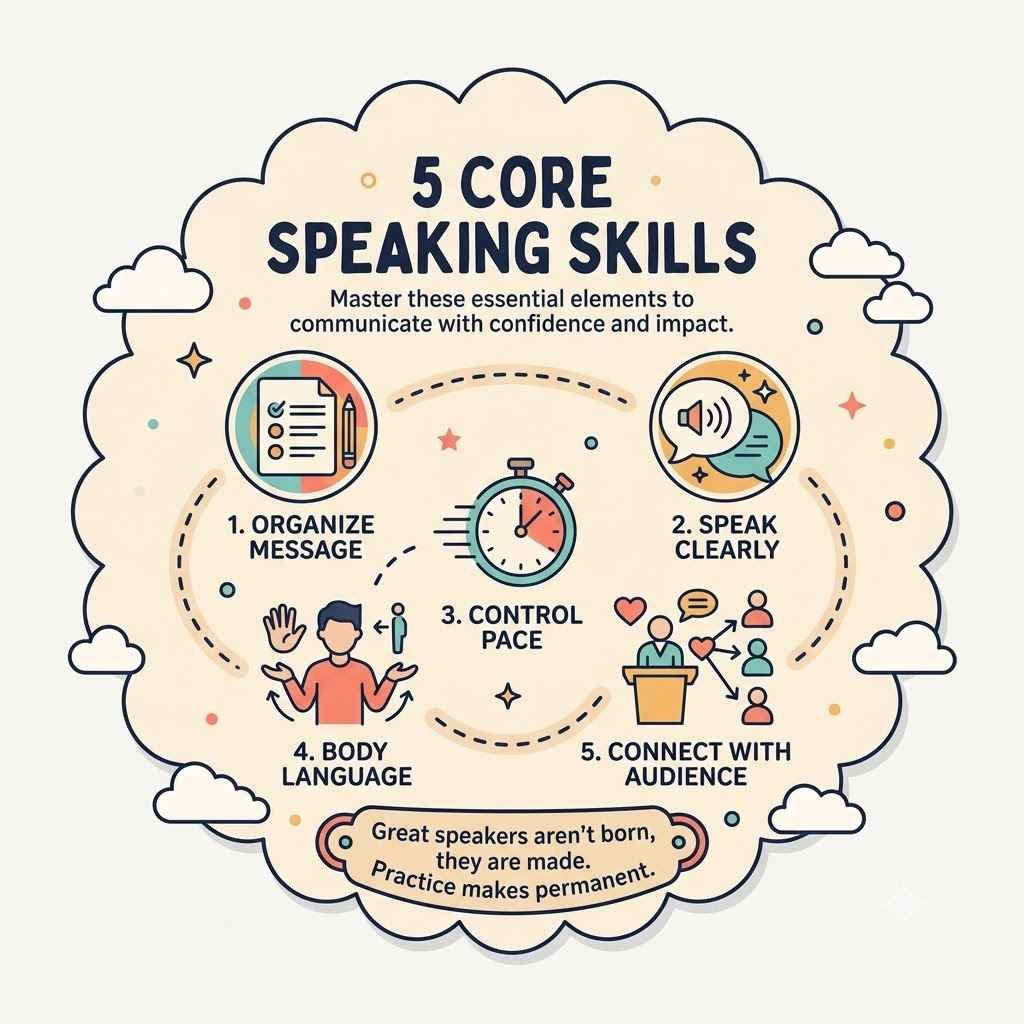
Start with five core skills:
- Organizing your message
- Speaking clearly
- Controlling your pace
- Using body language effectively
- Connecting with your audience
These skills support almost every type of speaking.
They apply to presentations, meetings, interviews, classroom discussions, workshops, and professional pitches.
Public Speaking Skill #1: Structure Your Message
A confident delivery can’t rescue a confusing message.
Before you worry about gestures or voice, decide what you want people to understand.
A simple presentation structure is:
Opening → Main Point → Supporting Ideas → Takeaway
For example, imagine you’re presenting a new marketing idea.
You could structure it as:
- What problem are we facing?
- Why does the problem matter?
- What solution are you proposing?
- What should we do next?
This gives your audience a path to follow.
Don’t Memorize Every Sentence
Writing a complete script can feel safe.
But memorizing every word creates another problem. If you forget one sentence, you may lose your place completely.
Instead, prepare key points and transitions.
Know where you’re going without forcing yourself to reproduce every sentence exactly.
That usually makes delivery more natural.
Public Speaking Skill #2: Speak Clearly
Clear speech matters more than sounding impressive.
Focus on:
- Pronouncing important words fully.
- Finishing your sentences.
- Using a comfortable volume.
- Avoiding unnecessarily complicated language.
- Speaking directly instead of filling space.
You don’t need to change your natural accent.
You need to make your message easy to understand.
Use Shorter Sentences
Long sentences become harder to deliver when you’re nervous.
Compare:
“The main reason we should consider changing this approach is because there are several different factors that could potentially affect our overall results.”
With:
“We should change the approach for three reasons.”
The second version is easier to say.
It’s also easier to understand.
Simple language is a speaking advantage.
Public Speaking Skill #3: Control Your Pace
Nervous speakers often speed up.
You may feel like you’re speaking normally, but your audience hears a rushed presentation.
Practice slowing down deliberately.
After making an important point, pause.
That pause gives your audience time to process the information.
It also gives you a moment to breathe and prepare the next sentence.
Replace Filler Words With Pauses
Common fillers include:
- “Um”
- “Like”
- “Basically”
- “You know”
- “So…”
An occasional filler isn’t a serious problem.
But repeated fillers can make your delivery sound uncertain.
The easiest replacement is silence.
You don’t need to fill every second.
A short pause can sound more confident than another “um.”

Public Speaking Skill #4: Use Body Language
Your audience notices more than your words.
Posture, eye contact, facial expression, and movement all affect how your message feels.
Start with the basics.
Stand Naturally
Keep your shoulders relaxed.
Avoid constantly shifting your weight or gripping the podium.
You don’t need to stand perfectly still. Natural movement is fine.
Make Comfortable Eye Contact
Don’t stare at one person.
Move your attention around the room.
In a small group, make brief eye contact with different people as you speak.
If eye contact feels uncomfortable, look toward the person’s eye area rather than forcing yourself to maintain an intense gaze.
Keep Gestures Useful
Hand gestures can reinforce a point.
They don’t need to accompany every sentence.
Use them naturally when describing size, direction, sequence, or emphasis.
Don’t copy another speaker’s body language.
Find movements that feel natural to you.
Public Speaking Skill #5: Learn to Read Your Audience
Speaking isn’t a performance delivered into empty space.
You’re communicating with people.
Watch for signs that your audience is following you.
Are they looking at you?
Are they taking notes?
Do they look confused?
Are they disengaging?
You may need to change your approach.
If people seem confused, slow down and give an example.
If you’re losing attention, shorten the explanation or introduce a more concrete point.
Good speakers don’t simply deliver a prepared message.
They respond to the people in front of them.
The Friction Factor: Practicing Only in Your Head
One of the biggest beginner problems is silent rehearsal.
You can read your presentation several times and feel prepared.
Then you stand up and discover that the sentences are harder to say than they looked on the page.
Public speaking is a physical skill.
Your mouth, breathing, pacing, posture, and attention all need practice.
The simplest solution is to speak aloud.
Record a two-minute presentation on your phone.
Watch it once.
Look for one problem.
Maybe you speak too quickly.
Maybe you look down constantly.
Maybe your opening takes too long.
Fix one issue and record it again.
Don’t try to perfect everything in one session.

Public Speaking Skill #6: Manage Nervousness
Confidence doesn’t require eliminating nervousness.
The goal is to function effectively while nervous.
Before speaking, try:
- Arriving early.
- Checking your materials.
- Taking a few slow breaths.
- Reviewing your opening.
- Drinking some water.
- Reminding yourself of your main point.
Then shift your attention away from yourself.
Instead of thinking:
“Do I look nervous?”
Ask:
“What does this audience need to understand?”
That changes your attention from self-monitoring to communication.
Practice Under Increasing Pressure
Don’t make your first practice session a major presentation.
Build gradually.
| Level | Practice |
|---|---|
| 1 | Explain an idea aloud alone |
| 2 | Record yourself for two minutes |
| 3 | Speak to one familiar person |
| 4 | Present to a small group |
| 5 | Present in a realistic professional setting |
Repeat each level until it becomes manageable.
Then increase the challenge.
Public Speaking Skill #7: Recover From Mistakes
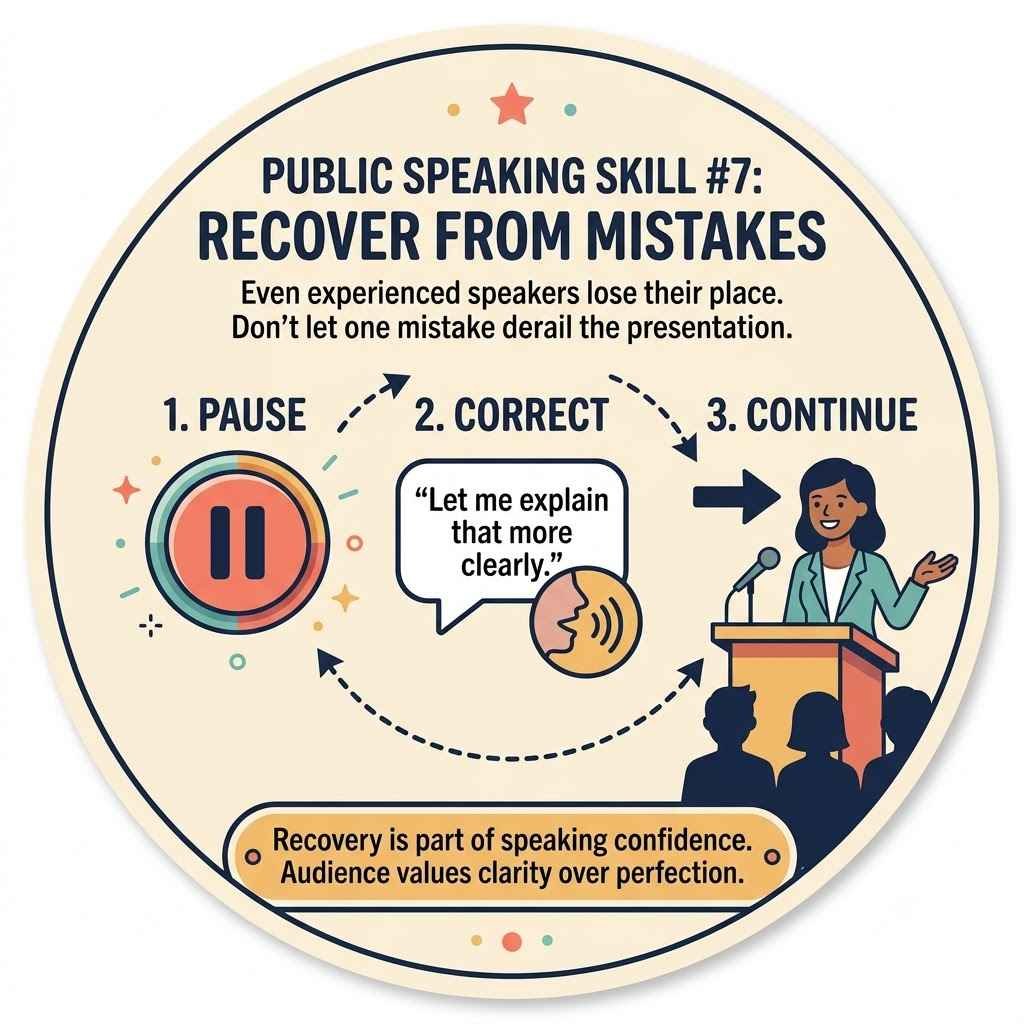
Even experienced speakers lose their place.
You may forget a word, skip a slide, or explain something poorly.
Don’t let one mistake derail the entire presentation.
Use a simple recovery pattern:
Pause → Correct → Continue
You can say:
“Let me explain that more clearly.”
Then continue.
The audience usually cares more about whether they understand your message than whether every sentence was perfect.
Recovery is part of speaking confidence.
Courses and Resources for Building Speaking Skills
The supplied SkillAdvisor materials emphasize balancing paid learning with free alternatives and avoiding the assumption that one course is perfect for everyone. They also recommend evaluating a course based on its practical outcome and honest limitations.
For public speaking, beginners can start without spending money.
A phone camera, notebook, and timer are enough for meaningful practice.
If you later choose a paid course, compare it against free presentations, talks, practice exercises, and public-speaking resources first. The goal is to improve the skill, not accumulate courses.
What to Learn Next: Presentation Design
Once your speaking fundamentals improve, learn presentation design.
Your visual material should support what you’re saying.
Focus on:
- Clear slide hierarchy
- Short text
- Useful visuals
- Consistent layouts
- Simple charts
- Strong contrast
- One main idea per slide
Avoid putting your entire speech on the screen.
Your audience should listen to you rather than read paragraphs while you talk.
The combination of clear speaking + clear visual communication is much more powerful than either skill alone.
Your Day-One Action Plan
You can start improving your public speaking skills today.
- Choose one familiar topic. Prepare a two-minute explanation using three main points.
- Record yourself speaking. Watch the recording and identify one issue with pace, clarity, eye contact, or filler words.
- Record it again. Fix that one issue and compare the second version with the first.
Repeat this exercise several times.
Don’t wait until you feel confident before practicing.
Practice is how speaking confidence develops.