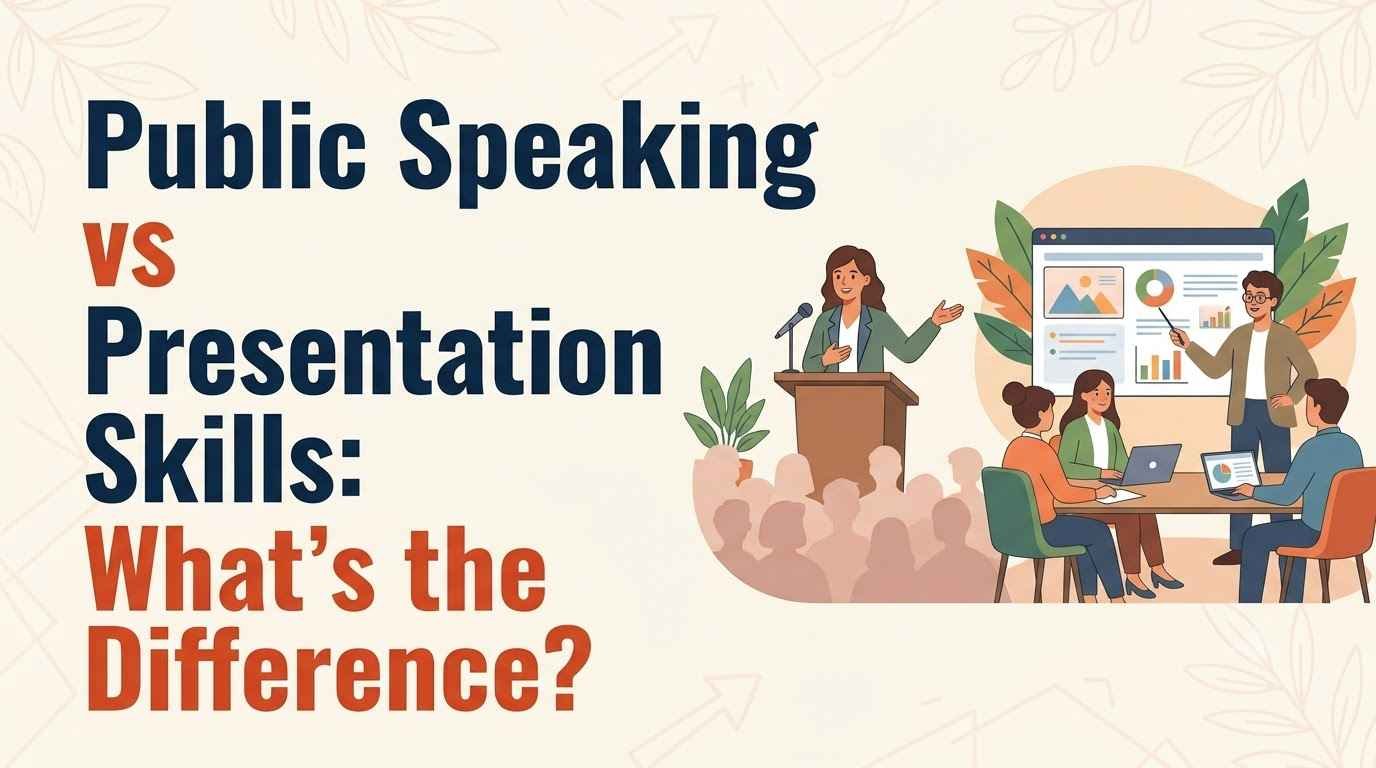
Public Speaking vs Presentation Skills: What’s the Difference?
Public speaking and presentation skills overlap, but they solve different problems.
Public speaking is mainly about communicating effectively to an audience. Presentation skills cover a broader set of abilities, including organizing information, designing slides, explaining ideas, and delivering a structured presentation.
Understanding the difference can help you practice the right skill instead of treating every speaking situation the same way.
| Day-One Metric | Beginner Estimate |
|---|---|
| Hours to basic competency | 3–5 hours |
| Minimum budget | $0 |
| Free tools | Phone camera, notebook, presentation software |
| Learning difficulty | 3/5 |

Public Speaking vs Presentation Skills: The Basic Difference
The simplest way to think about the distinction is this:
Public speaking = how you communicate with people.
Presentation skills = how you prepare, structure, support, and deliver a presentation.
There is considerable overlap.
A presentation usually involves public speaking, but public speaking doesn’t always involve a formal presentation.
For example, giving a speech at an event is public speaking.
Explaining an idea during a team meeting can involve public speaking skills without requiring slides.
Giving a sales pitch combines both.
What Is Public Speaking?
Public speaking is the skill of speaking effectively to an audience.
It can include:
- Speeches
- Meetings
- Interviews
- Workshops
- Panel discussions
- Classroom presentations
- Professional talks
- Community events
The focus is primarily on the speaker’s communication.
Important public-speaking skills include:
Clarity
Can people understand what you’re saying?
Pace
Are you speaking quickly enough to maintain attention but slowly enough to be understood?
Voice
Are your volume, emphasis, and tone appropriate?
Body Language
Does your posture and movement support your message?
Eye Contact
Are you engaging with the people listening?
Audience Awareness
Can you adjust your explanation based on how people are responding?
These skills remain useful even when there isn’t a slide deck.
What Are Presentation Skills?
Presentation skills cover the larger process of creating and delivering a structured presentation.
That can include:
- Defining the objective
- Understanding the audience
- Organizing information
- Creating a narrative
- Designing slides
- Explaining charts
- Using visual examples
- Managing time
- Delivering the presentation
- Handling questions
This means presentation skills combine communication with planning and visual communication.
A strong presenter therefore needs more than a strong speaking voice.
They also need to know what information belongs in the presentation and how it should be organized.
Public Speaking vs Presentation Skills: A Quick Comparison
| Skill Area | Public Speaking | Presentation Skills |
|---|---|---|
| Speaking clearly | Essential | Essential |
| Voice and pacing | Essential | Essential |
| Body language | Important | Important |
| Audience awareness | Essential | Essential |
| Message structure | Important | Essential |
| Slide design | Not required | Often important |
| Charts and visuals | Not required | Often important |
| Handling questions | Useful | Important |
| Presentation planning | Useful | Essential |
| Storytelling | Useful | Highly useful |
The key difference is scope.
Public speaking focuses more directly on communicating with an audience.
Presentation skills include that communication plus the planning and visual elements surrounding a presentation.
When Do You Need Public Speaking Skills?
You need public-speaking skills whenever your ability to communicate verbally matters.
Imagine you’re asked a question during a meeting.
There are no slides.
There is no formal presentation.
You still need to:
- Understand the question.
- Organize your response.
- Speak clearly.
- Stay concise.
- Respond to the audience.
That’s public speaking in a smaller setting.
The same applies during interviews, discussions, workshops, and networking situations.
You don’t need a stage to practice public speaking.
When Do You Need Presentation Skills?
Presentation skills become especially important when you’re responsible for delivering organized information.
For example:
- Presenting a project to management
- Pitching a business idea
- Explaining research findings
- Presenting a portfolio
- Giving a sales presentation
- Teaching a workshop
- Presenting a marketing strategy
Here, your audience isn’t only listening to your voice.
They’re also processing your structure, visuals, examples, evidence, and recommendations.
That’s why presentation skills are broader.
Which Should Beginners Learn First?
Start with basic public speaking.
Why?
Because your communication skills are the foundation.
If you cannot explain an idea clearly without slides, adding attractive slides won’t solve the underlying problem.
Practice:
- Speaking clearly
- Slowing down
- Pausing
- Organizing thoughts
- Making eye contact
- Explaining ideas simply
- Recovering from mistakes
Then add presentation-specific skills.
Learn how to:
- Structure a presentation
- Design simple slides
- Use visuals
- Present data
- Tell a story
- Handle questions
This creates a stronger progression.
Speak clearly first. Then learn how to build better presentations around that communication.
The Friction Factor: Hiding Behind Slides
A common beginner problem is using slides as a script.
You put complete paragraphs on the screen and then read them aloud.
This creates two problems.
Your audience is reading instead of listening.
You also become dependent on the slide to remember what comes next.
The solution is to separate speaker notes from audience slides.
Your slide might contain:
Three causes of project delays
Then you explain the three causes verbally.
The audience gets a visual anchor.
You provide the detail.
This makes the presentation feel more like communication and less like reading a document aloud.
Storytelling Helps Both Skills
Storytelling isn’t limited to formal speeches.
It can improve everyday public speaking and structured presentations.
A simple framework is:
Situation → Problem → Change → Result
For example:
Situation: The team handled customer requests manually.
Problem: Response times were increasing.
Change: The team introduced a simpler workflow.
Result: Routine requests became easier to process.
This structure gives your audience a reason to follow the information.
It works in a short meeting response just as well as in a 20-minute presentation.
Courses and Resources: What Should You Learn?
The supplied SkillAdvisor framework recommends choosing learning resources based on what you need to produce, rather than assuming one platform is best for everyone. It also recommends balancing paid courses with free learning options.
For beginners, a useful progression is:
Start Free
Use a phone camera to record yourself speaking.
Practice short explanations.
Review your pacing, clarity, filler words, and structure.
Add Presentation Practice
Use free presentation software to build a short five-slide presentation.
Practice delivering it without reading the slides.
Consider Paid Learning Later
If you still struggle with a specific area, choose a course that directly addresses that weakness.
For example:
- Nervousness → public-speaking practice
- Confusing explanations → communication structure
- Weak presentations → presentation design
- Boring delivery → storytelling and vocal delivery
Buy for a specific problem, not because a course promises confidence.
What to Learn Next
Once you understand the difference between public speaking and presentation skills, focus on persuasive communication.
Public speaking helps you communicate clearly.
Presentation skills help you organize and support the message.
Persuasive communication helps you move an audience toward a decision or action.
A simple framework is:
Problem → Evidence → Solution → Action
This is particularly useful for professional presentations, pitches, interviews, and project proposals.
Your Day-One Action Plan
You can practice both skills without buying anything.
- Give a two-minute explanation without slides. Focus on clarity, pace, and pauses.
- Create a five-slide presentation. Use one main idea per slide and keep the text minimal.
- Record yourself presenting it. Watch the recording and identify one improvement in your speaking and one improvement in your presentation structure.
Remember the distinction:
Public speaking is the communication skill.
Presentation skills are the broader set of skills used to plan, support, and deliver a structured presentation.
Learn the foundation first.
Then build on it.