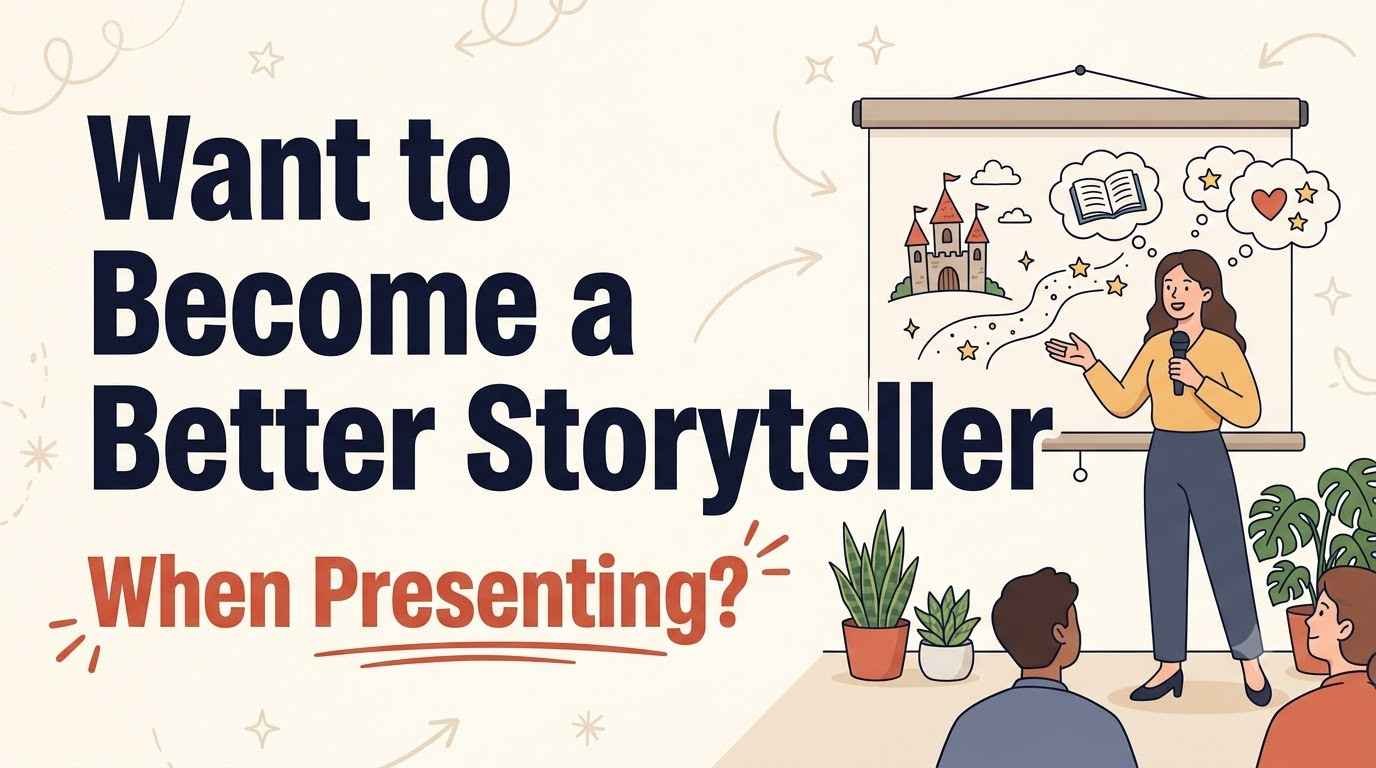
Want to Become a Better Storyteller When Presenting?
A presentation can contain excellent information and still feel forgettable.
Storytelling gives your audience a reason to care about the information. Instead of presenting disconnected facts, you create a clear path from a problem to an idea, decision, or outcome.
You don’t need to become a professional storyteller. You need to learn how to structure information so people can follow it and remember it.
| Day-One Metric | Beginner Estimate |
|---|---|
| Hours to basic competency | 3–5 hours |
| Minimum budget | $0 |
| Free tools | Notebook, phone camera, presentation software |
| Learning difficulty | 3/5 |

Why Use Storytelling in a Presentation?
People can struggle to remember a list of facts.
A story gives those facts context and sequence.
Imagine presenting these two messages:
“Customer complaints increased by 24% this quarter.”
That’s useful information.
Now consider:
“Three months ago, customers could finish the process in two minutes. Today, many are abandoning it halfway through.”
The second version creates a situation.
The audience immediately has questions.
Why are they leaving? What changed? How can we fix it?
That curiosity creates attention.
Storytelling Doesn’t Mean Making Everything Dramatic
You don’t need a personal confession or an emotional story for every presentation.
Business presentations can use simple storytelling structures.
For example:
Problem → Evidence → Change → Result
A project update might become:
- Problem: Customers struggled with the old process.
- Evidence: Support requests increased.
- Change: The team simplified the workflow.
- Result: Completion rates improved.
That’s already a story.
The information hasn’t disappeared.
You’ve simply organized it.
Start With the Audience’s Problem
A common presentation mistake is starting with everything you know.
Your audience doesn’t necessarily need your entire research process.
Start with their problem.
Ask:
- What are they trying to achieve?
- What is currently difficult?
- What do they already know?
- What decision do they need to make?
- What should they do after the presentation?
These questions help determine which information belongs in the presentation.
Good storytelling is selective.
You aren’t telling everything.
You’re choosing what helps the audience understand the point.
Give Your Presentation a Clear Beginning, Middle, and End
A simple narrative structure can make almost any presentation easier to follow.
Beginning: Set the Situation
Explain what is happening.
Give the audience enough context to understand the problem.
Middle: Introduce the Change
Show what changed, what was discovered, or what needs to happen.
This is where evidence, examples, and supporting information belong.
End: Show the Outcome
Explain what the information means.
Then tell the audience what should happen next.
This gives your presentation direction.
Instead of ending with “That’s all my slides,” you finish with a clear takeaway or action.
Use a “Before and After” Story
One of the easiest storytelling structures for beginners is before and after.
It works particularly well for:
- Project presentations
- Case studies
- Portfolio reviews
- Product pitches
- Business proposals
- Process improvements
For example:
Before: The team manually processed every request.
Problem: Requests were taking too long.
Change: A simpler workflow was introduced.
After: Routine requests became faster to handle.
The structure creates movement.
The audience can see what changed and why it matters.

The Friction Factor: Telling Too Much Story
The biggest beginner storytelling problem is adding unnecessary details.
Once you discover storytelling, it can be tempting to explain every event, conversation, and background detail.
That creates a longer presentation without necessarily making the message stronger.
Before including a story or example, ask:
Does this detail help the audience understand the main point?
If not, remove it.
A useful presentation story should have a job.
It might:
- Explain a problem.
- Make an abstract idea concrete.
- Show a consequence.
- Demonstrate a result.
- Help the audience remember an important point.
If it doesn’t do one of those things, it’s probably extra.
Make Abstract Ideas Concrete
Storytelling is especially useful when you’re explaining something complicated.
Instead of describing an abstract concept for five minutes, give the audience a specific situation.
For example, instead of saying:
“Good project management reduces uncertainty.”
Try:
“Imagine opening a project folder three weeks later and having no idea which version is current.”
Now the audience can picture the problem.
Then explain the solution.
Concrete examples make complex information easier to process.
Use People, Situations, and Decisions
When appropriate, explain:
Who was involved?
What were they trying to do?
What went wrong?
What decision was made?
What happened afterward?
You don’t need fictional drama.
A real project, customer situation, experiment, or personal experience can provide enough material.
Use Your Voice to Support the Story
A well-structured story can still fall flat if every sentence sounds identical.
Use your delivery to show changes in the narrative.
When introducing a problem, slow down slightly.
When revealing an important result, pause beforehand.
When moving between sections, let your voice signal the change.
You don’t need exaggerated acting.
Aim for natural variation in pace, volume, and emphasis.
Let Important Moments Breathe
Don’t rush immediately from an important statement into another paragraph.
Try:
Statement → pause → explanation
That small pause gives the audience time to process what you just said.
It also makes your delivery feel more deliberate.
Use Slides as Visual Support
Storytelling doesn’t mean filling slides with paragraphs.
Your slides should help the audience understand the story you’re telling.
For each slide, ask:
What is the one thing the audience should notice here?
Then design around that point.
A slide might contain:
- One large image
- One number
- One simple chart
- One short phrase
- A before-and-after comparison
Avoid reading the slide word for word.
Your audience should listen to you, not compete with your slide for attention.

Practice Storytelling With a Two-Minute Exercise
You don’t need a complete presentation to practice.
Choose something you know well.
It could be:
- A project you completed.
- A mistake you learned from.
- A product you recommend.
- A problem you solved.
- A skill you recently learned.
Explain it using four questions:
- What was happening?
- What was the problem?
- What changed?
- What happened as a result?
Record yourself answering those questions in two minutes.
Then watch the recording once.
Look for one issue.
Maybe the beginning is too long.
Maybe the main point appears too late.
Maybe you include unnecessary details.
Fix that one problem and record it again.
What If You Don’t Have Personal Stories?
You can still become a good presentation storyteller.
Use:
- Customer examples
- Case studies
- Historical examples
- Hypothetical scenarios
- Product demonstrations
- Project experiences
- Simple comparisons
The important thing is relevance and structure, not whether the story is dramatic.
Never invent customer results or personal experiences simply to make a presentation more interesting.
Credibility matters more than drama.
Courses and Resources for Presentation Storytelling
The supplied SkillAdvisor framework recommends evaluating courses by their practical outcome, ideal learner, and honest limitation rather than simply listing popular courses.
The provided materials do not identify specific public-speaking or storytelling courses, so we won’t invent course recommendations.
You can start for free with a phone camera, presentation software, and a notebook.
Record short presentations and study how professional speakers structure their talks. Then apply one technique at a time to your own presentations.
If you eventually choose a paid course, look for one that includes actual speaking exercises and presentation projects, rather than only lectures about communication.
What to Learn Next: Persuasive Presentations
Once you understand basic storytelling, the next useful skill is persuasion.
Storytelling helps people follow your message.
Persuasion helps them decide what to do with it.
A simple structure is:
Problem → Evidence → Solution → Action
For example:
Problem: Customers abandon a complicated signup process.
Evidence: Analytics show the largest drop occurs on the second form.
Solution: Reduce the form from eight fields to four.
Action: Test the shorter version next week.
Now your presentation has both a story and a purpose.
Your Day-One Action Plan
You can practice presentation storytelling today.
- Choose one real experience or project. Write four notes: situation, problem, change, result.
- Turn those notes into a two-minute story. Remove details that don’t support the main point.
- Record yourself presenting it. Watch once and improve the weakest part of the story.
Don’t try to sound like a professional storyteller.
Focus on making your audience understand what happened, why it mattered, and what they should remember.
That is where better presentation storytelling begins.