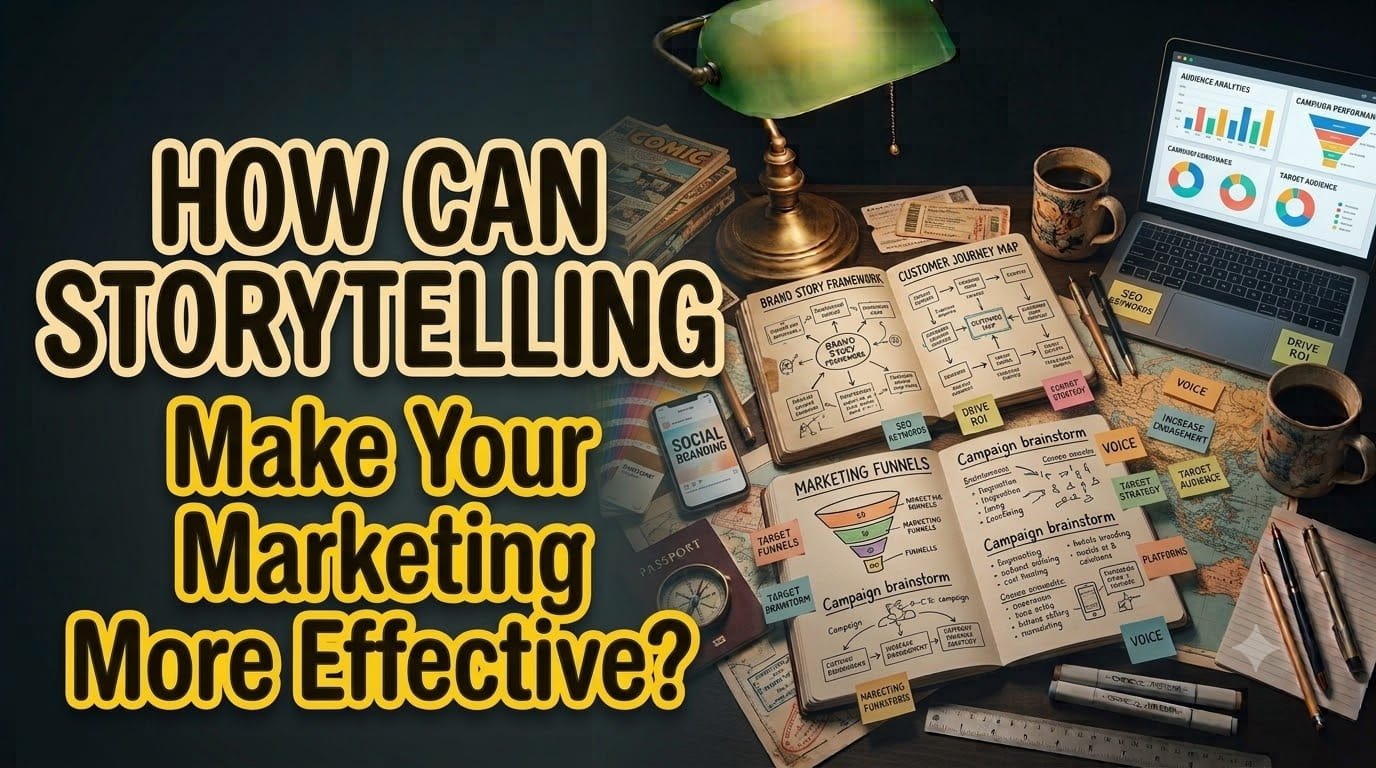
How Can Storytelling Make Your Marketing More Effective?
Good marketing gives people information. Good storytelling gives that information a reason to matter.
A product has features. A customer has a problem, goal, frustration, or aspiration. Storytelling connects the two by showing what changes for the customer.
That makes storytelling useful across social media, advertising, email, websites, content marketing, and brand campaigns.
| Day-One Metric | Beginner Target |
|---|---|
| Hours to Basic Competency | 10–20 hours |
| Minimum Budget | $0 |
| Free Software Prerequisites | Google Docs, Canva Free, social media account |
| Learning Difficulty | 2/5 |
Why Does Storytelling Work in Marketing?
People encounter enormous amounts of promotional content.
A list of product features can be easy to ignore. A relevant story can create curiosity because it gives the audience a situation to understand.
For example, instead of saying:
Our project-management app has automated reminders.
You could show a small team missing deadlines, changing its workflow, and eventually using reminders to keep projects moving.
The product remains the same.
The story explains why the feature matters.
Stories Give Products Context
Features describe what something does.
Stories demonstrate when and why someone would use it.
That distinction is useful for almost any product.
A camera can have excellent low-light performance. A story can show a photographer trying to capture a night event and finally getting the shot.
A course can contain 40 lessons. A story can follow a beginner using those lessons to complete their first project.
Context turns features into benefits.
How Can Storytelling Make Marketing More Memorable?
A memorable marketing story usually has a simple structure:
Situation → Problem → Change → Result
Start with something familiar to your audience.
Then introduce a problem.
Show what the person or business did.
Finally, show the outcome.
The result doesn’t have to be extraordinary.
A small improvement can be more believable and useful than a dramatic transformation.
Use a Customer as the Main Character
Your brand doesn’t always need to be the hero.
In many cases, the customer should be the main character.
For example:
A freelancer keeps losing track of client deadlines.
That’s the starting situation.
Your product becomes part of the solution rather than the entire story.
This changes the marketing message from:
“Look at our amazing product.”
to:
“Here’s a problem you recognize, and here’s how it can be handled.”
That is usually easier for an audience to relate to.
What Makes a Marketing Story Effective?
Focus on four elements.
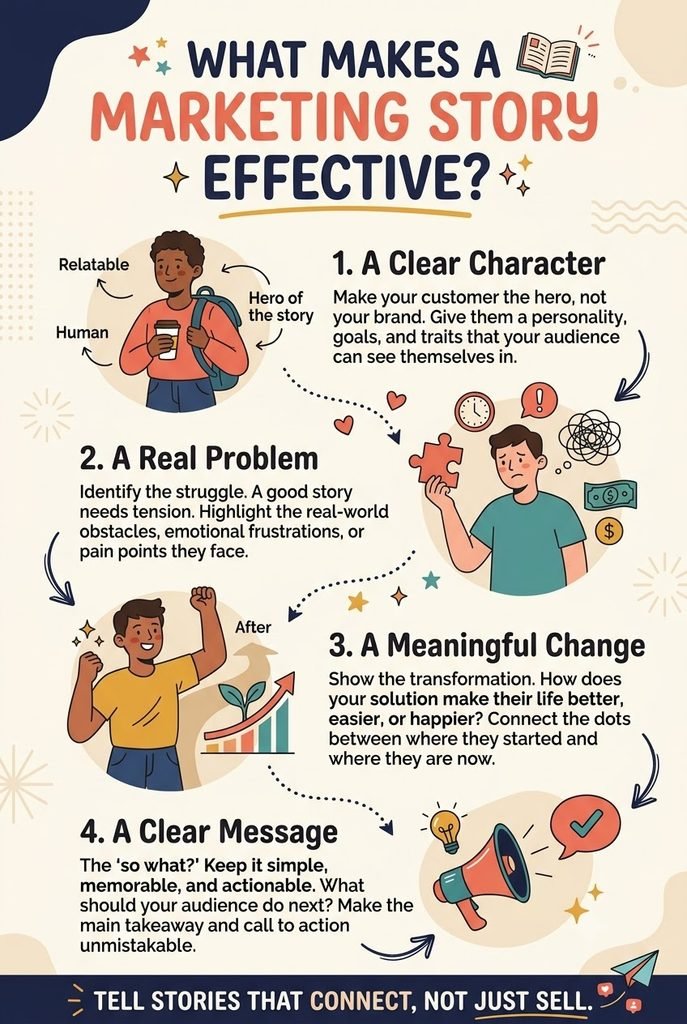
1. A Clear Character
Give the audience someone they can recognize.
It could be:
- A freelancer
- A student
- A small-business owner
- A parent
- A designer
- A marketing manager
- A first-time customer
The person doesn’t need to be famous.
They need a recognizable problem or goal.
2. A Real Problem
The problem gives the story a reason to exist.
Ask:
What was difficult before the product, service, or idea entered the picture?
Be specific.
“Business was difficult” is weak.
“Three hours every Friday were spent manually creating client reports” gives the audience something concrete.
3. A Meaningful Change
Show what changed.
Maybe the customer:
- Saved time
- Reduced confusion
- Completed a project
- Learned a skill
- Reached a new audience
- Avoided a common mistake
- Made a better decision
The change should connect directly to your offer.
4. A Clear Message
Don’t let the story become entertainment with no marketing purpose.
Know what you want the audience to understand.
Your message might be:
This tool saves time.
Or:
This course helps beginners build practical skills.
Or:
This service makes a complicated process easier.
The story should support that message.
The Beginner Friction Factor: Making the Brand the Hero
One common marketing mistake is telling a story entirely about the company.
The founder is brilliant.
The product is revolutionary.
The team works incredibly hard.
The company overcame huge obstacles.
The audience may not care.
A stronger approach is to connect the company’s story to a customer problem.
Ask:
“Why should the audience see themselves in this story?”
If they can recognize their own situation, the marketing becomes more relevant.
How Can Storytelling Build Trust?
Storytelling can make marketing feel more human, but it doesn’t automatically make claims credible.
Your story still needs evidence.
Customer stories should accurately represent the customer’s experience.
Don’t invent testimonials.
Don’t exaggerate results.
Don’t turn a single customer’s outcome into a promise that everyone will get the same result.
Use specific, verifiable details whenever possible.
For example:
“The team reduced its weekly reporting process from three hours to about one hour.”
is more useful than:
“The product completely transformed the business.”
Specificity gives the audience something they can evaluate.
How Can You Use Storytelling on Social Media?
You don’t need a long story for every post.
Try short formats.
The Before-and-After Story
Show the situation before using your product.
Then explain what changed.
The Customer Moment
Share one useful moment from a customer’s experience.
Keep the focus on the problem and outcome.
The Behind-the-Scenes Story
Show how something is made, tested, designed, or delivered.
This can make a brand feel more transparent.
The Mistake Story
Explain something the company got wrong and what changed afterward.
Used honestly, this can be more interesting than another polished promotional post.
How Can Storytelling Improve Content Marketing?
Storytelling can give educational content a stronger structure.
Suppose you’re writing about SEO mistakes.
Instead of presenting ten mistakes immediately, begin with a fictionalized or clearly labeled example of a small business publishing content for months without getting meaningful search traffic.
Then explain what went wrong.
The story becomes the entry point.
The educational information provides the solution.
This approach can work for:
- Blog posts
- Case studies
- Newsletters
- Videos
- Podcasts
- Webinars
- Guides
The important distinction is to label fictional examples clearly.
Don’t present an invented scenario as a real customer story.
How Can You Use Storytelling in Ads?
Advertising has limited space.
That makes simplicity important.
Try this structure:
Problem → Emotional moment → Solution → Action
For example:
You spend Sunday evening organizing next week’s tasks.
By Monday morning, three new requests have already changed the plan.
Here’s a simpler way to manage the workload.
The product appears because the story created a relevant problem.
Don’t force a complicated plot into a 15-second advertisement.
What Should You Avoid?
Storytelling doesn’t fix weak marketing.
Avoid:
- Generic inspirational stories
- Fake customer experiences
- Exaggerated results
- Overly dramatic language
- Stories unrelated to the product
- Long introductions before the useful information
- Emotional manipulation
The audience should understand why you’re telling the story.
Relevance matters more than drama.
What Skills Should You Learn First?
If you want to use storytelling in marketing, develop these skills:
- Audience research
- Story structure
- Customer interviewing
- Copywriting
- Case-study writing
- Content strategy
- Basic analytics
Start with audience research.
You need to understand the customer’s situation before you can tell a useful story about it.
What Courses Can Help?
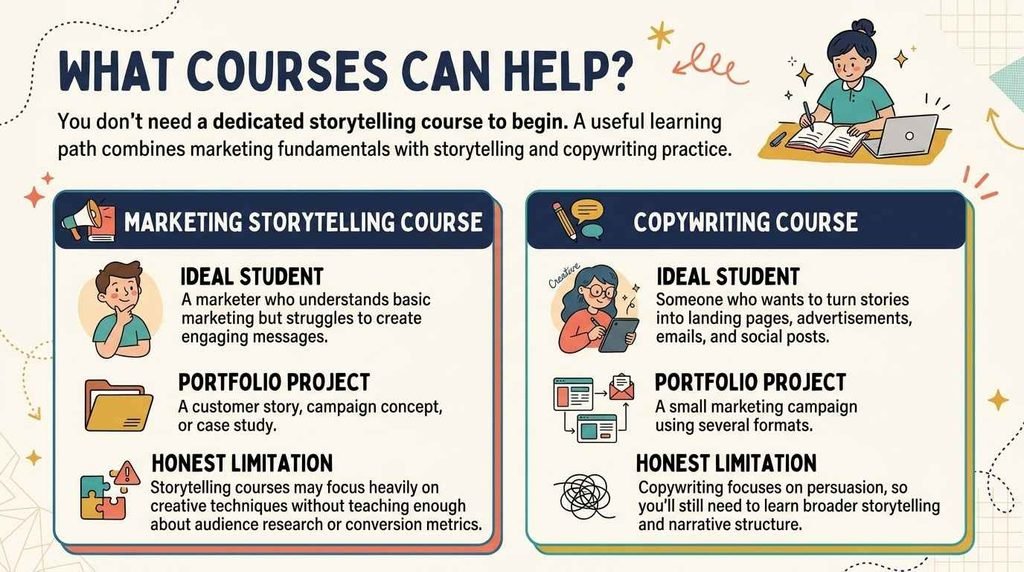
You don’t need a dedicated storytelling course to begin.
A useful learning path combines marketing fundamentals with storytelling and copywriting practice.
Marketing Storytelling Course
Ideal student: A marketer who understands basic marketing but struggles to create engaging messages.
Portfolio project: A customer story, campaign concept, or case study.
Honest limitation: Storytelling courses may focus heavily on creative techniques without teaching enough about audience research or conversion metrics.
Copywriting Course
Ideal student: Someone who wants to turn stories into landing pages, advertisements, emails, and social posts.
Portfolio project: A small marketing campaign using several formats.
Honest limitation: Copywriting focuses on persuasion, so you’ll still need to learn broader storytelling and narrative structure.
Free Practice
Choose five brands you already follow.
Study one recent campaign from each.
Ask:
- Who is the main character?
- What problem appears?
- What changes?
- Where does the product enter?
- What is the final message?
- What action does the audience get?
Then rewrite one campaign for a different audience.
This costs nothing and builds practical skill.
What Should You Learn Next?
Once you understand storytelling in marketing, learn customer research and copywriting.
A useful progression is:
Storytelling → Customer research → Copywriting → Content strategy → Campaign creation → Analytics
This helps you move beyond writing stories that sound good.
You’ll learn how to create stories that serve a specific marketing goal.
Your Day-One Action Plan
You can practice storytelling marketing today.
- Choose one product. Write down one customer problem it solves.
- Create a simple customer story. Use the structure: situation → problem → change → result.
- Turn it into three formats. Write a 100-word social post, a short email, and a one-paragraph website section.
Then remove every sentence that doesn’t help the audience understand the problem, solution, or outcome.
The goal isn’t to make marketing sound like a movie.
It’s to make the audience think:
“That sounds like my problem.”
That’s where storytelling becomes useful marketing.