Want Your Own AI Marketing Assistant? Here’s What It Can Do
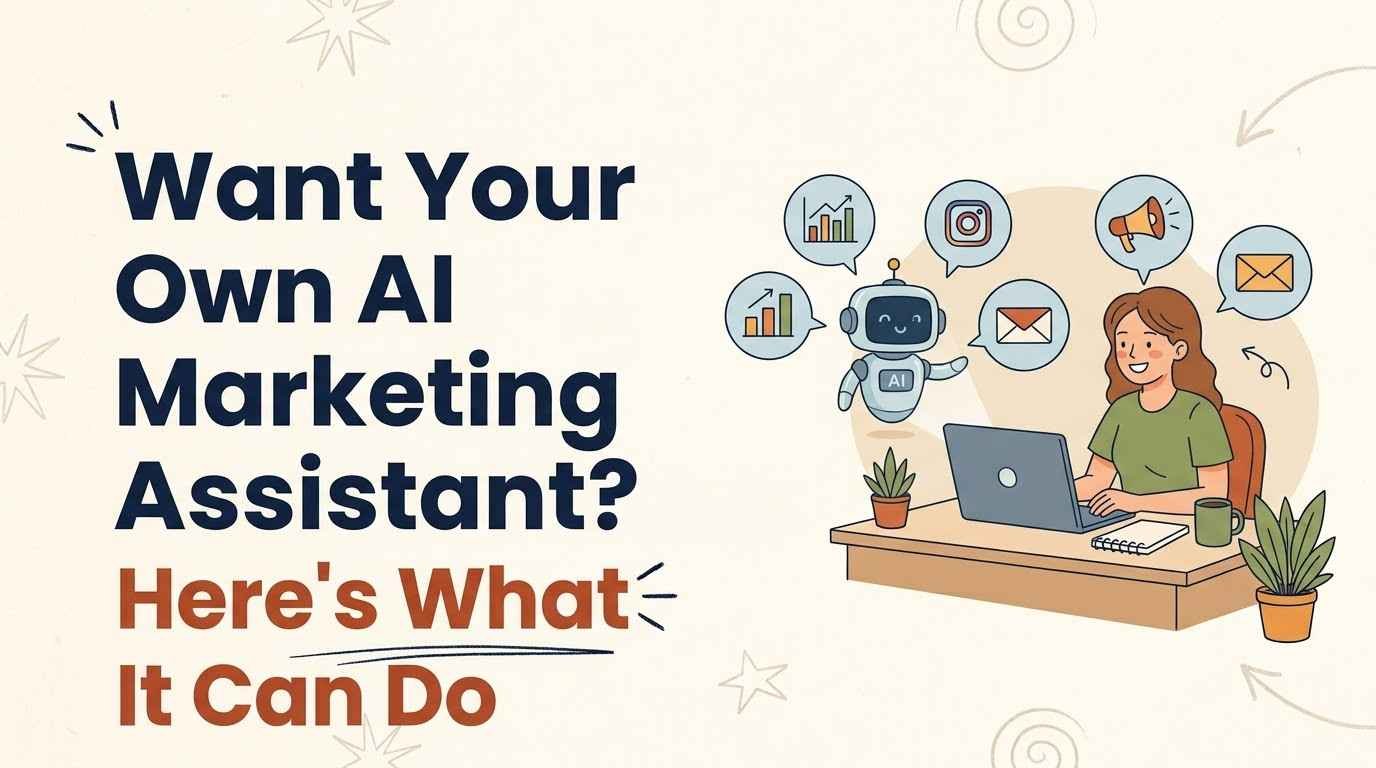
An AI marketing assistant can take over many repetitive marketing tasks without replacing the person making the important decisions. It can help brainstorm content, organize ideas, draft copy, repurpose existing material, and analyze information.
For beginners, the real value is not having AI do everything. It is having a reliable assistant that helps you move from blank page to useful first draft faster.
| Day-One Metric | Beginner Estimate |
|---|---|
| Hours to Basic Competency | 3–5 hours |
| Minimum Budget | $0 with a free AI tool |
| Learning Difficulty | 2/5 |
| Best First Project | Build a one-week AI-assisted marketing workflow |
What Is an AI Marketing Assistant?
An AI marketing assistant is software that uses AI to support marketing tasks.
Think of it as a digital helper, not an autonomous marketing department.
Depending on how you use it, an AI assistant can help with:
- Content ideas
- Blog outlines
- Social media posts
- Email drafts
- Customer research
- Content calendars
- Competitor analysis
- Content repurposing
- Basic data analysis
- Campaign brainstorming
The exact capabilities depend on the AI tool and the information you provide.
The best results usually come when you give the assistant specific context and clear instructions.
What Can an AI Marketing Assistant Actually Do?
1. Generate Marketing Ideas
You can use AI when you are stuck for ideas.
Give it your audience, industry, product, and marketing goal. Then ask it to suggest potential topics.
For example:
“Give me 20 content ideas for a small online business targeting beginners. Focus on problems customers have before they buy.”
You can then group the results into useful categories.
Do not treat the first list as your strategy. Select ideas based on real customer needs.
2. Create Content Briefs
A good content brief can save significant writing time.
Your AI assistant can organize:
- Target audience
- Search intent
- Main topic
- Supporting questions
- Key points
- Suggested structure
- Call to action
This gives you a clearer starting point.
It also makes it easier to keep multiple pieces of content consistent.
3. Draft Social Media Content
An AI marketing assistant can create several versions of a social media post.
You could request:
- A short caption
- A longer educational post
- Several opening hooks
- A question designed to encourage discussion
- A promotional variation
This makes testing different approaches easier.
The final version should still sound like your brand, not like generic AI copy.
How Can an AI Marketing Assistant Help With Content Marketing?
Content creation is only one part of marketing.
AI can also support the planning process around it.
Audience Research
You can provide customer questions, reviews, survey responses, or other notes and ask AI to identify recurring themes.
For example, it might organize questions into categories such as:
Pricing → Features → Problems → Comparisons → Buying concerns
Those categories can then inform your content strategy.
AI can help organize the information quickly, but you should still verify whether the patterns reflect your actual customers.
Content Repurposing
Your assistant can help turn one substantial piece of content into smaller assets.
A blog article could become:
- Three social media posts
- A short email
- A video outline
- A carousel concept
- Several FAQ answers
This reduces repetitive work.
The important part is adapting each version to its specific format and audience.
Marketing Calendar Planning
An AI assistant can also help create a basic content calendar.
Give it your content themes, publishing frequency, audience, and marketing goals.
It can then suggest a sequence of topics.
You should review the calendar before using it. A full schedule is not useful if the topics do not support your actual business objectives.
Can an AI Marketing Assistant Help With SEO?
Yes, it can support parts of an SEO workflow.
For example, AI can help you:
- Brainstorm related topics
- Organize article structures
- Generate FAQ ideas
- Improve headings
- Identify repetitive writing
- Suggest internal linking opportunities
- Turn research notes into content briefs
But AI should not be treated as a substitute for understanding search intent and useful content.
A page filled with keywords is not automatically good SEO.
The goal should be to answer the searcher’s question better.
Can It Help With Email Marketing?
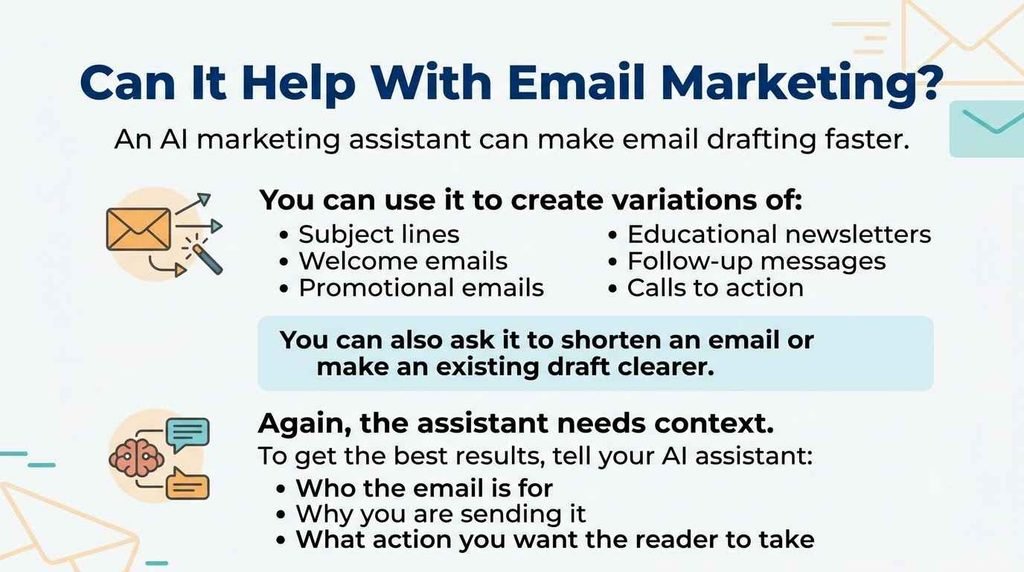
An AI marketing assistant can make email drafting faster.
You can use it to create variations of:
- Subject lines
- Welcome emails
- Promotional emails
- Educational newsletters
- Follow-up messages
- Calls to action
You can also ask it to shorten an email or make an existing draft clearer.
Again, the assistant needs context.
Tell it who the email is for, why you are sending it, and what action you want the reader to take.
The Beginner Friction Factor: Giving AI Too Little Context
One common technical and conceptual mistake is using vague prompts.
For example:
“Make me a marketing plan.”
The request leaves too many important questions unanswered.
A better instruction identifies:
- Business type
- Target customer
- Product or service
- Marketing objective
- Main channel
- Budget constraints
- Time available
- Desired outcome
You can then ask AI to create a first version.
Specific inputs generally produce more useful outputs.
If the result is poor, improve the brief before assuming the AI tool is the problem.
What Should You Never Hand Over Completely?
An AI marketing assistant can save time. It should not make every marketing decision for you.
Keep human control over:
Brand Positioning
Your business needs a clear reason for customers to choose it.
AI can suggest positioning ideas, but you need to decide what is actually true.
Customer Relationships
Automated responses can be useful for simple questions.
Sensitive complaints, unusual requests, and meaningful conversations deserve human attention.
Final Fact-Checking
AI can generate incorrect information with confidence.
Check important statistics, product claims, prices, regulations, and other factual information before publishing.
Strategic Decisions
AI can present options.
You decide which option fits your customers and business.
What Skills Should You Learn Alongside an AI Marketing Assistant?
AI works best when you understand the marketing problems you are asking it to solve.
Start with these foundations:
- Audience research
- Content marketing
- Basic SEO
- Copywriting
- Social media strategy
- Marketing analytics
Then learn how AI can support each area.
This creates a stronger skill progression than simply collecting prompt templates.
Which Platforms Can Help You Learn Marketing?
The SkillAdvisor framework recommends matching learning platforms to their strengths rather than assuming one platform works for every learner.
| Platform | Best Fit | Important Consideration |
|---|---|---|
| Udemy | Specific, practical marketing workflows | Wait for frequent discount sales instead of paying full price |
| Skillshare | Creative execution and short marketing workflows | Subscription works best if you take multiple classes |
| Coursera / edX | Broader marketing concepts and structured learning | Many courses can be audited free; certificates may cost extra |
The supplied materials do not provide specific current course titles for AI marketing assistants. We therefore would not invent course recommendations or claim that one particular course is best.
Instead, look for a course that makes you build something practical, such as a campaign plan, content calendar, customer research report, or marketing workflow.
What Should You Learn Next?
Once you are comfortable using an AI marketing assistant for basic tasks, learn marketing analytics.
Creating content is only half the process.
You need to know what happens afterward.
Learn to connect:
Audience → Content → Engagement → Conversion → Business outcome
That feedback can then improve your next AI-assisted content plan.
The long-term goal is a repeatable system where AI helps with execution while you continuously improve the strategy.
Your Day-One Action Plan
You can build your first simple AI marketing workflow in less than an hour.
- Choose one marketing task. Start with content ideas, captions, or a weekly calendar.
- Create a detailed AI brief. Include your audience, business, goal, platform, and tone.
- Review and improve the output. Fact-check it, remove generic suggestions, and add real business context.
An AI marketing assistant can become a useful part of your everyday workflow. It can help you move faster, generate options, organize information, and reduce repetitive work.
But the strongest results come from combining AI with marketing knowledge, customer understanding, editing, and strategic judgment.
You do not need to automate your entire marketing operation. Start with one task, learn what AI does well, and expand from there.
Your next step: choose the most repetitive marketing task you handle each week and use AI to build a first version of the workflow.