AI vs Human Content: Which Parts Should You Actually Automate?
AI can make content production faster, but faster does not always mean better. The smartest approach is to automate repetitive tasks while keeping strategy, originality, accuracy, and final judgment with a human.
For beginners, the question is not whether AI or humans should create content. It is which parts of the workflow each should handle.
| Day-One Metric | Beginner Estimate |
|---|---|
| Hours to Basic Competency | 3–5 hours |
| Minimum Budget | $0 with free AI tools |
| Learning Difficulty | 2/5 |
| Best First Project | Build one AI-assisted content workflow |
AI vs Human Content: What Should AI Handle?
AI is strongest when a task is repetitive, structured, and easy to review.
These are good candidates for automation or AI assistance.
1. Brainstorming Content Ideas
AI can generate many possible topics quickly.
Give it your audience, subject, content goals, and constraints. It can then produce potential:
- Blog topics
- Social posts
- Video ideas
- Newsletter themes
- FAQs
- Content angles
You still need to choose which ideas are relevant.
AI creates the options. You decide which ones deserve attention.
2. Creating First Drafts
AI can produce a rough first draft from a detailed brief.
This can help when the biggest obstacle is starting from a blank page.
The draft can then be rewritten with your own examples, experience, and perspective.
For many businesses, this is more useful than asking AI to create a finished article with no human editing.
3. Repurposing Existing Content
Repurposing is another strong use case.
A long article could become:
- Social media posts
- Email content
- Video outlines
- Carousel ideas
- FAQ responses
AI can quickly transform the material into different formats.
A human should still make sure each version fits its platform and audience.
4. Formatting and Editing
AI can identify:
- Repetitive sentences
- Long paragraphs
- Weak headings
- Awkward phrasing
- Grammar problems
- Structural gaps
These tasks are relatively easy to review.
That makes them good candidates for AI assistance.
Which Content Tasks Should Stay Human?
Some parts of content creation depend heavily on judgment.
These are harder to automate reliably.
Content Strategy
Someone needs to decide why the content exists.
Is the goal to attract search traffic, educate customers, generate leads, build trust, or support an existing campaign?
AI can suggest strategies.
The business still needs to choose the strategy.
Original Insights
AI can reorganize existing information.
Your strongest content may come from things AI does not know about your business:
- Customer conversations
- Internal data
- Personal experience
- Original research
- Product knowledge
- Lessons from mistakes
These details make content more useful.
Brand Voice
AI can imitate a writing style when given examples.
But your brand should not become dependent on generic AI phrasing.
A human needs to decide what the brand should sound like and what it should never sound like.
Final Editing
Every important piece of content should receive human review.
Check the facts.
Remove unnecessary sections.
Add specific examples.
Make sure the content actually helps the intended reader.
The final quality check should not be automated blindly.

AI vs Human Content: Where Is the Best Middle Ground?
You do not have to choose between full automation and completely manual content creation.
A hybrid workflow is often more practical.
For example:
Human → Define goal → AI → Generate options → Human → Select and improve → AI → Repurpose → Human → Final review
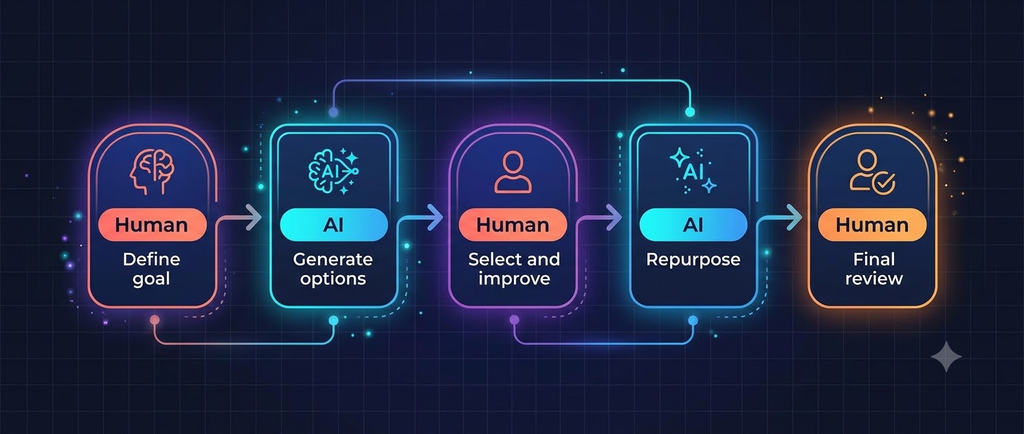
This approach uses AI where it saves time while protecting the parts of content that require judgment.
A Simple Automation Matrix
| Content Task | AI Role | Human Role | Automation Level |
|---|---|---|---|
| Topic brainstorming | Generate options | Select useful ideas | High |
| Outlining | Build structure | Add expertise | High |
| First drafts | Produce rough copy | Rewrite and fact-check | Medium |
| Repurposing | Adapt formats | Check platform fit | High |
| Grammar editing | Identify problems | Approve changes | High |
| Brand strategy | Suggest directions | Make decisions | Low |
| Original research | Organize information | Conduct and verify | Low |
| Customer stories | Help structure | Provide real details | Low |
| Final publishing | Assist workflow | Approve content | Low |
The rule is simple:
Automate the predictable. Protect the valuable.
The Beginner Friction Factor: Automating the Wrong Task
A common conceptual mistake is automating a task simply because AI can perform it.
That is the wrong test.
Ask two questions:
- How repetitive is this task?
- How costly is an error?
A repetitive task with low consequences is a strong automation candidate.
A task involving brand reputation, customer trust, or important factual claims deserves more human oversight.
For example, automatically formatting a draft is relatively low risk.
Automatically publishing unverified claims is not.
This simple distinction can prevent many content problems.
What Happens When You Automate Too Much?
Over-automation can create several problems.
Generic Content
If every brand uses AI to produce similar topics and wording, content becomes harder to distinguish.
Factual Errors
AI-generated information can sound convincing even when it is incorrect.
Weak Brand Voice
Content may become technically polished but lose the personality that makes a business recognizable.
Less Original Thinking
If marketers ask AI for every idea, they may stop bringing their own observations and experiences into the process.
AI should increase your capacity to think, not replace the thinking.
How Can You Decide What to Automate?
Use a simple four-question test.
Is the Task Repetitive?
If you perform it constantly, AI may save meaningful time.
Is There a Clear Desired Output?
Structured tasks are easier to automate.
Can Someone Easily Review the Result?
If errors are easy to spot, AI assistance is safer.
What Happens If It Gets It Wrong?
The higher the consequence, the more human oversight you should maintain.
This gives you a practical way to evaluate almost any content task.
What Skills Should You Build Alongside AI?
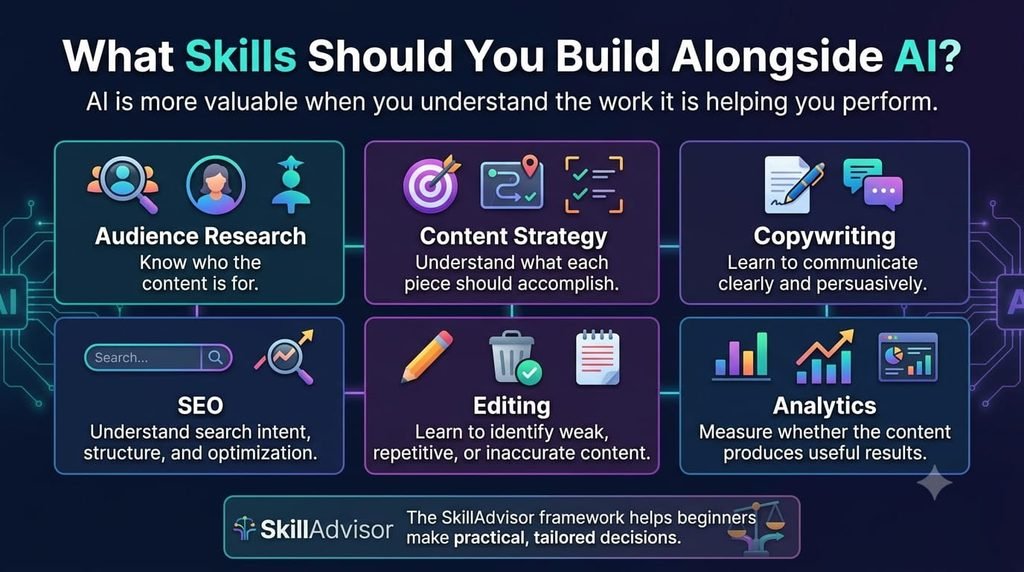
AI becomes more valuable when you understand the work it is helping you perform.
Focus on:
Audience Research
Know who the content is for.
Content Strategy
Understand what each piece should accomplish.
Copywriting
Learn how to communicate clearly and persuasively.
SEO
Understand search intent, content structure, and basic optimization.
Editing
Learn to identify weak, repetitive, inaccurate, or unnecessary content.
Analytics
Measure whether the content actually produces useful results.
The SkillAdvisor framework is designed around helping beginners make practical decisions without treating one course or tool as universally best.
Which Learning Platforms Can Help?
The supplied SkillAdvisor configuration recommends different platforms for different learning needs.
| Platform | Best Fit | Important Note |
|---|---|---|
| Udemy | Specific, practical workflows | Wait for frequent discount sales |
| Skillshare | Creative execution and short workflows | Subscription is most useful if taking several classes |
| Coursera / edX | Structured concepts and deeper theory | Many courses can be audited free; certificates may cost extra |
| LinkedIn Learning | Professional business workflows | Check for free employer or library access |
The supplied files do not identify specific current courses for AI-assisted content creation. We therefore would not invent course titles or claim that a particular course is the best option.
Look for courses that require a real project, such as a content strategy, editorial calendar, campaign, or AI-assisted workflow.
What Should You Learn Next?
Once you understand where AI fits into content production, learn content analytics.
The purpose of automation is not simply to produce more.
It is to create better results with less wasted effort.
Track:
- Content engagement
- Search performance
- Leads
- Conversions
- Audience response
- Time saved
Then use those results to decide which tasks deserve more automation.
This creates a continuous improvement loop:
Create → Measure → Learn → Improve → Automate
Your Day-One Action Plan
You can identify your first automation opportunity today.
- List five content tasks you repeat every week.
- Rate each task by repetition and risk. Start with repetitive tasks that are easy to review.
- Automate one low-risk task. Review the result carefully before expanding the workflow.

The AI vs human content debate is less useful than it sounds. You do not need to pick one side.
AI is good at speed, repetition, variations, organization, and first drafts. Humans are better positioned to provide strategy, originality, context, judgment, and accountability.
The best content workflow combines both.
Your next step: identify one repetitive content task you perform every week and test whether AI can handle the first draft while you keep final control.