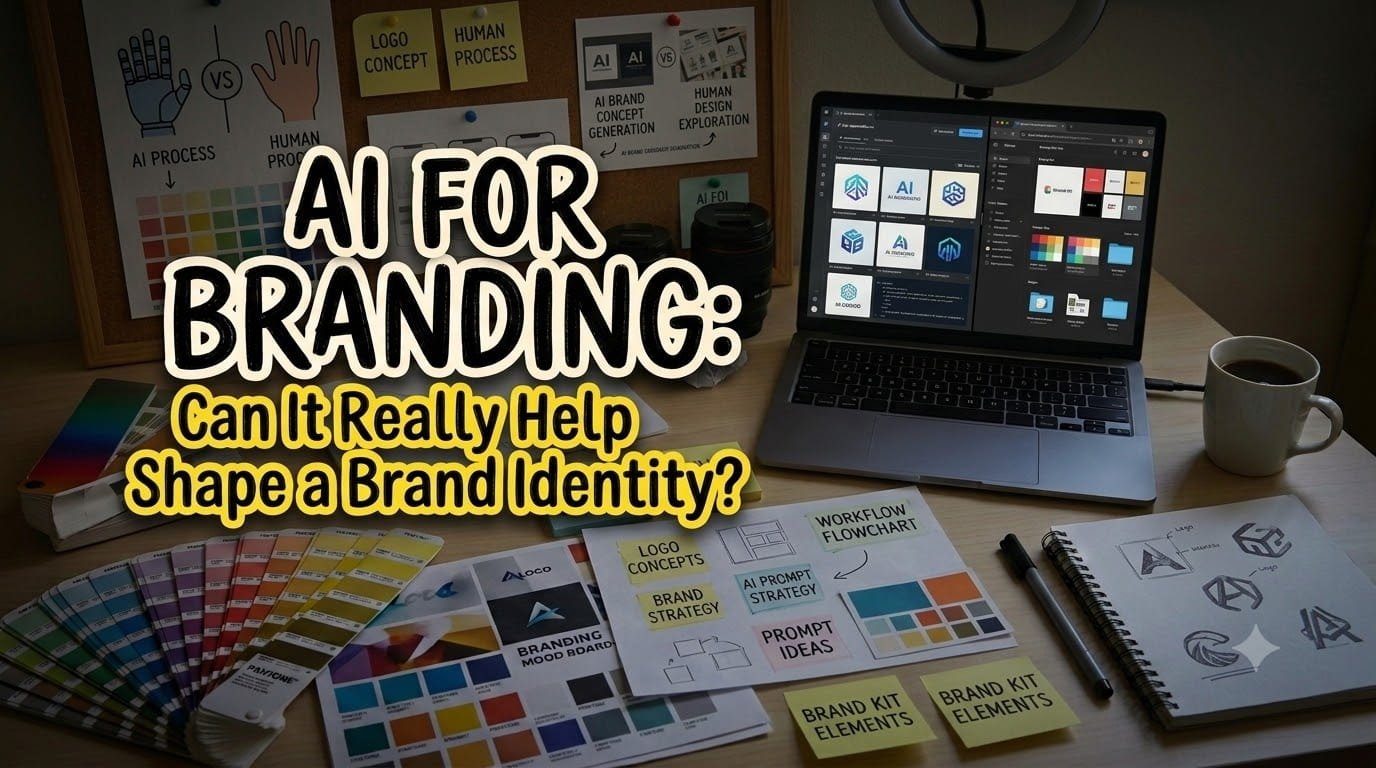
AI for Branding: Can It Really Help Shape a Brand Identity?
AI can help with branding, but it cannot decide what your brand should mean. It can generate ideas, organize research, explore visual directions, and help turn scattered thoughts into a clearer brand system.
That makes AI useful for the early and repetitive parts of branding. The final decisions still need human judgment because a brand identity has to reflect a real business, audience, and point of view.
| Day-One Metric | Beginner Estimate |
|---|---|
| Hours to Basic Competency | 3–5 hours |
| Minimum Budget | $0 with free AI tools |
| Learning Difficulty | 2/5 |
| Best First Project | Create a basic brand positioning and identity brief |

How Can AI Help With Branding?
AI accelerates the branding process by serving as a powerful tool for research, brainstorming, organization, and variation. It allows you to explore vast creative possibilities before committing to a final strategic direction.
- Market & Audience Research: AI can swiftly analyze customer sentiment, synthesize competitor strategies, and summarize industry trends to help you identify untapped market opportunities.
- Rapid Brainstorming: When you need fresh inspiration, AI can instantly generate diverse naming conventions, creative taglines, and evocative semantic concepts to break through mental blocks.
- Dynamic Variation: Once you establish a core direction, AI easily adapts your messaging across multiple formats, ensuring your brand voice scales efficiently for different channels.
By handling the heavy lifting of data synthesis and initial ideation, AI frees up human creators to focus on authentic strategy and final emotional resonance.
1. Define Your Target Audience
A clear brand starts with knowing who you are trying to reach.
AI can help organize audience information into potential groups based on details you provide.
For example, you could give it customer notes and ask it to identify recurring:
- Problems
- Needs
- Preferences
- Objections
- Buying motivations
- Questions
This can help turn unstructured information into a starting point for brand research.
But AI should not invent your audience.
Real customer research should remain the foundation.
2. Explore Brand Positioning
Positioning answers a basic question:
Why should someone choose this brand instead of another option?
AI can help you brainstorm different positioning statements based on your actual product, audience, and competitors.
You might ask for several directions, such as:
- Affordable and accessible
- Premium and specialized
- Beginner-friendly
- Fast and convenient
- Expert-led
- Community-focused
These are starting points, not final decisions.
You need to determine which positioning is credible and genuinely different.
3. Develop Brand Messaging
AI can turn a positioning idea into different messaging formats.
It can help draft:
- Taglines
- Brand descriptions
- Value propositions
- Website headlines
- Social media bios
- Product descriptions
- Elevator pitches
This is useful when you know what your business does but struggle to explain it clearly.
However, avoid choosing a tagline simply because it sounds clever.
A strong message should communicate something meaningful and believable.
Can AI Help Create a Visual Brand Identity?
Yes, AI can help explore visual directions.
It can generate ideas around:
- Color palettes
- Typography combinations
- Photography styles
- Illustration directions
- Layout approaches
- Mood boards
- Visual references
Image-generation tools can also help you visualize different creative directions before working with a designer.
That can make early exploration faster.
But there is an important distinction between exploring an identity and building a professional identity system.
A brand needs consistency across its actual touchpoints.

How Can AI Help Build Brand Guidelines?
Once you have made the major decisions, AI can help organize them.
For example, you could provide your chosen brand elements and ask AI to structure a basic guideline document covering:
- Brand positioning
- Target audience
- Brand personality
- Tone of voice
- Messaging principles
- Color usage
- Visual direction
- Content examples
This can make a growing brand easier to manage.
But the AI should be working from approved decisions, not inventing the rules itself.
The Beginner Friction Factor: Too Many Brand Options
Using AI for branding often introduces a major beginner hurdle: choice overload.
When you ask an AI tool for 50 names, 30 taglines, 20 color palettes, and 15 brand personalities, you end up with an overwhelming flood of possibilities. More options do not automatically create a stronger brand. Instead of clarifying your vision, this sudden abundance creates friction and decision paralysis.
To bypass this hurdle, define your strict criteria first. For example, decide beforehand that your brand must feel approachable, knowledgeable, practical, and modern.
Once your guardrails are set, use AI intentionally to generate a much smaller, highly targeted selection of options that fit those exact criteria. Finally, ruthlessly reject anything that feels generic or disconnected from your business.
Control the tool, or its infinite output will dilute your brand.
Can AI Create a Brand Name?
AI can generate potential names quickly.
That can be useful during brainstorming.
But a generated name is not automatically available for use.
Before choosing one, you need to check practical issues such as:
- Existing businesses
- Domain availability
- Social handles
- Trademark considerations
- Pronunciation
- Spelling
- Cultural meaning
Never assume an AI-generated name is legally or commercially available.
AI can help with the creative shortlist. The verification process requires real-world checks.
Can AI Create a Logo?
AI tools can produce logo concepts, but a logo is only one part of brand identity.
A usable identity also needs to work across different sizes and applications.
Think about:
- Websites
- Social profiles
- Packaging
- Documents
- Advertising
- Mobile screens
- Print materials
AI-generated concepts can help communicate an initial direction to a designer.
For a serious business, professional refinement may still be worthwhile.
What Should AI Not Decide for Your Brand?
While Artificial Intelligence accelerates content creation, core brand strategy requires human conviction. AI can process data and suggest possibilities, but critical decisions must remain firmly human-led to maintain authenticity.
- Brand Purpose: AI excels at refining copy, but it cannot manufacture soul. It can help articulate your purpose, but it cannot determine what your business genuinely believes or stands for.
- Brand Personality: A simple prompt can easily produce generic descriptors like “friendly” or “professional.” However, algorithms cannot live out these values. Your customers must experience those traits consistently through genuine human interactions.
- Differentiation: AI can instantly generate dozens of standard positioning statements based on historical data. Yet, true competitive advantage must stem from unique organizational capabilities that your business can actually deliver in the real world.
- Final Creative Direction: The strongest brand identity is rarely the one that looks most impressive on a synthetic, AI-generated mood board. It is the nuanced, strategic choice that perfectly fits your specific business, audience, product, and market.
Ultimately, AI is a powerful co-pilot, but humans must remain the authors of the brand’s truth.
AI Branding vs Traditional Branding
AI does not need to replace the traditional branding process.
It can fit inside it.
| Branding Task | AI Can Help With | Human Role |
|---|---|---|
| Audience research | Organize themes and questions | Validate against real customers |
| Positioning | Generate possible directions | Choose a credible position |
| Naming | Brainstorm options | Check availability and fit |
| Messaging | Draft variations | Establish the authentic voice |
| Visual direction | Explore concepts | Approve and refine the identity |
| Brand guidelines | Organize approved decisions | Set the actual rules |
| Brand strategy | Generate questions and options | Make the strategic decisions |
This is the practical middle ground.
AI increases the number of possibilities you can explore. Human judgment determines which possibilities are worth keeping.
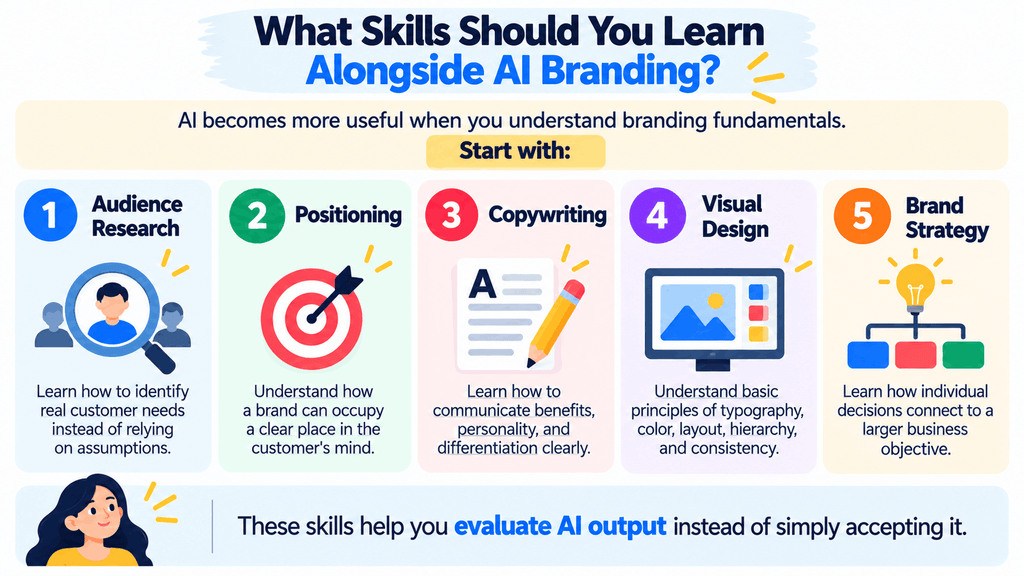
What Skills Should You Learn Alongside AI Branding?
AI becomes more useful when you understand branding fundamentals.
Start with:
Audience Research
Learn how to identify real customer needs instead of relying on assumptions.
Positioning
Understand how a brand can occupy a clear place in the customer’s mind.
Copywriting
Learn how to communicate benefits, personality, and differentiation clearly.
Visual Design
Understand basic principles of typography, color, layout, hierarchy, and consistency.
Brand Strategy
Learn how individual decisions connect to a larger business objective.
These skills help you evaluate AI output instead of simply accepting it.
Which Learning Platforms Can Help?
The supplied SkillAdvisor framework recommends matching platforms to their natural strengths.
| Platform | Best Fit | Pricing Consideration |
|---|---|---|
| Udemy | Specific, practical branding and design workflows | Wait for frequent discount sales |
| Skillshare | Creative execution and visual design practice | Subscription works best if you take several classes |
| Coursera / edX | Deeper concepts and structured learning | Many courses can be audited for free; certificates may cost extra |
The supplied materials do not identify specific current branding courses. We therefore would not invent course names or claim that one particular course is currently the best choice.
Look for practical courses that make you create something tangible, such as a brand strategy, mood board, messaging framework, or identity project.
What Should You Learn Next?
Once you understand how AI can support branding, learn content strategy.
A brand identity only becomes useful when it appears consistently in customer-facing content.
The progression looks like this:
Audience research → Positioning → Brand identity → Content strategy → Consistent execution
Your next skill should help you turn the brand into something customers actually experience.
That might include social media content, website copy, email marketing, packaging, or advertising.

Your Day-One Action Plan
You can test AI for branding without building an entire identity.
- Write down your ideal customer and what you want them to associate with your business.
- Ask AI for three positioning directions based only on information you provide.
- Choose one direction and turn it into a basic brand brief. Add your own judgment and remove anything generic.
AI can help shape a brand identity, especially during research, brainstorming, messaging, and visual exploration.
But it cannot manufacture authenticity or strategic differentiation.
Use AI to explore possibilities faster. Then apply human judgment, customer knowledge, and real-world validation before turning those ideas into a brand.
Your next step: write three words that should describe your brand, then use AI to explore how those traits could influence your positioning, messaging, and visual direction.