Choosing a Brand Name: What Makes One Stick?
A strong brand name does more than sound clever. It helps people remember you, understand your offer, and talk about your business later.
The problem is that naming often becomes personal. Founders fall in love with a word before checking whether customers can pronounce it, remember it, or connect it with the business.
We recommend treating a brand name as a practical business decision. Creativity matters, but clarity, distinctiveness, usability, and audience fit matter just as much.
| Day-One Metric | Beginner Target |
|---|---|
| Hours to Basic Competency | 2–4 hours |
| Minimum Budget Required | $0 to $30 |
| Learning Difficulty | 2/5 |
| Useful Free Tools | Google Docs, spreadsheets, search engines |

What Makes a Brand Name Memorable?
A memorable brand name usually has a few practical qualities. It does not need every quality to be perfect, but weaknesses should be deliberate rather than accidental.
1. It Is Easy to Say
People should be able to pronounce your name after seeing it once or twice.
This matters because spoken recommendations can drive discovery. If customers constantly ask how to pronounce your name, you have created unnecessary friction.
Try saying the name aloud. Then ask someone unfamiliar with the business to repeat it.
If they struggle, reconsider it.
2. It Is Easy to Remember
A complicated spelling can make a name harder to recall.
Short names can help, but length alone does not determine memorability. A distinctive word can stick better than a generic two-word phrase.
Ask yourself:
- Can someone remember it tomorrow?
- Can they spell it after hearing it?
- Could they recognize it among competitors?
- Does it create a useful mental association?
3. It Fits the Business
A brand name should match the impression you want customers to have.
A playful name may work for a children’s product. A financial service may need something more reassuring and professional.
The goal is not to describe everything you sell. The goal is to create an appropriate starting point for the customer’s perception.
4. It Has Room to Grow
Avoid names that trap the company inside one product, location, or trend.
For example, a business called “Bhubaneswar Cakes” may face problems if it expands nationally or starts selling other foods.
A broader name can give the business more room to change.
How to Choose a Brand Name Step by Step
Choosing a brand name becomes easier when you separate creativity from evaluation.
Step 1: Define Your Naming Brief
Before brainstorming, write down five things:
- Who is the target customer?
- What does the business sell?
- What personality should the brand have?
- Which competitors matter?
- Where could the business expand later?
This prevents random brainstorming.
Step 2: Generate a Large List
Aim for 30–50 potential names before judging them.
Use different naming directions:
- Real words
- Combined words
- Invented words
- Metaphorical names
- Names based on a benefit
- Names based on an emotion
- Names based on the audience
Do not evaluate every idea immediately. Early criticism can kill useful concepts before they develop.
Step 3: Create a Shortlist
Reduce your list to around five to ten candidates.
Now score each brand name against the same criteria.
A simple scoring system can use 1–5 points for:
| Criterion | Question |
|---|---|
| Memorability | Will people remember it? |
| Pronunciation | Can people say it easily? |
| Distinctiveness | Does it stand apart from competitors? |
| Relevance | Does it fit the intended positioning? |
| Flexibility | Can the business grow around it? |
| Usability | Can customers search and type it easily? |
The highest score is not automatically the winner. Use the scores to identify weaknesses that need discussion.
The Beginner Friction Factor: Falling in Love With One Name Too Early
One of the most common naming problems is analysis paralysis.
A founder finds one name they personally love. Every later idea gets compared against it.
That creates a biased process.
Instead, keep your top five names alive until the final evaluation. Ask potential customers what each name makes them expect, rather than asking which one they personally prefer.
You are testing perception, not collecting compliments.
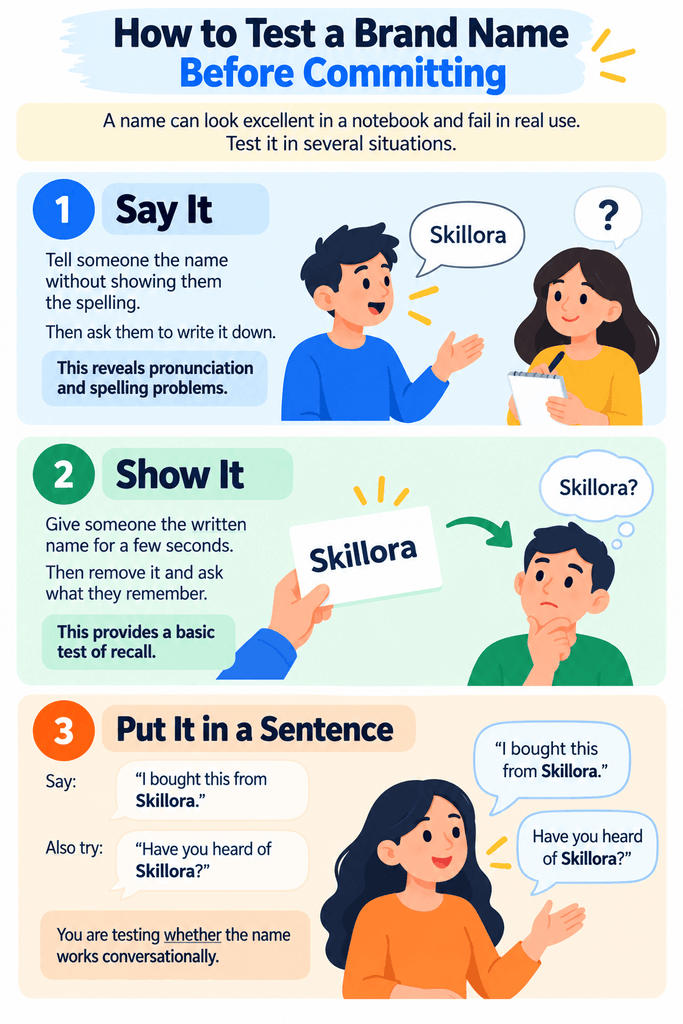
How to Test a Brand Name Before Committing
A name can look excellent in a notebook and fail in real use.
Test it in several situations.
Say It
Tell someone the name without showing them the spelling.
Then ask them to write it down.
This reveals pronunciation and spelling problems.
Show It
Give someone the written name for a few seconds.
Then remove it and ask what they remember.
This provides a basic test of recall.
Put It in a Sentence
Say:
“I bought this from [brand name].”
Does it sound natural?
Also try:
“Have you heard of [brand name]?”
You are testing whether the name works conversationally.
Check the Practical Constraints
Before committing, investigate:
- Domain availability
- Social handle availability
- Existing businesses with similar names
- Trademark conflicts
- Search-result confusion
- Unwanted meanings in relevant languages
Do not treat an available domain as proof that the name is legally safe. For serious businesses, professional legal advice may be worthwhile.

Courses and Resources for Learning Brand Naming
You do not need an expensive branding program to learn the fundamentals. Start with free material, then pay for structured instruction if you need more guidance.
Brand Management and Brand Strategy — Coursera
Portfolio project: A basic brand strategy and naming framework.
Ideal student: Beginners who want direct instruction on brand naming and brand identity.
Why we selected it: The course specifically covers brand naming principles, memorable brand identities, positioning, and brand associations. Its modules also include the process of selecting a brand name.
Honest limitation: It is broader than naming alone. You will spend time on general brand management concepts.
Coursera currently lists the course as available to enroll for free, with paid options for additional access or credentials depending on the learner’s plan.
Brand and Product Management — Coursera
Portfolio project: A brand and product strategy covering naming, positioning, architecture, and customer experience.
Ideal student: Beginners who want to understand how a name fits into a larger business strategy.
Why we selected it: Its curriculum includes brand identity, brand architecture, naming, competitor analysis, and customer experience.
Honest limitation: It is not a pure creative naming workshop. Product strategy receives substantial attention.
Brand Management: Aligning Business, Brand and Behaviour — Coursera
Portfolio project: A broader brand-management analysis connected to customer experience and organizational behavior.
Ideal student: Learners who want to move beyond naming into professional brand strategy.
Why we selected it: The course is beginner-level and connects branding with customer experience, brand strategy, and organizational behavior.
Honest limitation: It is more strategic than creative. Choose another option if your immediate goal is generating dozens of name ideas.
Free alternative: You can also learn by studying real brands. Pick ten businesses and analyze their names, positioning, audience, pronunciation, and flexibility. This costs nothing and gives you practical naming examples.
What to Learn After Choosing a Brand Name
A brand name is only one part of the identity.
Your next skill should be brand positioning.
Positioning answers a different question:
Why should this audience choose you instead of another option?
Once that is clear, move into:
- Brand voice
- Visual identity
- Logo and typography
- Messaging
- Customer experience
- Content and social media
This sequence prevents a common mistake. Businesses often design a logo before deciding what the brand should actually communicate.
The name should support the strategy. The strategy should guide the visual identity.

Your Day-One Action Plan
You can make real progress on your brand name within the next hour.
- Write your naming brief.
Define your customer, offer, personality, competitors, and future direction. - Generate 30 names.
Spend 20 minutes creating ideas without judging them. Then shortlist your best five. - Run the five-name test.
Score each name for memorability, pronunciation, distinctiveness, relevance, flexibility, and practical usability.
Do not choose the name simply because it sounds clever.
Choose the one that works for the people you want to reach.