How to Build a Personal Brand From Scratch
A personal brand is the reputation people build around your name, expertise, work, and ideas.
You do not need thousands of followers to start one. You need a clear reason for people to remember you.
For beginners, the hardest part is often deciding what to say and where to begin. We recommend starting with positioning, then building your content and visibility around it.
What Is a Personal Brand?
Your personal brand is the consistent impression people form when they encounter your work.
It can include your:
- Skills
- Knowledge
- Opinions
- Experience
- Communication style
- Work examples
- Online presence
- Professional reputation
It is not the same as pretending to be an expert.
A strong personal brand can actually make your learning journey more visible. You can share what you are learning, what you have built, mistakes you have made, and lessons you have discovered.
That gives people a reason to follow your progress.
Start With What You Want to Be Known For
Do not begin by asking, “What should I post?”
Start with:
“What do I want people to associate with my name?”
Your answer should be specific enough to guide your content.
For example:
- A designer who explains branding to small businesses
- A beginner developer documenting practical coding projects
- A career switcher sharing lessons about learning data analytics
- A photographer teaching simple portrait techniques
You can have several interests. Your personal brand does not need to represent your entire personality.
Choose a primary professional theme that gives people a reason to remember you.
Define Your Audience
A personal brand becomes easier when you know who you are speaking to.
Ask:
- Who would benefit from my knowledge?
- What problems do they have?
- What questions do they repeatedly ask?
- What can I explain clearly?
- What experience can I share?
Avoid targeting everyone.
“People interested in business” is broad.
“First-time founders trying to understand Instagram marketing” gives you a much clearer direction.
Your audience can change later. You need enough focus to start.
Build Your Personal Brand Around Useful Content
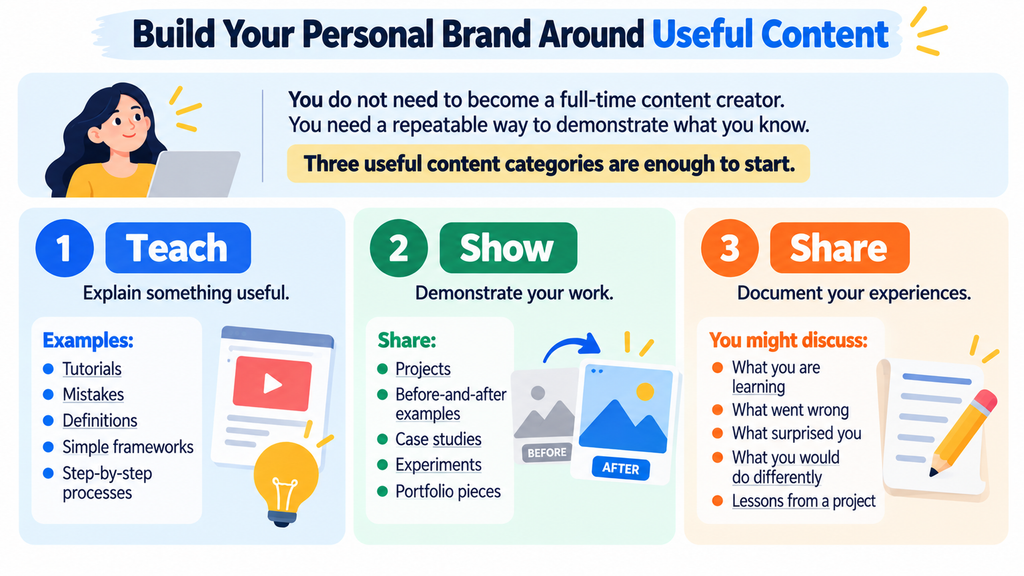
You do not need to become a full-time content creator.
You need a repeatable way to demonstrate what you know.
Three useful content categories are enough to start.
Teach
Explain something useful.
Examples include:
- Tutorials
- Mistakes
- Definitions
- Simple frameworks
- Step-by-step processes
Show
Demonstrate your work.
Share:
- Projects
- Before-and-after examples
- Case studies
- Experiments
- Portfolio pieces
Share
Document your experiences.
You might discuss:
- What you are learning
- What went wrong
- What surprised you
- What you would do differently
- Lessons from a project
This combination makes your brand more credible without requiring constant self-promotion.
The Beginner Friction Factor: Trying to Look Like an Expert
One of the biggest problems beginners face is performing expertise instead of demonstrating useful knowledge.
They use complicated language. They repeat popular advice. They avoid sharing mistakes because they think mistakes damage credibility.
The opposite can be more useful.
You can say:
“I tested this approach and here is what happened.”
That is more specific than making a broad claim.
Share what you actually know. Be clear about what you are still learning.
Credibility grows through evidence and consistency, not exaggerated authority.
Choose One Main Platform First
You do not need to build your personal brand everywhere.
Start with one platform where your target audience already spends time.
Useful for:
- Career development
- Business
- Professional expertise
- B2B topics
- Industry insights
Useful for:
- Visual work
- Personal stories
- Creative skills
- Lifestyle-related expertise
- Short-form educational content
YouTube
Useful for:
- Tutorials
- Demonstrations
- Long-form education
- Reviews
- Detailed explanations
X or Similar Text-Based Platforms
Useful for:
- Ideas
- Commentary
- Short educational posts
- Industry discussions
The best platform is not necessarily the most popular one.
Choose the platform where your audience and your preferred content format overlap.
Make Your Profile Explain You Quickly
A visitor should understand your personal brand within seconds.
Review these elements:
Profile Photo
Use a clear, recognizable image.
You do not need a professional studio photograph. Good lighting and a simple background are often enough.
Bio or Headline
Explain:
- What you do
- Who you help
- What you talk about
Avoid vague statements such as “Helping people achieve their dreams.”
Be concrete.
Profile Links
If relevant, connect your portfolio, website, newsletter, or other useful destination.
Your profile should make the next step obvious.
Develop a Consistent Personal Brand Style
Consistency makes recognition easier.
You do not need identical templates for every post.
Instead, create a few repeatable choices:
- A small color palette
- One or two typefaces
- A consistent photo style
- Similar writing tone
- Recurring content formats
Your personality should still come through.
A personal brand that looks overly polished but feels completely impersonal can become difficult to connect with.
Think consistent, not manufactured.
Build Trust Before Chasing Followers
Follower count is easy to notice.
It is not the same as professional credibility.
Someone with 1,000 relevant followers may have a stronger personal brand than someone with 50,000 unrelated followers.
Pay attention to signals such as:
- Meaningful comments
- Direct messages
- Collaboration requests
- Profile visits
- Portfolio inquiries
- Newsletter sign-ups
- Relevant professional opportunities
These tell you whether your content is reaching the right people.
Courses and Resources for Building a Personal Brand
You can learn personal branding without buying an expensive coaching program.
Start with free platform resources and practical experimentation. Consider a paid course when you want a structured framework.
Personal Branding — Coursera
Portfolio project: A structured personal branding plan covering positioning and professional identity.
Ideal student: Beginners who want a more systematic approach to defining their professional image.
Why consider it: Coursera works well for structured conceptual learning and can help you think about branding beyond social media posts.
Honest limitation: A course cannot create your reputation for you. You still need to publish work and interact with your audience.
Coursera and edX may allow eligible courses to be audited for free. Payment is generally needed for certificates or certain additional features.
Personal Branding and Creative Presence — Skillshare
Portfolio project: A personal visual and content direction.
Ideal student: Creative learners who want practical exercises around presenting themselves online.
Why consider it: Skillshare is strong for creative execution and short visual workflows.
Honest limitation: It uses a subscription model. It makes more sense if you plan to take several relevant classes during the subscription period.
Free Alternative: Build a Personal Brand Audit
Find three professionals you respect in your field.
Study:
- Their profile headline
- About section
- Content themes
- Visual identity
- Posting formats
- Portfolio
- Audience interaction
Then write down what makes each person recognizable.
Do not copy their brand.
Use the exercise to identify patterns worth adapting to your own strengths.
What to Learn After Personal Branding
Once you have your basic personal brand, develop the skills that support it.
A useful progression is:
- Content writing
- Public speaking or video
- Basic visual design
- Audience research
- Networking
- Portfolio development
- Analytics
Your brand becomes stronger when your underlying skill becomes stronger.
Do not spend months designing your online identity while having little work to show.
Build the skill. Create projects. Document the process.
Your Day-One Action Plan
You can start your personal brand within the next hour.
- Write your positioning statement.
Complete this sentence: “I want to be known for helping [audience] with [specific problem].” - Choose three content pillars.
Write five possible posts under each pillar. Keep the ideas connected to your experience or learning. - Fix your profile.
Update your photo, headline or bio, description, and relevant links so visitors understand your focus immediately.
Then publish something useful.
It does not need to be perfect.
Your first post can explain what you are learning, share a project, answer a common question, or document a mistake.
A personal brand from scratch is built through repeated evidence of what you know, what you create, and how you think.