How to Build a Brand on Instagram
Building a brand on Instagram is not mainly about posting attractive photos.
Your profile needs to tell people who you are, who you help, and why they should care. A consistent visual style helps, but it cannot compensate for unclear positioning or random content.
We recommend treating Instagram as a public expression of your wider brand. Your name, profile, visuals, captions, content themes, and interactions should all reinforce the same idea.
What Does It Mean to Build a Brand on Instagram?
A brand on Instagram is the consistent impression people develop from your account.
That impression comes from much more than your logo.
It includes:
- Your username and profile name
- Profile photo
- Bio
- Visual style
- Content topics
- Captions
- Posting patterns
- Stories and short-form video
- Comments and replies
- Overall customer experience
A visitor should understand your basic value quickly.
If someone lands on your profile and cannot tell what you offer, consistency will not solve the problem.
Start With Your Brand Positioning
Before creating content, decide what you want your account to be known for.
Ask three questions:
Who are you trying to reach?
Be specific. “Everyone who likes fashion” is not a useful audience definition.
What do you help them do?
Your answer could involve education, entertainment, inspiration, products, services, or a combination.
Why should they follow you instead of another account?
This is where differentiation matters.
You do not need to invent something nobody else offers. You need a clear reason for your particular audience to choose your content.
The Beginner Friction Factor: Posting Without a Content Position
A common beginner mistake is creating content based on whatever feels interesting that day.
One post is motivational. The next is a product photo. Then comes a personal update. Then a random trend.
Each post may be fine individually.
Together, they can create an unclear brand.
The fix is to choose three to five content pillars.
For example, a small design business could use:
- Educational design tips
- Behind-the-scenes work
- Client problems and solutions
- Brand examples
- Founder perspective
These pillars give you structure without forcing every post to look identical.
Your Instagram Profile Is Part of the Brand
Your profile is often the first serious interaction someone has with your business.
Make each element work.
Profile Name
Use a name people can understand and search for.
If your username is abstract, your profile name can provide additional context about what you do.
Profile Photo
A logo can work for a business. A recognizable personal photo can work better for a personal brand.
Keep the image simple enough to remain recognizable at small sizes.
Bio
A useful bio quickly communicates:
- What you do
- Who you help
- What makes your offer relevant
- What action people should take next
Avoid filling the bio with vague claims.
“Helping businesses achieve their dreams” tells a visitor very little.
“Simple Instagram content strategies for local businesses” is much clearer.
Create a Recognizable Visual Style
Your brand on Instagram should look consistent without becoming repetitive.
Choose a small visual system.
Consider:
- Primary colors
- Supporting colors
- Typography
- Photography style
- Graphic style
- Illustration style
- Spacing and layouts
You do not need every post to use exactly the same template.
Instead, create recognizable patterns.
Someone should gradually become familiar with your visual language while scrolling.
Content Matters More Than Perfect Branding
A polished profile cannot rescue weak content.
Your posts should give people a reason to stop, read, watch, save, share, or follow.
A useful content mix can include:
Educational Content
Teach something your audience genuinely needs.
Examples:
- Tutorials
- Mistakes to avoid
- Simple explanations
- Checklists
- Before-and-after examples
Proof and Experience
Show how your knowledge works in practice.
This could include:
- Case studies
- Projects
- Results
- Customer experiences
- Behind-the-scenes processes
Personality
People often connect with the person or perspective behind a business.
Share opinions, lessons, stories, or experiences that fit your brand.
Promotional Content
You can sell on Instagram.
But if every post asks for a purchase, people have fewer reasons to follow.
Build useful content alongside promotional posts.
Consistency Does Not Mean Posting Every Day
Many beginners assume they need to post constantly.
That can lead to burnout.
A better approach is to create a repeatable publishing system you can maintain.
For example:
- Two educational posts each week
- One proof or case-study post
- One promotional post
- Several lightweight Stories when useful
The exact schedule can change.
What matters is that your audience knows what kind of value they can expect.
Learn What Your Audience Responds To
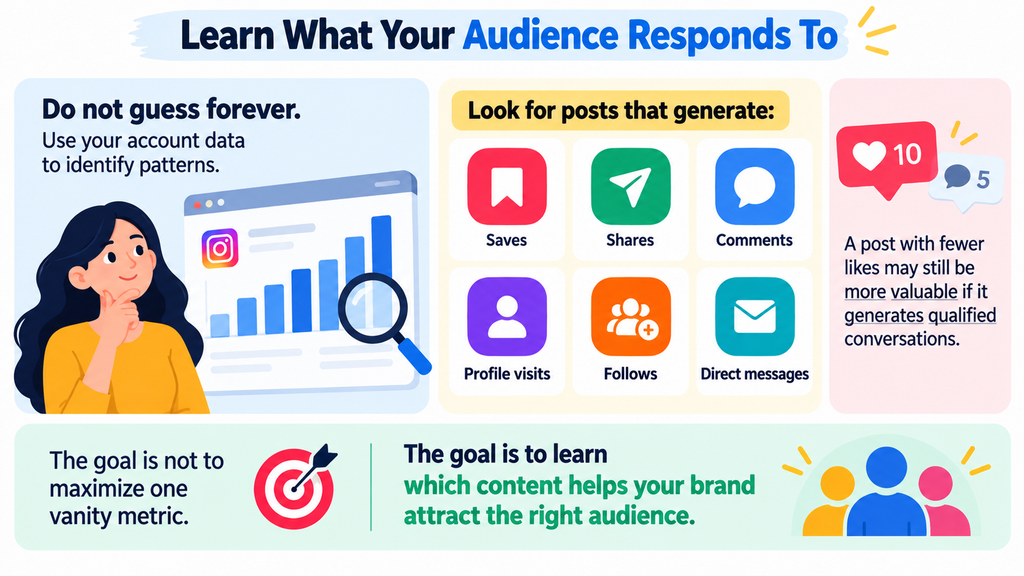
Do not guess forever.
Use your account data to identify patterns.
Look for posts that generate:
- Saves
- Shares
- Comments
- Profile visits
- Follows
- Direct messages
A post with fewer likes may still be more valuable if it generates qualified conversations.
The goal is not to maximize one vanity metric.
The goal is to learn which content helps your brand attract the right audience.
Courses and Resources for Building an Instagram Brand
You can learn the fundamentals without buying an expensive social media program.
Start with Instagram’s own resources and free educational content. Then consider structured courses if you want a guided learning path.
Instagram Marketing — Skillshare
Portfolio project: A practical Instagram content and visual strategy.
Ideal student: Creative beginners who want hands-on guidance for developing social content.
Why consider it: Skillshare is designed around creative execution and short, practical workflows.
Honest limitation: Skillshare uses a subscription model. It makes more sense if you plan to complete several classes rather than one isolated course.
Social Media Marketing — Coursera
Portfolio project: A structured social media marketing plan covering strategy and content.
Ideal student: Beginners who want marketing fundamentals alongside Instagram skills.
Why consider it: Coursera is useful when you want the strategic concepts behind social media rather than only post-design tutorials.
Honest limitation: A broad social media course may cover several platforms. You will still need to adapt the principles specifically to Instagram.
Coursera and edX courses can often be audited for free when the course supports that option. Payment may be necessary for certificates or additional features.
Free Alternative: Study Five Successful Accounts
Pick five accounts serving a similar audience.
For each one, analyze:
- Bio positioning
- Content pillars
- Visual patterns
- Posting formats
- Most useful content
- Calls to action
- Audience interaction
Do not copy their content.
Instead, identify why their approach works and decide what you can adapt to your own position.
What to Learn Next
Once you understand how to build a brand on Instagram, the next useful skill is content strategy.
Then move into:
- Copywriting for social media
- Short-form video
- Basic graphic design
- Audience research
- Analytics
- Conversion-focused landing pages
This progression matters because Instagram is only one part of the customer journey.
Your content attracts attention. Your profile builds interest. Your offer and wider brand experience turn that interest into action.
Your Day-One Action Plan
Start building your Instagram brand today.
- Write your positioning statement.
Define your audience, what you help them with, and your main difference. - Choose three content pillars.
Write five post ideas under each pillar. You now have 15 starting ideas. - Audit your profile.
Check your name, bio, profile photo, visual style, and recent posts. Remove anything that makes your position harder to understand.
Do not wait until your branding is perfect.
Build a clear system, publish useful content, watch what people respond to, and improve from there.
That is how a brand on Instagram becomes recognizable—and eventually, trusted.