
Who Are You Trying to Reach on Social Media?
You cannot create useful social media content until you know who you are creating it for.
“Everyone” is rarely a useful target audience. A specific audience gives you clearer content ideas, better messaging, and a more practical way to measure whether your social media efforts are working.
For beginners, the goal is not to build a complicated customer profile. Start by identifying who you want to reach, what they need, and why they would care about your content.
| Audience Question | What You Need to Identify | Example |
|---|---|---|
| Who are they? | Basic audience characteristics | Freelancers |
| What do they need? | Problems and goals | Finding more clients |
| What do they care about? | Priorities and motivations | Stable income |
| What content helps? | Useful information | Pricing and marketing tips |
| What action matters? | Desired next step | Book a consultation |
This approach follows SkillAdvisor’s beginner-focused editorial framework: keep the roadmap practical and avoid unnecessary complexity.
Start With the Problem, Not the Demographics
Age and location can be useful.
But they rarely tell you what content someone actually needs.
Compare these two descriptions:
Audience A: Women aged 25–34.
Audience B: Early-career professionals who want to improve their digital skills but do not know which skill to learn first.
The second description gives you far more to work with.
You can create content about:
- Choosing a career skill
- Learning roadmaps
- Beginner mistakes
- Online courses
- Career transitions
- Job-ready projects
The audience’s problem creates your content opportunities.
Ask Who Benefits Most From What You Offer
Start with your product, service, or expertise.
Then ask:
Who has the strongest reason to need this?
A local fitness business might serve many people. But its strongest audience could be busy professionals who want short workouts near their workplace.
A freelance designer might technically serve anyone. A more useful audience could be small businesses that need affordable branding but cannot hire a large agency.
The narrower description is not necessarily permanent.
It simply gives you a starting point.
Identify Your Audience’s Goals
People follow accounts because they expect some form of value.
That value can take different forms.
Your audience may want to:
- Learn something
- Solve a problem
- Save time
- Save money
- Become better at a skill
- Find inspiration
- Compare options
- Make a purchase
- Stay informed
Ask what your audience is trying to accomplish.
That question often produces better content ideas than simply asking what demographic they belong to.
Turn Goals Into Content Ideas
Suppose your audience consists of beginners learning digital illustration.
Their goals might include:
- Choosing the right drawing software
- Improving basic drawing skills
- Learning character design
- Building a portfolio
- Finding affordable courses
Each goal can become a content category.
You are no longer wondering what to post every morning. You have a set of audience problems to work from.
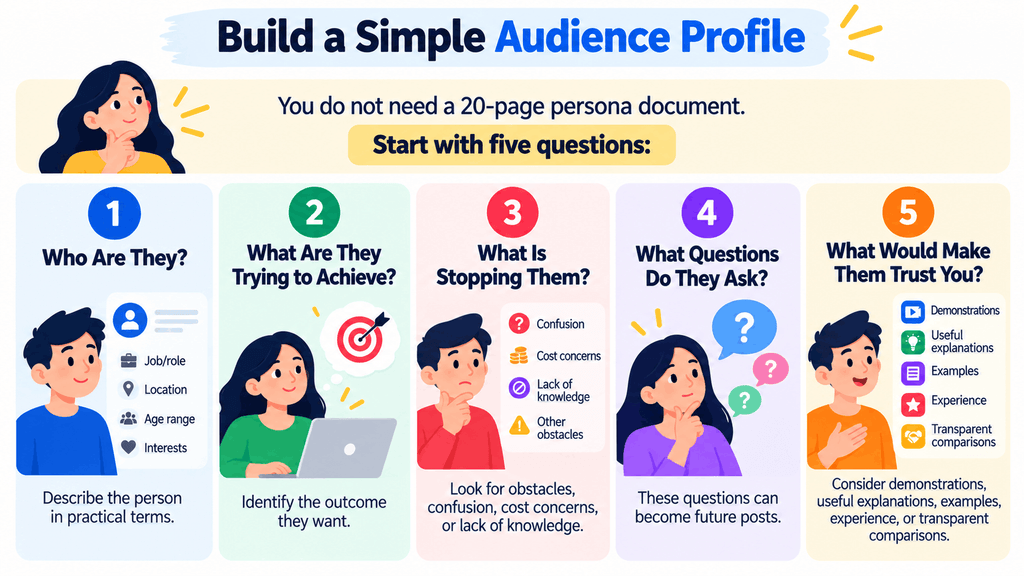
Build a Simple Audience Profile
You do not need a 20-page persona document.
Start with five questions:
1. Who Are They?
Describe the person in practical terms.
2. What Are They Trying to Achieve?
Identify the outcome they want.
3. What Is Stopping Them?
Look for obstacles, confusion, cost concerns, or lack of knowledge.
4. What Questions Do They Ask?
These questions can become future posts.
5. What Would Make Them Trust You?
Consider demonstrations, useful explanations, examples, experience, or transparent comparisons.
Keep your answers specific.
A useful audience profile should help you make better content decisions, not simply look impressive in a marketing document.
The Beginner Friction Factor: Trying to Please Everyone
One of the most common social media mistakes is making content so broad that nobody feels specifically addressed.
A business may avoid choosing an audience because it fears excluding potential customers.
But broad messaging often becomes vague messaging.
For example:
“Tips for everyone who wants to improve their career.”
That could describe thousands of topics.
Compare it with:
“Beginner-friendly digital skills for people changing careers without returning to college.”
Now the content direction is much clearer.
You can still attract people outside that group. Your messaging simply has a stronger starting point.
Find Out What Your Audience Actually Talks About
Do not rely entirely on assumptions.
Look at the questions people already ask.
Useful places to investigate include:
- Comments on your existing posts
- Direct messages
- Customer questions
- Product reviews
- Community discussions
- Search queries
- Questions asked during sales calls
- Feedback from existing customers
Pay attention to repeated language.
If several people describe the same problem using similar words, that is valuable information.
You can use those phrases when planning future content because they reflect real audience concerns rather than guesses.
Separate Followers From Potential Customers
Your social media audience and your customer audience are not always identical.
Some people may follow you because they enjoy your content.
Others may be actively looking for what you sell.
Both groups can matter, but they serve different purposes.
For a business, ask:
Which audience is most likely to take the action we need?
That action could be:
- Buying a product
- Booking a service
- Signing up for an email list
- Downloading a resource
- Requesting information
A large follower count means little if the audience has no meaningful connection to your offer.
Your Platform Should Follow Your Audience
Do not choose a social platform simply because everyone else is using it.
First identify where your target audience is likely to spend time and what type of content they prefer.
Then choose your platforms.
For example, an audience that responds well to visual demonstrations may behave differently from an audience looking for professional career discussions.
The important point is audience first, platform second.
This also prevents beginners from spreading themselves across five platforms before they can consistently manage one.
How to Know If You Chose the Right Audience
Your audience definition is a hypothesis.
You should test it.
Create content specifically for the audience you identified. Then look at the quality of the response.
Ask:
- Are the right people engaging?
- Are people asking relevant questions?
- Are profile visits increasing?
- Are inquiries coming from potential customers?
- Are people sharing or saving useful posts?
- Are your followers becoming more relevant over time?
You do not need perfect results immediately.
The goal is to gather enough feedback to improve your audience definition.
What Should You Learn Next?
Once you understand your audience, the next useful skill is content strategy.
You need to turn audience problems into repeatable content categories.
After that, learn basic copywriting so your posts communicate the value quickly.
Then add analytics to understand which content attracts the right people.
This creates a practical progression:
Audience research → Content strategy → Copywriting → Analytics
You do not need to master all four immediately.
Start with the skill that addresses your biggest weakness.
Your Day-One Action Plan
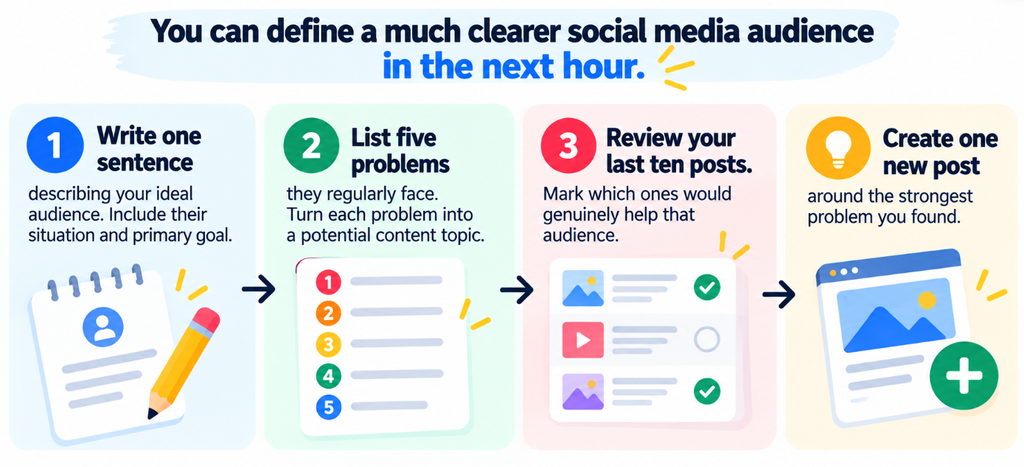
You can define a much clearer social media audience in the next hour.
- Write one sentence describing your ideal audience. Include their situation and primary goal.
- List five problems they regularly face. Turn each problem into a potential content topic.
- Review your last ten social posts. Mark which ones would genuinely help that audience.
Then create one new post around the strongest problem you found.
Do not aim for everyone.
Aim to become useful to the right people. A clear audience makes every later social media decision easier, from choosing topics to selecting platforms and measuring results.