

How Do You Speak Confidently in Front of People?
Speaking confidently in front of people isn’t about never feeling nervous.
Even experienced speakers can feel their heart rate increase before presenting. The useful skill is learning how to stay clear, organized, and understandable while you’re nervous.
You don’t need a naturally commanding personality. You need a few repeatable speaking habits and enough practice to make them feel familiar.
| Day-One Metric | Beginner Estimate |
|---|---|
| Hours to basic competency | 3–5 hours |
| Minimum budget | $0 |
| Free tools | Phone camera, notebook, timer |
| Learning difficulty | 3/5 |
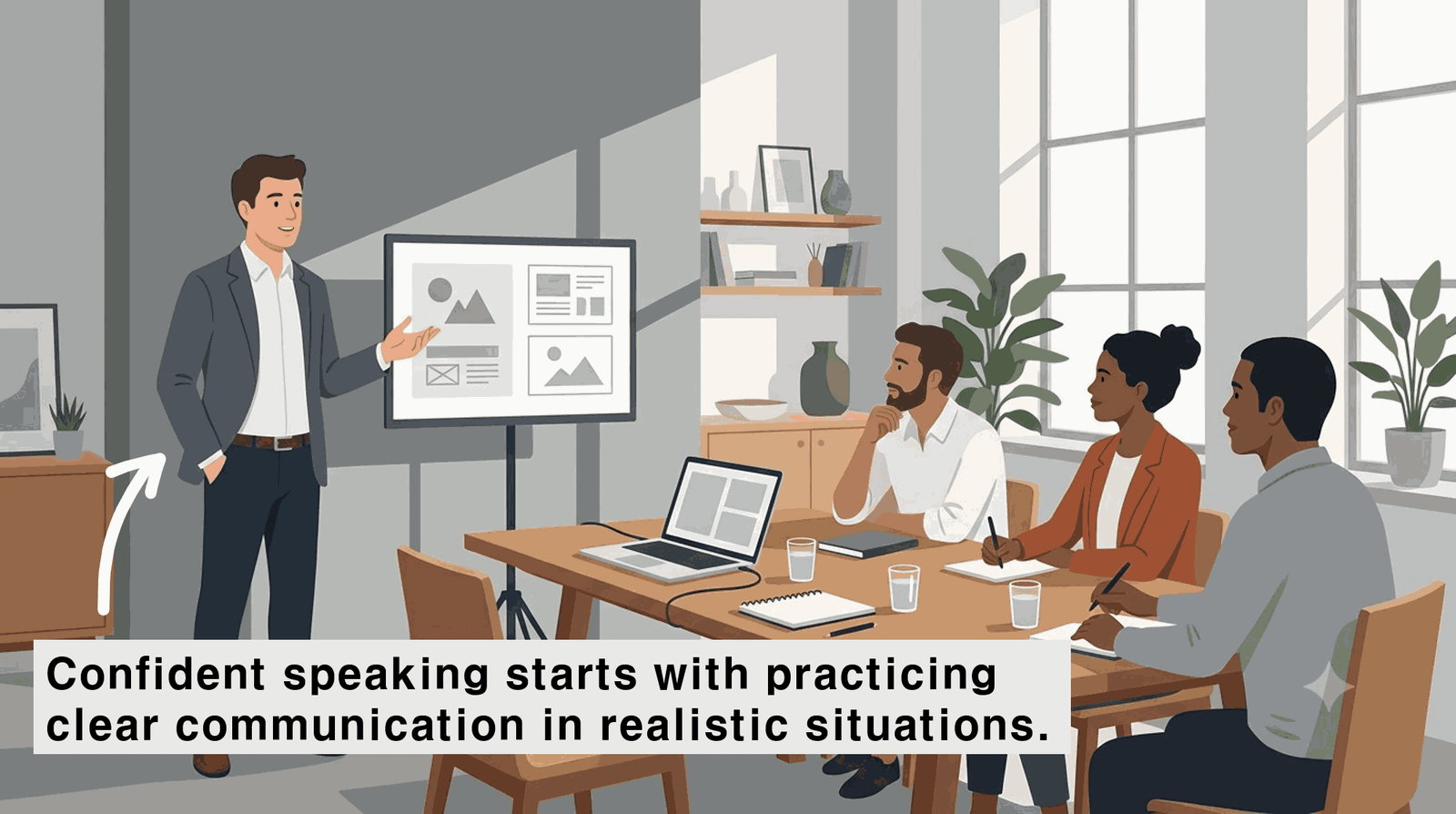
What Does Confident Speaking Actually Look Like?
Many beginners think confidence means speaking loudly, never pausing, or appearing completely relaxed.
That’s not necessary.
A confident speaker usually does a few simple things well:
- Speaks clearly.
- Uses a comfortable pace.
- Makes reasonable eye contact.
- Organizes ideas logically.
- Pauses instead of filling every silence.
- Continues after making a small mistake.
Confidence is easier to communicate when your audience can follow your thinking.
You don’t have to perform confidence. Focus on making your message useful and understandable.
How to Speak Confidently by Preparing Less, but Better
Over-preparing every sentence can make speaking harder.
If you memorize a complete script, forgetting one sentence can make you panic.
Instead, prepare key points.
For a five-minute presentation, you might use:
- The problem
- The main idea
- Three supporting points
- The recommendation
- The takeaway
Write only the important information.
Then practice explaining each point in your own words.
This makes your delivery more natural.
Know Your First Sentence
There is one part worth preparing almost word for word: your opening.
The first few seconds can feel especially uncomfortable.
A prepared opening gives you somewhere to begin.
For example:
“Today, I want to show you three simple ways we can improve this process.”
After that sentence, move to your first key point.
You don’t need a clever opening.
You need a reliable one.
Slow Down When You Feel Nervous
Nervous speakers often speed up without noticing.
You may think you’re speaking at a normal pace while your audience struggles to keep up.
Try deliberately speaking slightly slower than feels natural.
Add short pauses:
Point → pause → explanation → pause → next point
Pauses aren’t failures.
They give your audience time to process your point and give you time to think.
Replace Filler Words With Silence
Common fillers include:
- “Um”
- “Like”
- “You know”
- “Basically”
- “So…”
Using one occasionally isn’t a problem.
The problem comes when fillers appear after almost every sentence.
The easiest replacement is silence.
When you need to think, pause for a second.
It may feel much longer to you than it sounds to your audience.
Use Eye Contact Without Staring
You don’t need to stare at one person throughout your presentation.
Instead, move your attention naturally around the room.
Look at one person while making a point.
Then shift to another person.
In a larger room, divide the audience into sections and move your gaze between them.
If direct eye contact feels intimidating, look near the person’s eyes.
From normal speaking distance, the difference isn’t obvious.
The Friction Factor: Practicing Only in Your Head
A common beginner mistake is mental rehearsal without speaking aloud.
You can understand your presentation perfectly while reading your notes.
That doesn’t mean you can deliver it smoothly.
Speaking is a physical skill.
You need to practice:
- Saying the words.
- Breathing while speaking.
- Pausing.
- Looking up.
- Recovering from mistakes.
- Managing your voice.
Record yourself on your phone.
You don’t need professional equipment.
Watch the recording once and identify one thing to improve.
Maybe you’re speaking too quickly.
Maybe you rarely look up.
Maybe your explanation takes too long.
Fix one issue and record it again.
Don’t try to correct everything simultaneously.

How to Control Nervousness Before Speaking
You probably can’t eliminate nervousness completely.
Instead, prepare your body and attention for the situation.
Before speaking:
- Arrive early when possible.
- Check your presentation materials.
- Take a few slow breaths.
- Drink some water.
- Review your first sentence.
- Avoid rushing through your preparation.
Then shift your attention away from yourself.
Ask:
What does this audience need to understand?
That question is often more useful than:
Do I look nervous?
The first question focuses on communication.
The second focuses on self-monitoring.
Practice With Increasing Difficulty
Don’t wait for a major presentation to practice.
Build up gradually.
| Practice Level | Example |
|---|---|
| 1 | Explain an idea aloud alone |
| 2 | Record a one-minute video |
| 3 | Speak to one familiar person |
| 4 | Give a short explanation to three people |
| 5 | Present to a larger group |
Repeat a level until it feels manageable.
Then increase the difficulty.
This gives you repeated exposure without making every practice session feel overwhelming.
Practice Explaining, Not Performing
Choose an ordinary topic.
Explain it for two minutes without reading a script.
For example:
“How does my favorite app work?”
Then try:
“How would I explain this to someone who has never used it?”
This develops the ability to organize thoughts quickly.
That skill transfers directly to meetings, interviews, presentations, and conversations.
Use Your Voice More Deliberately
Confidence isn’t only about the words you choose.
Your volume, pace, and emphasis also influence how your message sounds.
Try emphasizing important words.
Instead of saying every word with the same intensity:
“We need to finish the project by Friday.”
Put more emphasis on Friday.
Your voice naturally gives the listener a clearer signal about what matters.
Don’t force a deeper voice or artificial speaking style.
Aim for a voice that is clear and comfortable.
What to Do When You Make a Mistake
You will occasionally lose your place, mispronounce something, or forget a point.
Don’t turn a small mistake into a major interruption.
Use a simple recovery:
Pause → correct it → continue.
For example:
“Let me rephrase that.”
Then continue.
Most audiences are far less focused on your mistakes than you are.
A confident speaker doesn’t need perfect delivery.
They demonstrate that a small mistake doesn’t stop the conversation.

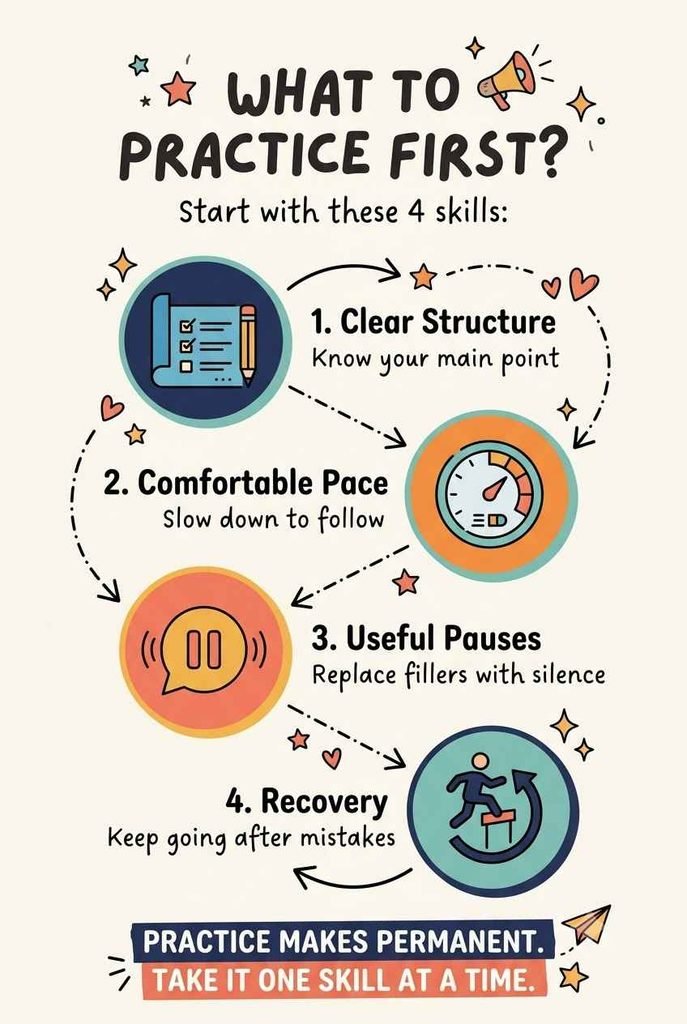
What Should You Practice First?
Don’t try to improve everything at once.
Start with these four skills:
1. Clear Structure
Know your main point before you begin.
2. Comfortable Pace
Slow down enough for people to follow you.
3. Useful Pauses
Replace unnecessary filler words with short silence.
4. Recovery
Practice continuing after mistakes.
These fundamentals matter more than impressive presentation tricks.
If you’re comfortable with these basics, you can later work on storytelling, persuasive speaking, presentation design, and advanced body language.
What to Learn Next: Presentation Structure
Once you can speak more comfortably, learn how to structure a persuasive presentation.
A simple framework is:
Problem → Evidence → Solution → Action
For example:
Problem: Customers abandon the current signup process.
Evidence: Analytics show a large drop at the second form.
Solution: Reduce the form from eight fields to four.
Action: Test the shorter version next week.
Now your speaking skills have something useful to carry.
Good delivery matters.
But clear thinking and useful information matter more.
Your Day-One Action Plan
You can begin practicing today without joining a speaking club or buying equipment.
- Choose one familiar topic. Explain it aloud for two minutes without reading.
- Record yourself. Watch the recording once and identify one speaking habit to improve.
- Repeat the presentation. Slow down, add deliberate pauses, and improve that one issue.
Do this several times over the next few days.
Don’t aim to look fearless.
Aim to become comfortable communicating while slightly nervous.
That is a much more realistic definition of speaking confidence.