
Storytelling Explained: What Makes a Story Stick?
Think about the last movie, book, or video that kept you hooked until the very end. You probably weren’t thinking about sentence structures, vocabulary words, or literary terms. You were glued to the screen or the page because you desperately wanted to know one thing: what happens next?
A story sticks when readers care about the outcome. When people lose interest in a story, it is almost never because the author used simple words or forgot to add a giant explosion. It is because the audience stopped caring about the person on the page.
You do not need fancy language, massive budgets, or complicated plots to make an impact. Good storytelling comes down to a few basic mechanics that work every single time, whether you are writing an essay for class, telling a personal memory, scriptwriting a short film, or creating content online.
The Core Engine: Goal, Obstacle, Stakes
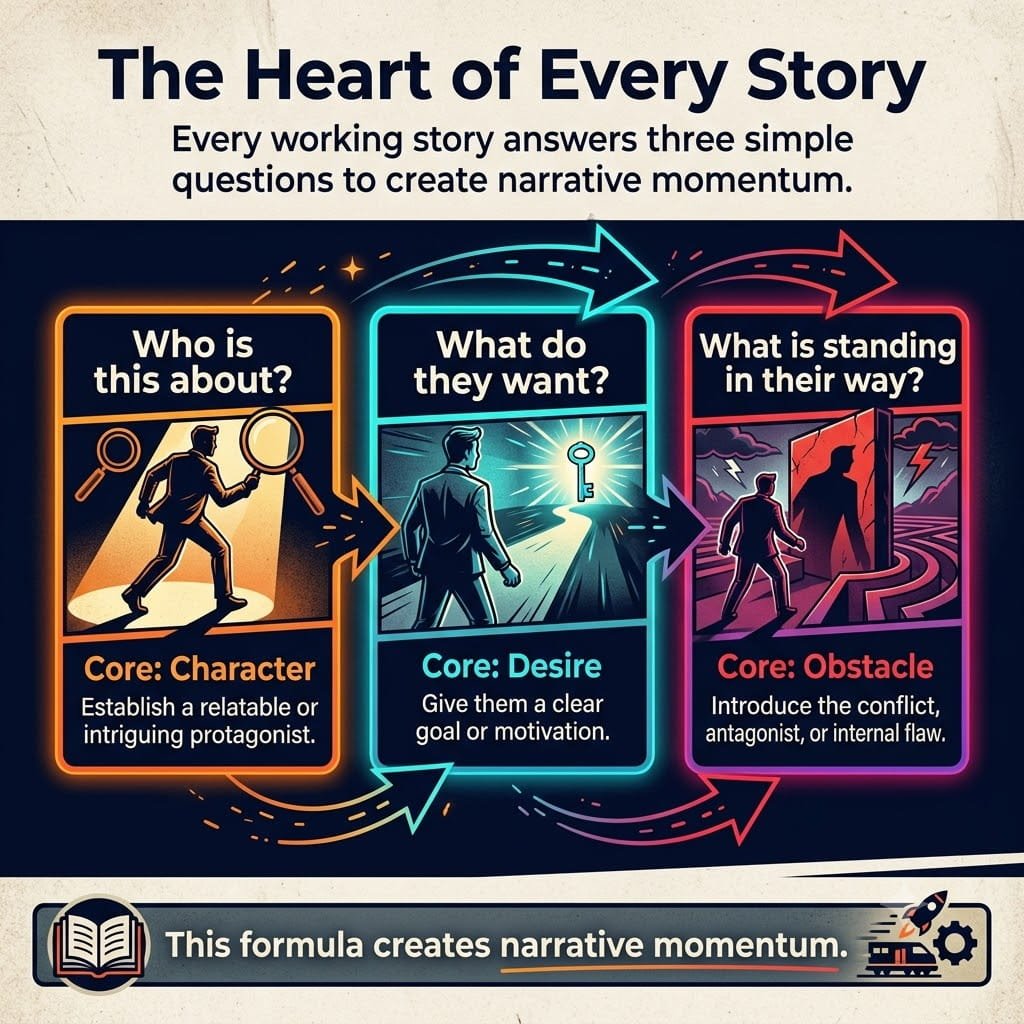
At its heart, every working story answers three simple questions:
- Who is this about?
- What do they want?
- What is standing in their way?
This formula creates narrative momentum. Without these three pieces working together, you do not have a story—you just have a list of events happening in order.
Consider this: “A boy woke up, ate breakfast, rode his bike to school, and sat in class.” That is accurate, but it is completely boring. There is nothing to wonder about. Now add the three questions: “A boy needs to pass his science test today to stay on the soccer team, but his bicycle tire went flat three miles from school with twenty minutes left on the clock.” Suddenly, the reader leans in.
The obstacle does not need to involve saving the world from aliens or running from a villain. Small, human problems carry plenty of weight if the characters care about them:
- A kid trying to win a middle school debate round.
- A traveler who realizes their wallet is missing on a train in a foreign city.
- A high school sophomore deciding whether to tell the truth about who broke a window.
All of these work because an outcome hangs in the balance. The reader stays around because they want to see if the character pulls it off.
The One-Sentence Test
Before you draft a whole scene, boil your central idea down to one sentence:
“A nervous photographer enters her first gallery show and struggles with whether to show her most personal picture.”
If you cannot explain the main conflict in one line, your story is probably trying to cover too many things at once. Strip away the extra details until the central problem is clear.
Believable Characters Are Built on Flaws and Friction
Readers do not connect with flawless heroes. If a character is smart, athletic, universally loved, and never makes a bad choice, they are boring. There is nowhere for them to grow, and nothing they do feels risky. Real people have quirks, blind spots, and contradictions. That friction is what makes them feel alive.
Think about the people you know in real life. Humans are messy:
- Someone can be wildly ambitious and competitive, yet secretly terrified of anyone finding out they feel insecure.
- A student might be the first to jump in and defend a friend from a bully, but completely unable to stand up to their own older brother at home.
- Someone might dream of becoming a famous musician, but freeze in panic the moment they step onto a stage.
These internal contradictions give characters depth. When you give your main character a weakness, every choice they make becomes much harder. A fearless warrior fighting a dragon is predictable; a warrior who is terrified of the dark heading into an unlit cave forces the reader to worry.
Every memorable character also needs an internal shift. That change does not have to be earth-shattering. A character who starts off completely sure of themselves might end up realizing they don’t have all the answers. A character who starts out scared to make decisions might finally stand their ground on one small issue. That shift is the real point of the journey.
Real Stakes Beat Manufactured Drama
When beginners want to make their writing more exciting, they often reach for extreme drama. They throw in sudden car crashes, random villains jumping out from corners, or characters screaming melodramatically. But if the audience has not been given a reason to care about the people involved, sudden chaos feels empty.
Suspense does not come from loud events. It comes from real consequences. To figure out whether your story has genuine tension, ask two questions:
- What does the character lose if they fail?
- Why can’t they just walk away and quit?
If walking away from the problem costs the character nothing, then there are no stakes.
Imagine a runner in a race. If they lose, they just go home and play video games with zero regrets. That is boring. But what if winning this specific race is their only shot at proving to their skeptical older brother that their hard work was worth it? Now, giving up carries an emotional price tag. The moment walking away becomes painful, the reader starts rooting for them.
Ground Emotion in Specific Actions
You have probably heard English teachers say “show, don’t tell” a hundred times. It sounds simple, but it is easy to get wrong. Telling means using summary words to label an emotion. Showing means giving the audience concrete proof so they can feel the emotion for themselves.
Look at the difference:
- Telling:Marcus was terrified before his presentation.
- Showing:Marcus smoothed down the wrinkled corners of his index cards until the paper tore, then wiped his sweaty palms against his jeans.
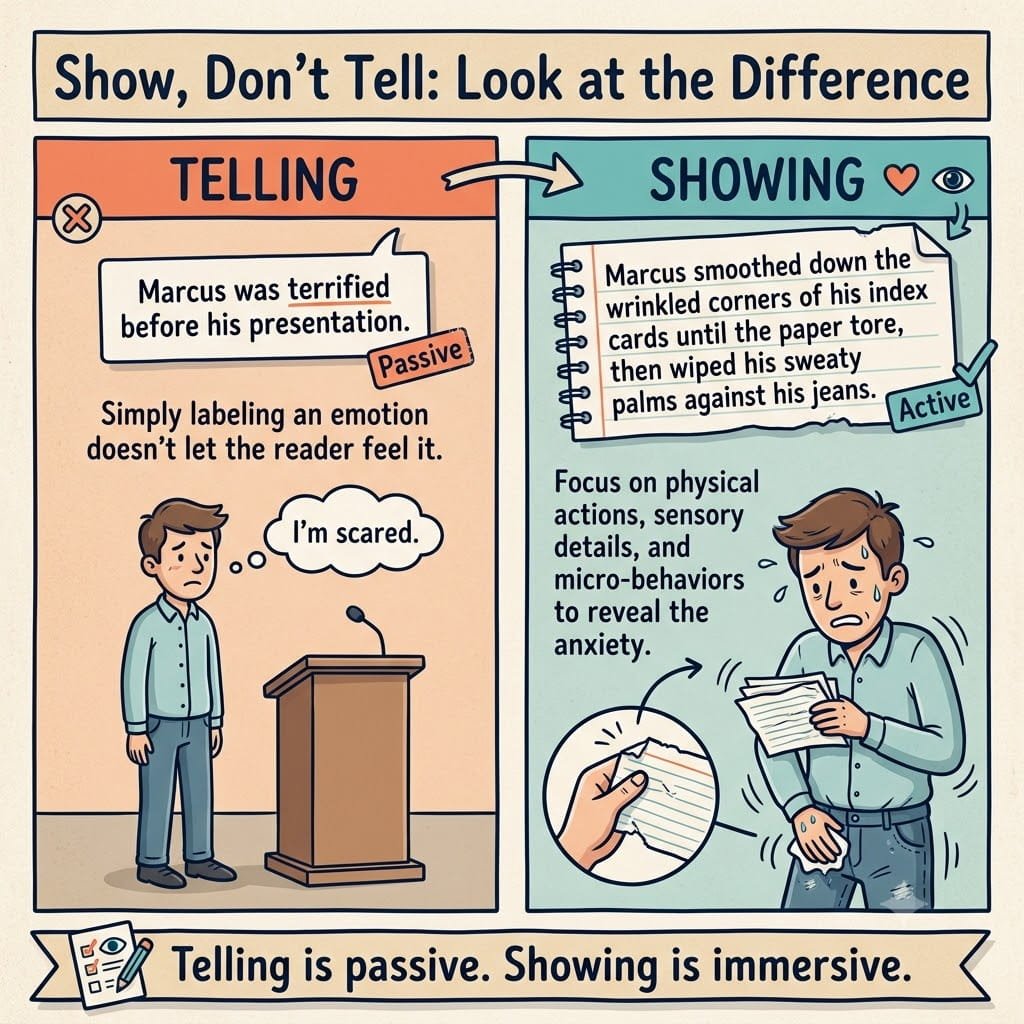
The second version puts you in the room with Marcus. You do not need the narrator to announce that he is terrified; his body language gives it away immediately.
Good details work like evidence in a courtroom. They give the reader clues about what is happening beneath the surface:
- A character who claims they aren’t angry, but presses their pencil lead so hard against the desk that it snaps.
- A messy bedroom where every single trophy on the shelf is dusted and wiped spotless.
- A character who keeps checking the clock every thirty seconds while pretending to listen to a friend.
Do not fill pages with descriptions just to hit a word count. Describe the things that tell us who the character is and what they are hiding.
Understanding the Story Arc
Every story needs a sense of direction. Without structure, writing turns into wandering. A dependable five-step arc keeps your pacing steady from the opening line to the final sentence:
- The Hook: Drop your reader into the middle of a specific moment. Skip the long paragraphs explaining the character’s family history, what the town looks like, or what happened five years ago. Start where the tension begins.
- The Problem: Something interrupts everyday life. An unexpected phone call, a missing item, or an unfair rule forces the character out of their comfort zone.
- The Struggle: The character tries to fix the problem, but their first attempt fails. Things get more complicated, time runs short, and the pressure builds.
- The Turning Point: The highest point of pressure. The character is forced to make a hard choice between two tough options, and there is no turning back.
- The Aftermath: The dust settles. The problem is resolved, and we see how the character or their world has changed because of the choices they made.

This arc works for massive fantasy novels, but it works just as well for an everyday personal essay. A story about burning dinner while trying to cook for your parents follows the exact same pattern: the goal, the disaster, the scramble to fix it, the moment you have to admit what happened, and the quiet conversation over takeout pizza afterward.
The Secret Power of Revision
Nobody writes a clean, perfect story on their first attempt. Professional writers know that a first draft is just you telling the story to yourself so you can figure out what happens. The real magic happens during revision.
When you finish a draft, take a break from it for a day, then read it through with an editor’s eye:
- Look for scenes where nothing changes. If a scene can be removed without affecting the ending, cut it.
- Cut down long explanations. Trust your readers to connect the dots.
- Check your dialogue. Read it out loud. If it sounds like a textbook instead of how people actually talk in hallways and living rooms, rewrite it.
The Single-Scene Exercise
The quickest way to sharpen your storytelling skills is to practice with short, focused scenes rather than trying to write a whole book right away:
Pick one person. Give them an obvious goal, a real flaw, and an immediate problem that must be dealt with right now. Put them in an uncomfortable room with another person who disagrees with them. Give yourself five hundred words to write the scene, and stop writing the exact second a decision is made that changes the situation.
Once you are done, read your work and ask yourself the most important question in storytelling: “Did I give the reader a reason to care about what happens next?”
If the answer is yes, you have written a story that sticks.