

Want to Start a Travel Journal? Here’s Where to Begin
A travel journal doesn’t need to be a perfect scrapbook. It can be a simple record of where you went, what you noticed, who you met, and what you thought about the experience.
You can write in a notebook, type on your phone, sketch in a journal, or combine several formats. The best approach is the one you can maintain while actually enjoying your trip.
| Day-One Metric | Beginner Target |
|---|---|
| Hours to Basic Competency | 1–3 hours |
| Minimum Budget | $0 |
| Free Software Prerequisites | Notes app or Google Docs |
| Learning Difficulty | 1/5 |
What Should You Put in a Travel Journal?
Start with observations rather than trying to document everything.
You don’t need a detailed account of every meal, train ride, or tourist attraction.
Instead, record the moments you think you’ll want to remember later.
Useful details include:
- Where you were
- What you saw
- What surprised you
- Interesting conversations
- Food you tried
- Sounds and smells
- Small cultural observations
- Mistakes or unexpected problems
- Favorite places
- Questions you had
- How you felt about the experience
A few specific details can bring an entire day back to memory.
How Do You Start a Travel Journal?
Choose a format before your trip.
Option 1: A Paper Notebook
A small notebook is simple and doesn’t depend on batteries or internet access.
You can write, sketch, paste tickets, record addresses, or add quick observations.
Choose something small enough to carry comfortably.
You are less likely to use a journal that feels like another piece of luggage.
Option 2: A Digital Journal
A phone, tablet, or laptop can make longer entries easier.
Digital notes are also searchable and easy to organize.
You can add photographs, links, maps, voice notes, and other digital material.
The downside is that notifications and other apps can make it harder to focus.
Option 3: A Mixed Journal
You can combine both approaches.
Write quick notes by hand during the day. Expand them into a longer digital entry later.
This works well if you enjoy writing but don’t want to spend an hour sitting in a café every evening.
What Should You Write Each Day?
Don’t create a complicated writing schedule.
Try a five-minute travel journal entry instead.
At the end of the day, answer:
- What happened today?
- What surprised me?
- What do I want to remember?
That’s enough.
If something particularly interesting happened, write more.
The goal is to create a record you will actually return to.
What Makes a Travel Journal Interesting?
Specific details make travel writing stronger.
Compare these two entries:
Today was a beautiful day in the city. I visited several interesting places and had great food.
It’s difficult to remember much from that description.
Now consider:
The bakery opened before sunrise, and the first customers were already waiting outside. I ordered something I couldn’t pronounce and ended up with a pastry filled with a sweet, citrusy paste.
The second entry contains specific observations.
Years later, those details are more likely to bring the experience back.
Record Small Moments
Big landmarks are easy to remember.
The small moments are often what disappear.
Write down:
- A conversation with a stranger
- Something funny that happened
- A street you almost missed
- An unexpected meal
- A local custom you noticed
- A mistake that changed your plans
- Something that made you feel at home
These details can become the most valuable parts of your journal.
The Beginner Friction Factor: Trying to Record Everything
The most common travel-journal problem is over-documenting.
You take dozens of photos, write long entries, save every receipt, and try to capture every detail.
Eventually, the journal becomes another task.
Instead, use a simple rule:
Capture a few things well.
If you’re tired, write three sentences.
If you have more time, write a page.
A travel journal should support your trip, not compete with it.
Should You Add Photos and Sketches?
Absolutely, if you enjoy them.
Your journal can include:
- Photos
- Sketches
- Maps
- Tickets
- Restaurant cards
- Museum stubs
- Pressed leaves
- Handwritten observations
But you don’t need expensive supplies.
A basic notebook and pen are enough.
If you sketch, don’t worry about creating polished artwork. A quick drawing of a building, meal, street sign, or object can become a useful memory.
How Can You Turn Notes Into Travel Stories?
Once you have several entries, look for connections.
Maybe one person kept appearing during your trip.
Maybe a planned activity went wrong.
Maybe your opinion about a place changed.
Those patterns can become travel stories.
Start by choosing one moment rather than trying to summarize the entire trip.
Then build around it:
Moment → Details → Context → Reflection
For example, instead of writing about an entire week in a city, write about one evening when you got lost and discovered a neighborhood you hadn’t planned to visit.
That gives your writing a clearer focus.
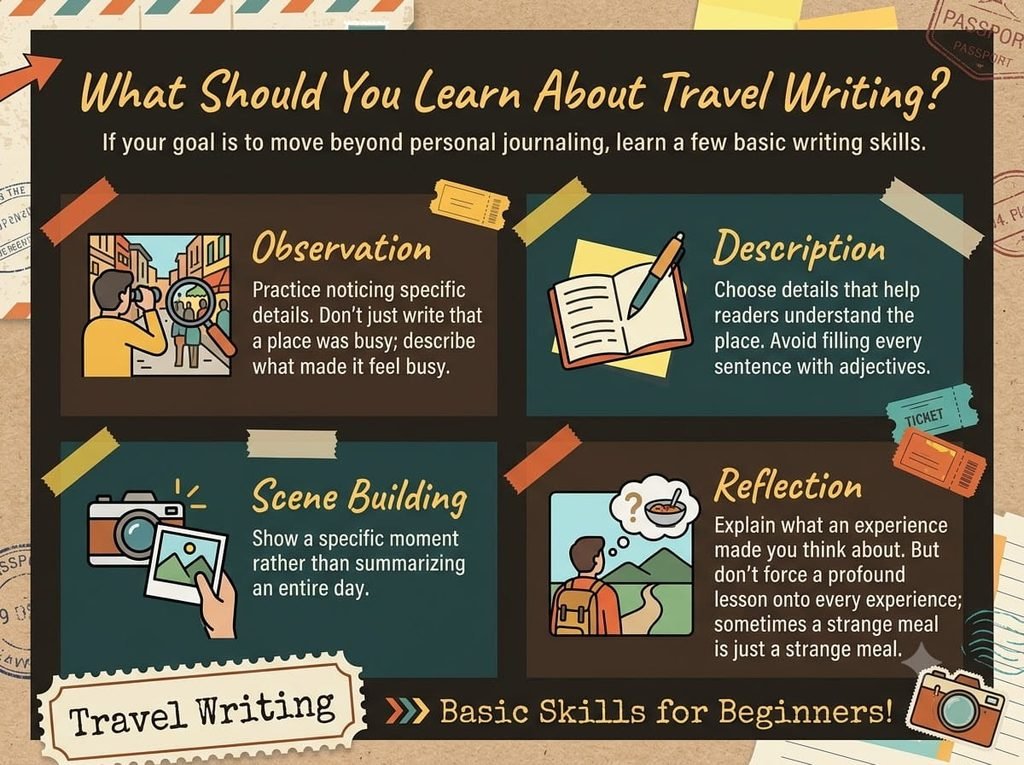
What Should You Learn About Travel Writing?
If your goal is to move beyond personal journaling, learn a few basic writing skills.
Observation
Practice noticing specific details.
Don’t just write that a place was busy. Describe what made it feel busy.
Description
Choose details that help readers understand the place.
Avoid filling every sentence with adjectives.
Scene Building
Show a specific moment rather than summarizing an entire day.
Reflection
Explain what an experience made you think about.
But don’t force a profound lesson onto every experience.
Sometimes a strange meal is just a strange meal.
What Courses or Resources Can Help?
You don’t need a course to start a travel journal.
The most useful first step is consistent practice.
Travel Writing Course
Ideal student: Someone who wants to turn personal travel experiences into polished articles.
Portfolio project: A finished travel feature or destination essay.
Honest limitation: A writing course won’t replace actual travel observation. You still need experiences and material to write about.
Creative Writing Course
Ideal student: Someone who wants to improve descriptions, scenes, narrative structure, and personal voice.
Portfolio project: A short travel narrative.
Honest limitation: General creative writing courses may spend little time on practical travel reporting or destination research.
Free Alternative
Read good travel writing.
Study how writers:
- Open a story
- Introduce a place
- Use sensory details
- Introduce people
- Move between scenes
- Add cultural context
- End a piece
Then write a short version of your own experience.
What Should You Learn Next?
Once you’re comfortable keeping a travel journal, try travel writing.
The next progression could look like:
Travel journal → Observation → Personal narrative → Travel article → Feature writing
You can also add photography, sketching, or basic digital storytelling.
If you plan to publish your work, learn basic fact-checking and responsible travel reporting.
Be careful with claims about local communities, cultures, history, and traditions. Personal experience is valuable, but it doesn’t automatically represent everyone who lives in a place.
Your Day-One Action Plan
You can start before your next trip.
- Choose your format. Pick a small notebook, phone app, or simple digital document.
- Create three prompts. Use “What happened?”, “What surprised me?”, and “What do I want to remember?”
- Write one 200-word entry. Describe a recent place you’ve visited using five specific details.
Don’t worry about making it beautiful.
Your first goal is simply to notice, record, and remember.
Once that becomes a habit, your travel journal can naturally grow into something more: a collection of personal stories, observations, and experiences that you can return to long after the trip ends.