How Do You Tell a Story People Actually Remember?
Memorable stories give people something to care about. They introduce a person, create a problem, build curiosity, and make the audience feel that the outcome matters.
You don’t need a complicated plot or dramatic language. A clear character, meaningful conflict, specific details, and strong structure can make an ordinary experience memorable.
| Day-One Metric | Beginner Target |
|---|---|
| Hours to Basic Competency | 10–20 hours |
| Minimum Budget | $0 |
| Free Software Prerequisites | Google Docs or any basic word processor |
| Learning Difficulty | 2/5 |
What Makes a Story Memorable?
Start with a simple question:
Why should someone care about this story?
If you can’t answer that, adding more description probably won’t solve the problem.
A memorable story usually gives the audience:
- Someone to care about
- Something that person wants
- A problem or obstacle
- A reason the outcome matters
- A change or discovery
- Details that make the experience specific
These elements create a reason to keep listening or reading.
How Do You Give People a Reason to Care?
The easiest starting point is a character with something at stake.
Your character doesn’t need to be famous or extraordinary.
They might be:
- Starting a new job
- Preparing for an important performance
- Trying to save a business
- Moving to a new city
- Repairing a relationship
- Learning something difficult
The audience needs to understand what the character wants and why it matters.
Give the Character a Clear Goal
A vague goal produces a vague story.
Instead of:
She wanted to succeed.
Try:
She had one week to prepare for her first public exhibition.
Now there is a specific situation.
Readers can immediately understand what the character is trying to accomplish.
Why Does Conflict Matter?
Conflict gives the story movement.
If a character gets exactly what they want without difficulty, there may be little reason to continue.
The obstacle doesn’t have to be dramatic.
It could be:
- A deadline
- A difficult decision
- Another person’s expectations
- A lack of money
- Fear of failure
- Missing information
- A mistake
- An unexpected change
Ask:
What makes the character’s goal difficult?
That question often reveals the story.
How Does Emotion Help People Remember?
People tend to remember experiences that create a strong emotional response.
That doesn’t mean you need to force sadness or excitement into every story.
You can create:
- Curiosity
- Humor
- Surprise
- Anxiety
- Hope
- Frustration
- Relief
- Wonder
The key is to create the emotion through the situation.
Don’t simply tell the audience that a character was terrified.
Show what they did.
Use Specific Behavior
Compare:
He was nervous before giving his speech.
With:
He read the first sentence three times before walking onto the stage.
The second version gives the audience something concrete.
Specific actions make characters easier to picture.
The Beginner Friction Factor: Trying to Make Everything Dramatic
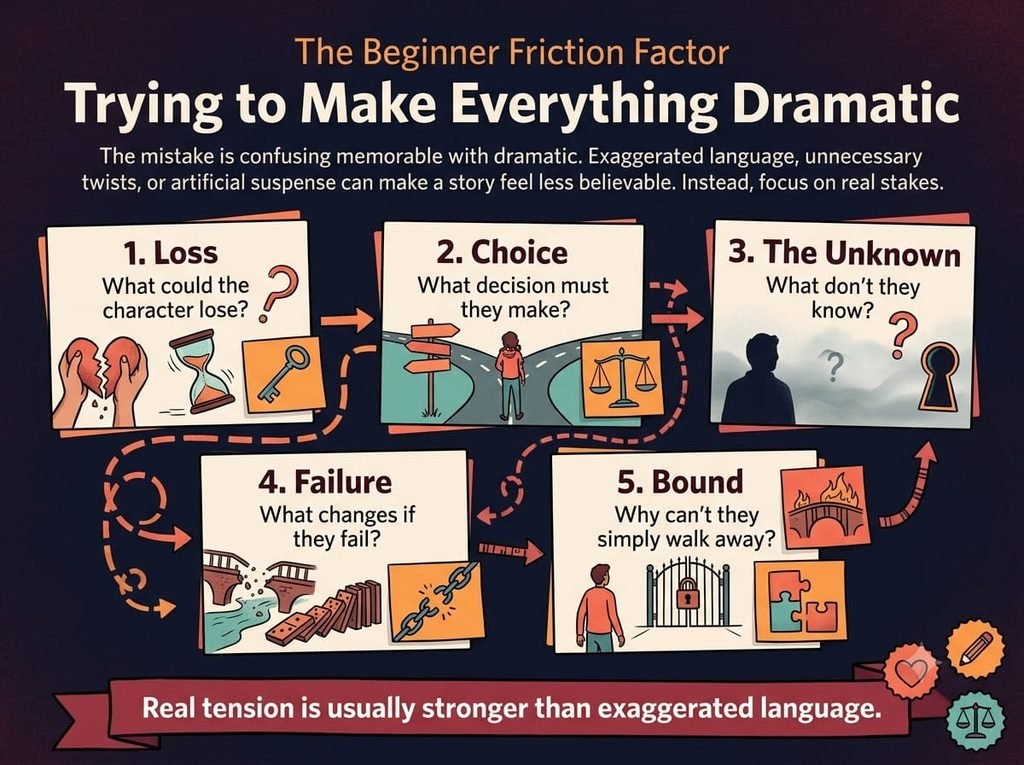
A common storytelling mistake is confusing memorable with dramatic.
Beginners sometimes add exaggerated language, unnecessary twists, or artificial suspense.
That can make a story feel less believable.
Instead, focus on the real stakes.
Ask:
- What could the character lose?
- What decision must they make?
- What don’t they know?
- What changes if they fail?
- Why can’t they simply walk away?
Real tension is usually stronger than exaggerated language.
How Do Specific Details Make Stories Stick?
Generic details can make almost any story sound interchangeable.
Specific details give the audience something to remember.
Instead of saying:
The restaurant was busy.
You might describe:
Every table was occupied, and two families were waiting beside the door for the next empty seat.
The second version gives readers an image.
Choose details that reveal:
- Character
- Setting
- Mood
- Conflict
- Time
- Change
Don’t overload the story with description.
One useful detail is better than five random ones.
How Important Is Story Structure?
Structure determines how information reaches the audience.
A simple structure for beginners is:
Setup → Goal → Obstacle → Escalation → Turning Point → Outcome
The setup establishes the situation.
The goal tells us what the character wants.
The obstacle makes that goal difficult.
Escalation increases the pressure.
The turning point changes the direction of the story.
The outcome shows what happened.
You don’t have to follow this structure mechanically.
Use it as a way to check whether your story actually moves.
How Can You Create Curiosity?
Don’t reveal everything immediately.
Give the audience enough information to understand the situation, then create a question.
For example:
At 7:00 a.m., the shop owner unlocked the door for the last time.
That immediately raises questions.
Why is it the last time?
What happened?
What will happen to the shop?
The audience now has a reason to continue.
Don’t Manufacture Mystery
Curiosity should come from the story.
Avoid deliberately hiding basic information just to create suspense.
Readers shouldn’t feel confused because the writer is withholding information they need.
Curiosity works best when the audience understands the situation but wants to know what happens next.
Can Ordinary Experiences Become Memorable Stories?
Absolutely.
You don’t need an extraordinary event.
A story can come from:
- Getting lost in a new city
- Meeting someone unexpectedly
- Starting a new hobby
- Failing at something
- Returning to a childhood place
- Making a difficult decision
What matters is change.
Something should be different by the end.
Maybe your character learns something.
Maybe their expectations change.
Maybe they lose something.
Maybe they finally understand a decision they had been avoiding.
The event can be small.
The change gives it meaning.
How Do You Make Your Opening Stronger?
Start close to the moment that matters.
Avoid spending several paragraphs explaining someone’s entire history before the story begins.
Try opening with:
- A decision
- An action
- A surprising detail
- A problem
- A question
- A specific moment
Then add background when the audience needs it.
This keeps the story moving.

What Should You Cut During Editing?
Memorable storytelling isn’t only about adding good material.
It’s also about removing material that slows the story down.
During revision, look for:
- Repeated information
- Unnecessary background
- Generic descriptions
- Dialogue that doesn’t reveal anything
- Scenes without a purpose
- Long explanations
- Details that don’t affect the story
For every paragraph, ask:
Does this make the character, conflict, setting, or outcome clearer?
If not, consider cutting it.
What Skills Should You Practice?
If you want to tell stories people remember, focus on these skills:
- Character development
- Conflict
- Scene writing
- Specific description
- Narrative structure
- Dialogue
- Pacing
- Revision
You don’t need to master all eight immediately.
Start with character + goal + obstacle.
Those three elements give you a foundation for almost any short narrative.

What Can You Use to Learn Storytelling?
You don’t need expensive software or equipment.
A basic word processor is enough.
Creative Writing Courses
Ideal student: Beginners who want structured practice with characters, scenes, and narrative structure.
Portfolio project: A finished short story or personal narrative.
Honest limitation: Courses can explain techniques, but consistent writing and revision are still necessary.
Choose courses that include assignments and feedback when possible.
Free Reading Practice
Find stories you genuinely enjoy.
Read them once normally.
Then read them again as a writer.
Mark:
- The opening
- The character’s goal
- The first obstacle
- The turning point
- The strongest detail
- The ending
This helps you see why the story works, rather than simply deciding that you like it.
What Should You Learn Next?
Once you understand the basics, focus on character development and story structure.
Then try different forms:
Short story → Personal narrative → Profile → Feature story → Long-form storytelling
You can also apply these skills to presentations, journalism, video, podcasts, and marketing.
The format changes.
The underlying need remains the same: give people a reason to care and a reason to continue.
Your Day-One Action Plan
Start with a story you already know well.
- Choose one person and one goal. Give the character something specific they want.
- Add one meaningful obstacle. Make the outcome uncertain.
- Write a 500-word story. Include one specific setting, three concrete details, and a clear change by the ending.
Then remove anything that doesn’t help the audience understand the character or situation.
Finally, ask yourself:
“If I told this story to someone tomorrow, which detail would I want them to remember?”
Build the story around that detail.
That’s often where memorable storytelling begins.