Writing and Illustration: How Do You Make Them Work Together?
Writing and illustration work best when neither tries to do the same job. Writing provides story, character, emotion, context, and structure. Illustration turns those ideas into something readers can see.
This relationship matters in comics, children’s books, graphic novels, editorial illustration, travel journals, and visual storytelling. A strong project does not simply place text beside an attractive image. The words and visuals should give the reader information that feels connected.
| Day-One Metric | Beginner Target |
|---|---|
| Hours to basic competency | 6–12 hours |
| Minimum budget | $0 with paper and free writing software |
| Learning difficulty | 3/5 |
| First project | One illustrated 2–4 page story |

Start by Giving Writing and Illustration Different Jobs
The easiest way to make writing and illustration work together is to decide what each one should communicate.
Writing can handle:
- Character thoughts
- Dialogue
- Context
- Story structure
- Information that cannot be shown visually
- Internal emotions
Illustration can handle:
- Facial expressions
- Body language
- Setting
- Appearance
- Movement
- Atmosphere
- Visual details
Problems appear when both repeat exactly the same information.
If your text says, “Maya stood alone in the dark room, looking frightened,” and the illustration shows exactly that, you may be wasting one of your storytelling tools.
A stronger combination might show Maya gripping a door handle while the text says, “She heard footsteps upstairs.”
Now the words and image add different pieces of information.
Build the Story Before Adding the Artwork
Do not begin by creating illustrations simply because you have a visual idea.
Start with a basic story structure.
Ask:
- Who is the main character?
- What do they want?
- What problem do they face?
- What changes?
- What should the reader feel?
Once those answers are clear, decide which moments need visual treatment.
This prevents illustration from becoming decoration.
Identify the Important Visual Moments
Not every sentence needs an illustration.
Mark moments involving:
- A major character introduction
- A change in location
- An emotional reaction
- An important object
- A reveal
- A change in time
- A major action
These moments give an illustrator useful material.
Write for What the Reader Can See
If you are writing for an illustrator, avoid vague instructions.
Instead of:
“Make the scene dramatic.”
Give useful information:
“Show Lena standing outside the closed train station at midnight. Her suitcase is open beside her, but the platform is empty.”
The second description gives the illustrator something concrete.
You can still leave room for interpretation. Good creative direction provides purpose without controlling every artistic decision.
Let Illustration Carry Emotion
One of the biggest strengths of illustration is showing emotion without explaining it.
Consider a character sitting at a kitchen table.
The writing might simply say:
“He hadn’t touched his dinner.”
The illustration could show the cold plate, untouched fork, hunched shoulders, and phone lying face down.
The reader understands that something is wrong.
This is especially valuable in children’s books and comics, where visual storytelling can carry a large part of the narrative.
Think About Composition Before Final Artwork
Illustration is not just about drawing the correct objects.
Where those objects appear matters.
A character placed alone in a large empty environment can feel isolated. A tightly framed face can create intimacy or tension. A crowded composition can make a scene feel chaotic.
Writers should understand this even if they never draw.
When planning a scene, consider what the reader should notice first.
Use Visual Hierarchy
A useful visual hierarchy might be:
Main character → important object → background detail
If everything has equal visual importance, the illustration can become difficult to read.
The same principle applies to text.
The reader should know where to look first.
The Beginner Friction Factor: Over-Explaining the Illustration
A common beginner mistake is writing too much visual direction.
Writers sometimes describe every color, shadow, camera angle, facial expression, background object, and artistic technique.
That can make collaboration frustrating.
The illustrator needs to understand the story purpose, not receive instructions for every brushstroke.
Try this approach:
1. State what must appear.
2. Explain why it matters.
3. Leave artistic choices open where possible.
For example:
“Show Daniel finding the damaged photograph. The image should make it clear that he recognizes the person in it.”
That communicates the narrative requirement while leaving room for the illustrator to decide how the moment should look.
Create a Shared Visual Reference
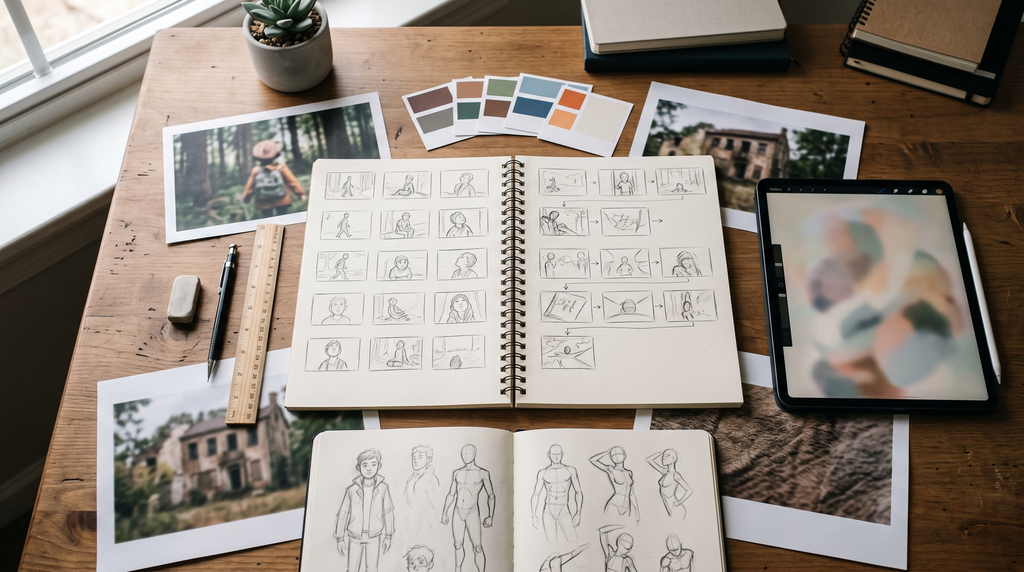
Before producing final artwork, gather references.
You might collect examples of:
- Character clothing
- Architecture
- Locations
- Historical periods
- Objects
- Color palettes
- Lighting
- Illustration styles
A simple mood board can prevent misunderstandings.
For collaborative projects, create a shared document containing the story outline, character descriptions, visual references, and important scene notes.
The goal is not to make the artist copy the references. It is to establish a common visual direction.
Make Character Design Support the Writing
Character design should reflect the story.
Think about:
- Age
- Personality
- Lifestyle
- Occupation
- Relationships
- Environment
- Character development
A character who becomes more confident might gradually change their posture. Their clothing might become more expressive. Their visual presence might become stronger.
These changes allow character development to appear in the artwork, rather than existing only in the prose.
The same principle works in reverse.
If an illustrator creates a distinctive character design, the writer can use that design to discover new story possibilities.
Use Pacing to Connect Words and Images
Pacing becomes particularly important in comics and picture-based storytelling.
A page containing one large illustration creates a different reading experience from a page containing six small panels.
Likewise, a children’s book might use one large illustration for an important emotional moment and several smaller images for a sequence of actions.
Think about how long you want the reader to stay with an image.
Large visual moments deserve space.
Fast actions can use smaller sequential images.
Decide Who Controls Which Creative Decisions
Collaboration works better when responsibilities are clear.
For example:
| Decision | Primary Responsibility |
|---|---|
| Story premise | Writer |
| Character motivation | Writer |
| Dialogue | Writer |
| Character appearance | Shared |
| Composition | Illustrator |
| Color choices | Illustrator |
| Visual pacing | Shared |
| Final storytelling effect | Shared |
These roles can change depending on the project.
The important point is to discuss them before production begins.
If you are hiring an illustrator, also agree on deadlines, revisions, payment, ownership, and how final artwork will be used.
Learn From Both Sides
Writers benefit from learning basic visual storytelling.
Illustrators benefit from understanding basic narrative structure.
You do not need to become an expert in the other discipline.
A writer should understand composition, visual pacing, expressions, and sequential storytelling.
An illustrator should understand character motivation, scene structure, conflict, and emotional progression.
That shared vocabulary makes collaboration much easier.

What Should You Learn Next?
Once you understand how writing and illustration interact, learn visual storytelling and page composition.
If you are primarily a writer, practice describing scenes without controlling every artistic detail.
If you are primarily an illustrator, practice turning short pieces of writing into visual sequences.
A useful exercise is to take a 100-word story and create three illustrations for it.
Then reverse the exercise.
Take one illustration and write a short scene inspired by what you see.
This teaches you how each medium can provide information the other cannot.
Your Day-One Action Plan
You can test the relationship between writing and illustration within an hour.
- Write a 150-word scene.
Give the scene one character, one problem, and one emotional change. - Underline what can be shown visually.
Remove unnecessary descriptions that an illustration could communicate. - Create three simple thumbnails.
Each thumbnail should show a different important moment from the scene.
Then compare them.
Ask whether the illustrations add information rather than simply repeating your words.
That is the key principle: writing tells part of the story, illustration shows another part, and the reader experiences both together.