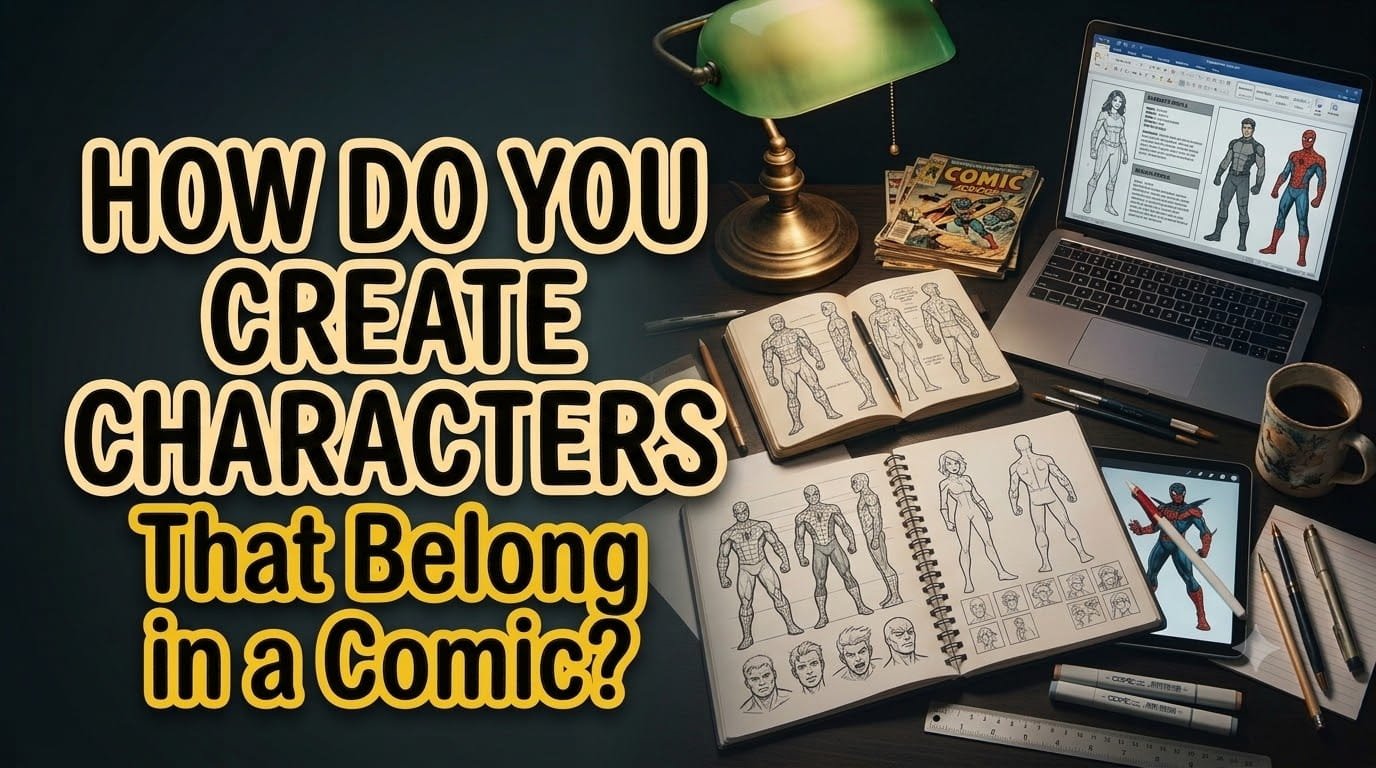
How Do You Create Characters That Belong in a Comic?
A comic character needs to work as both a person and a visual idea. Readers should understand something about the character from their appearance, actions, expressions, and dialogue before you explain their entire backstory.
The best comic characters are not simply detailed. They are easy to recognize, interesting to watch, and useful to the story.
| Day-One Metric | Beginner Target |
|---|---|
| Hours to basic competency | 6–12 hours |
| Minimum budget | $0 with paper or free drawing software |
| Learning difficulty | 4/5 |
| First project | One character sheet + 2-page comic scene |
Start With the Character’s Role in the Story
Before designing a hairstyle or costume, decide why the character exists.
Ask four basic questions:
- What does this character want?
- What is stopping them?
- What are they afraid of?
- How do they change during the story?
A protagonist might want freedom but fear being alone. A villain might want control because they cannot tolerate uncertainty.
These contradictions make characters more useful than a long list of personality traits.
Give Every Character a Job
Not every character needs equal development.
Your main character might drive the plot. A friend might challenge their decisions. A rival might expose their weaknesses. A mentor might provide information.
This prevents your cast from becoming a collection of people who all perform the same function.
Design the Character So Readers Recognize Them
Comic storytelling is visual. A reader should be able to identify an important character even when they appear in a small panel.
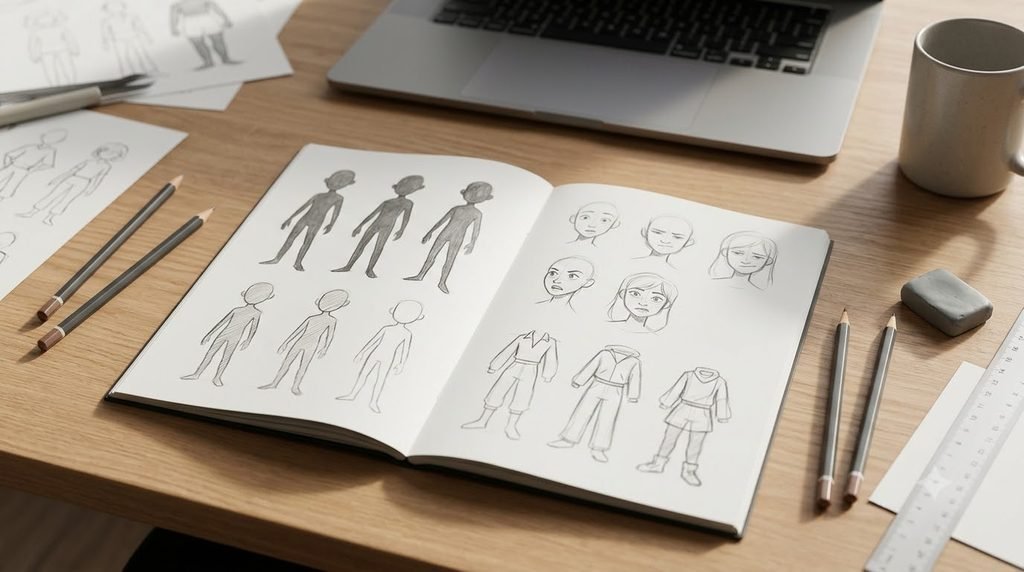
Start with the silhouette.
Consider:
- Hair shape
- Body proportions
- Clothing
- Accessories
- Posture
- Typical gestures
Try drawing the character as a simple black silhouette. If several characters look almost identical, their designs need more variation.
You do not need elaborate costumes. A distinctive jacket, hairstyle, glasses, backpack, or posture can be enough.
Build a Character Around Visual Contrast
Characters become easier to distinguish when their designs contrast with one another.
If your protagonist is short and heavily layered in clothing, perhaps their rival is tall with a simple, sharp silhouette.
If one character moves constantly, another might barely move.
This contrast also helps storytelling.
Visual differences can communicate personality without dialogue.
Use Clothing to Show Character
Clothing can reveal practical information.
A character who works outdoors may dress differently from someone who spends every day in an office. Someone who cares about appearance may dress carefully, while another character might repeatedly wear the same comfortable clothes.
Avoid designing outfits simply because they look impressive.
Ask what the character would actually choose to wear.
Give the Character a Strong Emotional Core
A character becomes more interesting when their external goal conflicts with an internal problem.
For example:
External goal: Maya wants to win a school art competition.
Internal problem: She is terrified that people will discover she does not think her work is good enough.
Now the competition matters for more than the prize.
Every major scene can pressure that insecurity.
This creates opportunities for expressions, body language, dialogue, and visual storytelling.
Create Expressions You Can Reuse
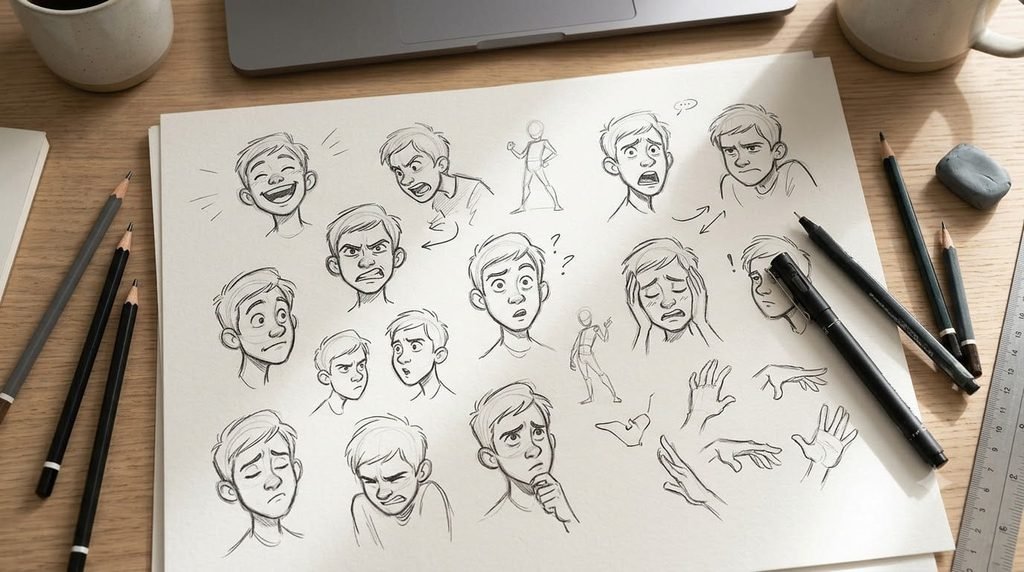
A comic character needs to communicate emotion repeatedly.
Create a small expression sheet containing:
- Happiness
- Anger
- Fear
- Confusion
- Surprise
- Sadness
- Concentration
- Embarrassment
Do not make every emotion a completely different face.
Look for the small changes that make expressions readable. Eyebrows, eyes, mouth shape, head position, and posture can dramatically change how a character feels.
Write Dialogue That Sounds Like the Character
A character’s dialogue should reveal who they are, not simply deliver information.
Imagine two characters seeing the same broken window.
One might say:
“Someone broke in.”
Another might say:
“That’s going to be expensive.”
A third might say:
“We’re leaving. Now.”
The situation is identical. Their reactions reveal different personalities.
Give each important character a different communication style.
Think about:
- Vocabulary
- Sentence length
- Humor
- Formality
- Confidence
- What they avoid saying
You should eventually be able to remove character names from a short exchange and still have some idea who is speaking.
Give Characters Relationships, Not Just Backstories
A detailed biography will not automatically make a character interesting.
Relationships create opportunities for conflict.
Ask how your characters behave differently around:
- A parent
- A close friend
- A stranger
- A rival
- Someone they secretly admire
- Someone they distrust
Your protagonist may be confident around friends but become awkward around a particular person.
That difference gives you material for scenes.
The Beginner Friction Factor: Designing Before Understanding
One common beginner problem is spending too much time making a character look cool before deciding what the character does.
You can end up with beautiful concept art that has no role in the story.
Fix this by defining the character’s goal, conflict, role, and personality first.
Then design around those decisions.
A useful test is to write a short scene before finalizing the character design. Put the character into a difficult situation and see how they react.
If their personality feels unclear, go back to the character foundation.
Build a Simple Comic Character Sheet
You do not need a 20-page document.
Start with one page.
| Category | What to Define |
|---|---|
| Role | Protagonist, rival, friend, mentor, etc. |
| Goal | What they want |
| Fear | What they want to avoid |
| Flaw | What makes success difficult |
| Personality | Three to five key traits |
| Appearance | Shape, clothing, hair, accessories |
| Expressions | Common emotional states |
| Relationships | Important connections |
| Character change | What they learn or lose |
This becomes your reference when writing and drawing.
Choose a Visual Style That Fits the Story
Your character design should belong to the world around them.
A realistic crime comic may require different visual choices from a playful fantasy story.
Think about:
- Line quality
- Proportions
- Clothing
- Color palette
- Facial exaggeration
- Background detail
- Level of realism
Consistency matters more than complexity.
A simple character drawn consistently is usually more effective than an extremely detailed character whose appearance changes from panel to panel.
Learn From Existing Comics Without Copying Them
Study comics you admire.
Do not only ask, “Do I like this character?”
Ask:
Why can I recognize them immediately?
Look at their silhouette. Study their expressions. Notice how their clothing supports the setting. Pay attention to how their personality appears through action rather than exposition.
Then apply those observations to an original character.
What Should You Learn Next?
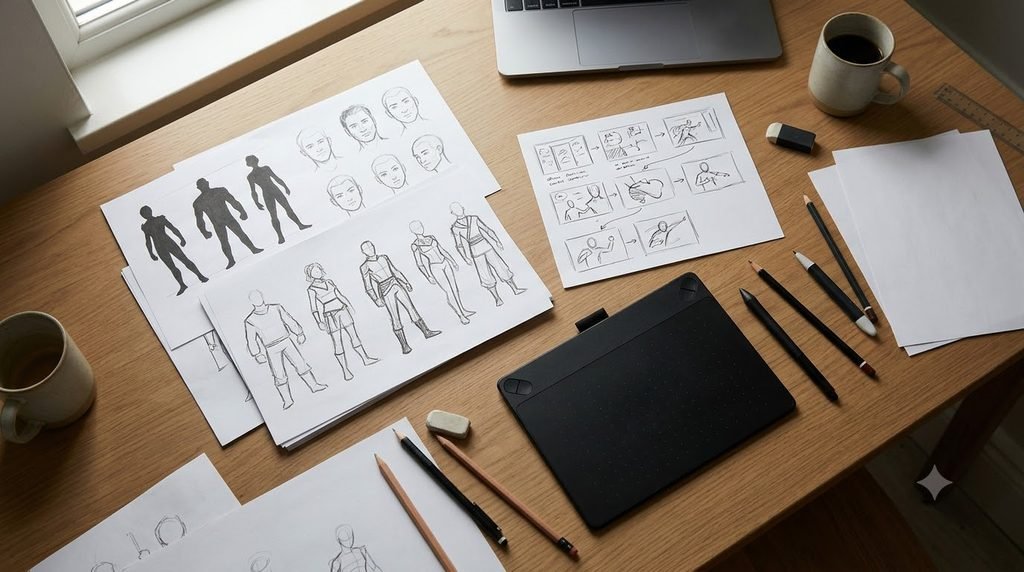
Once you can create a convincing character, learn sequential storytelling.
Your character does not exist in isolation. They need to move through scenes.
Practice showing:
- A character entering a room.
- The character noticing something.
- Their emotional reaction.
- Their decision.
- The consequence.
This teaches you how character design and comic storytelling work together.
If you draw your own comics, add gesture drawing and basic anatomy next. If you primarily write, focus on panel descriptions, visual pacing, and dialogue.
Your Day-One Action Plan
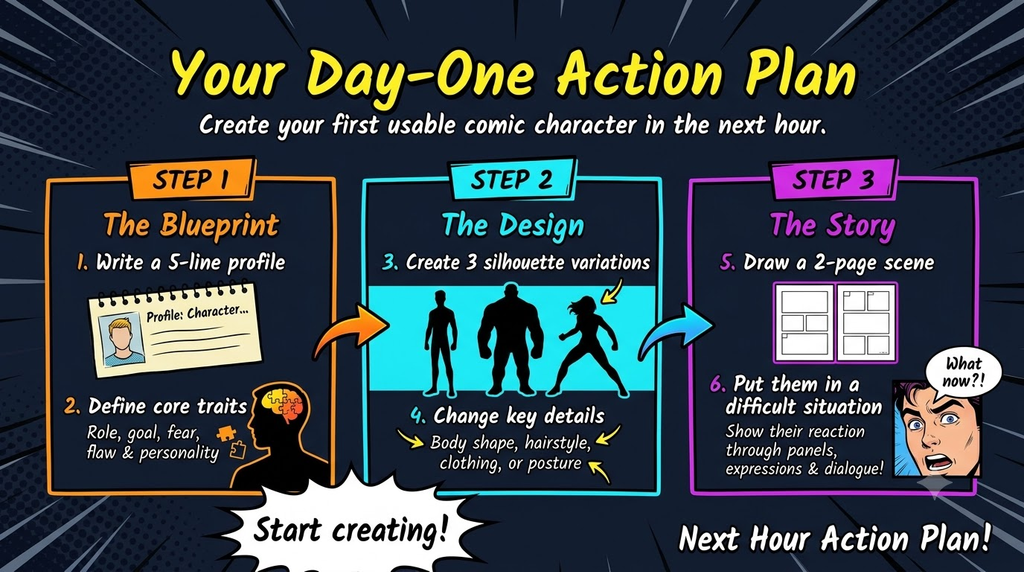
You can create your first usable comic character in the next hour.
- Write a five-line character profile.
Define their role, goal, fear, flaw, and personality. - Create three silhouette variations.
Change the body shape, hairstyle, clothing, or posture. - Draw one two-page scene.
Put the character into a difficult situation and show their reaction through panels, expressions, and dialogue.
Then review the result.
Can you recognize the character without their name? Can you understand what they want? Does their appearance support their personality?
If the answer is yes, you have moved beyond designing a character. You have started creating someone who belongs in a comic.